
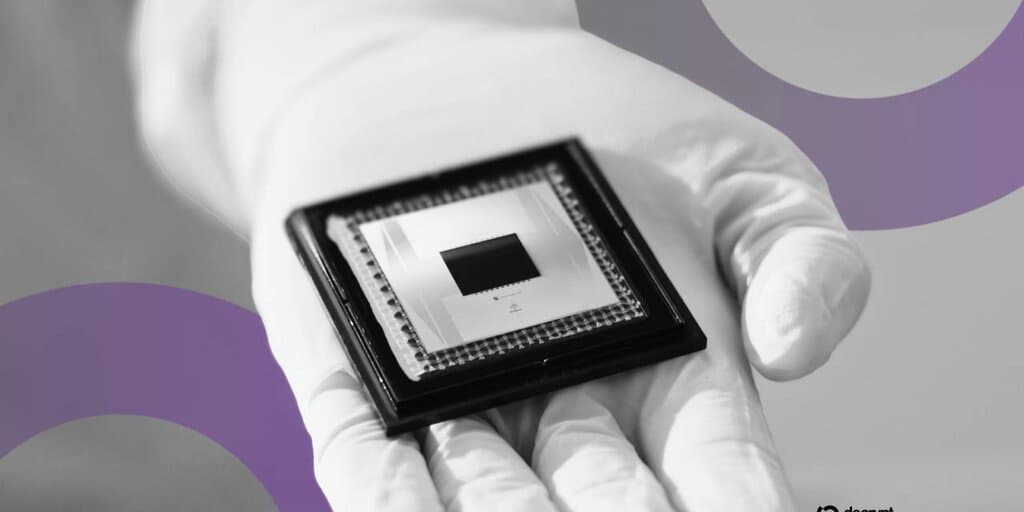
Quantum computers capable of breaking the cryptography underpinning Bitcoin and Ethereum may arrive far sooner than previously anticipated, according to groundbreaking research from the California Institute of Technology. In a study published Monday, Caltech researchers and their Pasadena-based startup, Oratomic, unveiled a neutral-atom quantum computing system that could make fault-tolerant machines capable of running Shor’s algorithm a reality with just 10,000–20,000 reconfigurable qubits—dramatically fewer than earlier projections. The findings intensify concerns over the vulnerability of widely used encryption standards, including elliptic-curve cryptography, which secures not only blockchain networks but also much of the global digital infrastructure.
- Caltech researchers estimate fault-tolerant quantum computers could crack modern cryptography with 10,000–20,000 qubits, far fewer than previous estimates of one billion.
- Neutral-atom quantum systems, where atoms are trapped and controlled with lasers, offer a new error-correction approach that could accelerate Shor’s algorithm implementation.
- A Caltech-Oratomic quantum computer with 6,100 qubits and 99.98% accuracy in September renewed concerns about quantum threats to Bitcoin and other encrypted systems.
- Governments and tech firms are already migrating to post-quantum cryptography, but major engineering challenges remain in scaling quantum systems while maintaining low error rates.
- Experts warn the cryptography risk extends beyond blockchain to global digital infrastructure, including IoT devices, routers, and satellites.
Why Quantum Computers Threaten Bitcoin and Ethereum’s Security
Bitcoin and Ethereum rely on elliptic-curve cryptography (ECC) to secure transactions and wallets. This cryptographic method uses public keys derived from private keys through complex mathematical operations that are currently infeasible for classical computers to reverse. However, Shor’s algorithm—a quantum computing method—could efficiently solve these mathematical problems, effectively deriving private keys from public ones. This would allow an attacker to steal cryptocurrency or manipulate transactions without detection. Until now, the prevailing wisdom was that quantum computers powerful enough to run Shor’s algorithm would require millions of qubits, far beyond the capabilities of today’s technology. But the Caltech-led research suggests that with advancements in neutral-atom quantum systems, the threshold could drop dramatically to just 10,000–20,000 qubits.
The Role of Neutral-Atom Quantum Computers
Neutral-atom quantum computers represent a promising approach to quantum computing. Unlike superconducting qubits, which require extreme cooling near absolute zero, neutral-atom systems use individual atoms trapped and manipulated by lasers to perform quantum calculations. This method offers inherent scalability and long coherence times—key factors for error correction. The Caltech-Oratomic system, for instance, demonstrated a neutral-atom quantum computer with 6,100 qubits and 99.98% accuracy in September 2023. While this system is not yet fault-tolerant, it represents a significant step toward machines that could run Shor’s algorithm. Dolev Bluvstein, co-founder and CEO of Oratomic and a visiting associate in physics at Caltech, emphasized the rapid pace of progress. 'People are used to quantum computers always being 10 years away,' Bluvstein said. 'But when you look at where we were a little over ten years ago, the best estimates of what would be required for Shor’s algorithm were one billion qubits at a time when the best systems we had in the lab were roughly five qubits.'
How Error Correction Could Bring Quantum Threats Closer
One of the biggest challenges in quantum computing is error correction. Quantum systems are notoriously fragile, with qubits losing their quantum state due to environmental noise—a phenomenon known as decoherence. To mitigate this, quantum computers use error-correcting codes that require multiple physical qubits to create a single, reliable logical qubit capable of performing calculations. Traditional error-correcting systems, such as the surface code, often need about 1,000 physical qubits to create one logical qubit. This overhead has pushed estimates for fault-tolerant quantum computers into the million-qubit range, delaying the timeline for machines capable of running Shor’s algorithm. However, the new neutral-atom approach developed by Caltech and Oratomic could significantly reduce this overhead. By using reconfigurable atomic qubits, the system achieves higher fidelity with fewer resources, potentially bringing the threshold for fault-tolerant quantum computing closer to reality. 'You can really see the system size and controllability increasing over time as the required system size goes down,' Bluvstein noted.
The Timeline: Could Quantum Computers Break Bitcoin Within a Decade?
The timeline for quantum computers capable of breaking Bitcoin’s cryptography has been a subject of intense debate. Previous estimates suggested such machines were decades away, but recent advances—including Caltech’s neutral-atom system and Google’s new findings—have shortened this window significantly. Bluvstein cautioned that while achieving 10,000 physical qubits may be possible within a year, the real challenge lies in scaling and maintaining the system’s accuracy. 'Just having 10,000 physical qubits is something that could happen within a year,' he said. 'But that’s really not the goalpost people think it is. It’s not like when you design a computer, you just put the transistors on the chip, wash your hands, and say you’re done. It’s a highly non-trivial, extremely complicated task to actually go and build one of these.' Despite these challenges, Bluvstein believes a practical quantum computer capable of threatening Bitcoin’s encryption could emerge before the end of the decade. This accelerated timeline adds urgency to the push for post-quantum cryptography—a new generation of encryption designed to withstand quantum attacks.
Beyond Bitcoin: The Broader Impact on Global Digital Infrastructure
While much of the focus on quantum computing threats has centered on cryptocurrencies like Bitcoin and Ethereum, the risk extends far beyond blockchain networks. Modern digital infrastructure relies heavily on public-key cryptography for secure communication, authentication, and data integrity. This includes internet of things (IoT) devices, routers, satellites, and even military communications. If quantum computers capable of running Shor’s algorithm become viable, they could compromise the security of these systems, leading to widespread disruptions. 'I think the whole world’s digital infrastructure. It’s not just blockchain,' Bluvstein said. 'It’s internet of things devices, internet communication, routers, satellites. It spans the entire global digital infrastructure, and it’s complicated.' Governments and technology firms are already taking steps to address this looming threat. The U.S. National Institute of Standards and Technology (NIST) has been leading efforts to standardize post-quantum cryptographic algorithms, with several candidates already selected for future use. Companies like Google, IBM, and Cloudflare are also investing in quantum-resistant encryption solutions. However, the transition to post-quantum cryptography is not without its challenges. Integrating new encryption standards into existing systems requires significant time, resources, and coordination across industries. Additionally, the cryptographic community must remain vigilant, as advances in quantum computing could outpace the development of post-quantum solutions.
The Race to Post-Quantum Cryptography
In response to the growing threat posed by quantum computers, governments, researchers, and technology companies are racing to develop and deploy post-quantum cryptography. Post-quantum cryptography refers to encryption methods that are believed to be resistant to attacks from both classical and quantum computers. Unlike traditional public-key cryptography, which relies on mathematical problems vulnerable to Shor’s algorithm, post-quantum cryptography uses alternative approaches such as lattice-based, hash-based, or code-based cryptography. In 2022, NIST announced the first three post-quantum cryptographic standards, with additional algorithms currently under consideration. These standards are designed to replace vulnerable encryption methods in critical infrastructure, financial systems, and digital communications. However, the adoption of post-quantum cryptography is a massive undertaking. Many systems, including those used by banks, governments, and cloud providers, rely on encryption methods that have been in place for decades. Migrating to new cryptographic standards will require extensive testing, updates, and sometimes complete overhauls of existing infrastructure. 'Researchers caution that major engineering challenges remain, including scaling quantum systems while maintaining extremely low error rates,' noted a Caltech statement accompanying the study. Despite these obstacles, the urgency to act is clear. If quantum computers capable of breaking current cryptography become a reality within the next decade, the window to transition to quantum-resistant encryption may close faster than expected.
Historical Context: The Evolution of Quantum Computing Threats
The idea that quantum computers could threaten modern cryptography is not new. In 1994, mathematician Peter Shor developed an algorithm that could factor large numbers and compute discrete logarithms—mathematical problems that form the basis of many widely used encryption schemes, including RSA and elliptic-curve cryptography. Shor’s algorithm demonstrated that quantum computers could, in theory, break these encryption methods far more efficiently than classical computers. However, at the time, quantum computing was still in its infancy, with early experiments limited to just a few qubits. Over the past three decades, progress in quantum computing has accelerated, driven by advances in hardware, software, and error correction. In 2019, Google claimed to have achieved 'quantum supremacy' with its 53-qubit Sycamore processor, performing a task in 200 seconds that would take a classical supercomputer thousands of years. While this milestone was largely symbolic—demonstrating the potential of quantum computing rather than practical applications—it underscored the rapid pace of progress. The publication of the Caltech study, combined with Google’s recent findings, suggests that the timeline for quantum threats to cryptography may be shortening. 'The threat has prompted governments and technology firms to begin migrating to post-quantum cryptography,' the Caltech statement noted. This historical context highlights the need for proactive measures to mitigate the risks posed by quantum computing.
“People are used to quantum computers always being 10 years away. But when you look at where we were a little over ten years ago, the best estimates of what would be required for Shor’s algorithm were one billion qubits at a time when the best systems we had in the lab were roughly five qubits.” — Dolev Bluvstein, co-founder and CEO of Oratomic, visiting associate in physics at Caltech
What’s Next: Preparing for a Quantum-Secure Future
As the threat of quantum computers capable of breaking Bitcoin’s cryptography looms closer, stakeholders across industries are taking steps to prepare. For cryptocurrency users, this means staying informed about post-quantum developments and considering the use of quantum-resistant wallets or exchanges. For technology companies, it means investing in research and development of post-quantum cryptographic solutions. For governments, it means establishing regulations and standards to ensure a smooth transition to quantum-resistant infrastructure. However, the path forward is fraught with challenges. The sheer scale of the cryptographic systems that need to be updated—from financial networks to national security databases—makes this one of the most complex cybersecurity transitions in history. Additionally, the cryptographic community must remain vigilant, as advances in quantum computing could outpace the development of post-quantum solutions. 'It’s a highly non-trivial, extremely complicated task to actually go and build one of these,' Bluvstein said, underscoring the magnitude of the challenge ahead.
Frequently Asked Questions
Frequently Asked Questions
- Could a quantum computer really crack Bitcoin’s encryption?
- A quantum computer running Shor’s algorithm could theoretically derive private keys from public keys used in Bitcoin’s elliptic-curve cryptography, allowing theft of funds. While such machines are not yet practical, recent research suggests they may require far fewer qubits than previously thought.
- How soon could quantum computers break Bitcoin’s encryption?
- Experts now believe practical quantum computers capable of threatening Bitcoin’s encryption could emerge within the next decade, with some estimates suggesting as few as 10,000–20,000 qubits may be sufficient. This timeline is faster than earlier projections.
- What is post-quantum cryptography, and how does it protect against quantum attacks?
- Post-quantum cryptography uses encryption methods believed to be resistant to attacks from both classical and quantum computers. These methods, such as lattice-based or hash-based cryptography, rely on mathematical problems that are not easily solved by quantum algorithms like Shor’s.


