It is a double-edged sword. As the planet heats up, more of us are turning up and turning to air conditioning to keep us cool. The trouble is that, as well as consuming vast amounts of electricity, AC also leads to significant greenhouse gas emissions and worsens the climate change we are trying to combat.
According to a new study published in Nature Communications, by 2050 AC-related emissions could increase the global mean temperature by 0.05°C under a middle-of-the-road scenario. The principal causes are carbon emissions from power grids and leaking chemical refrigerants.
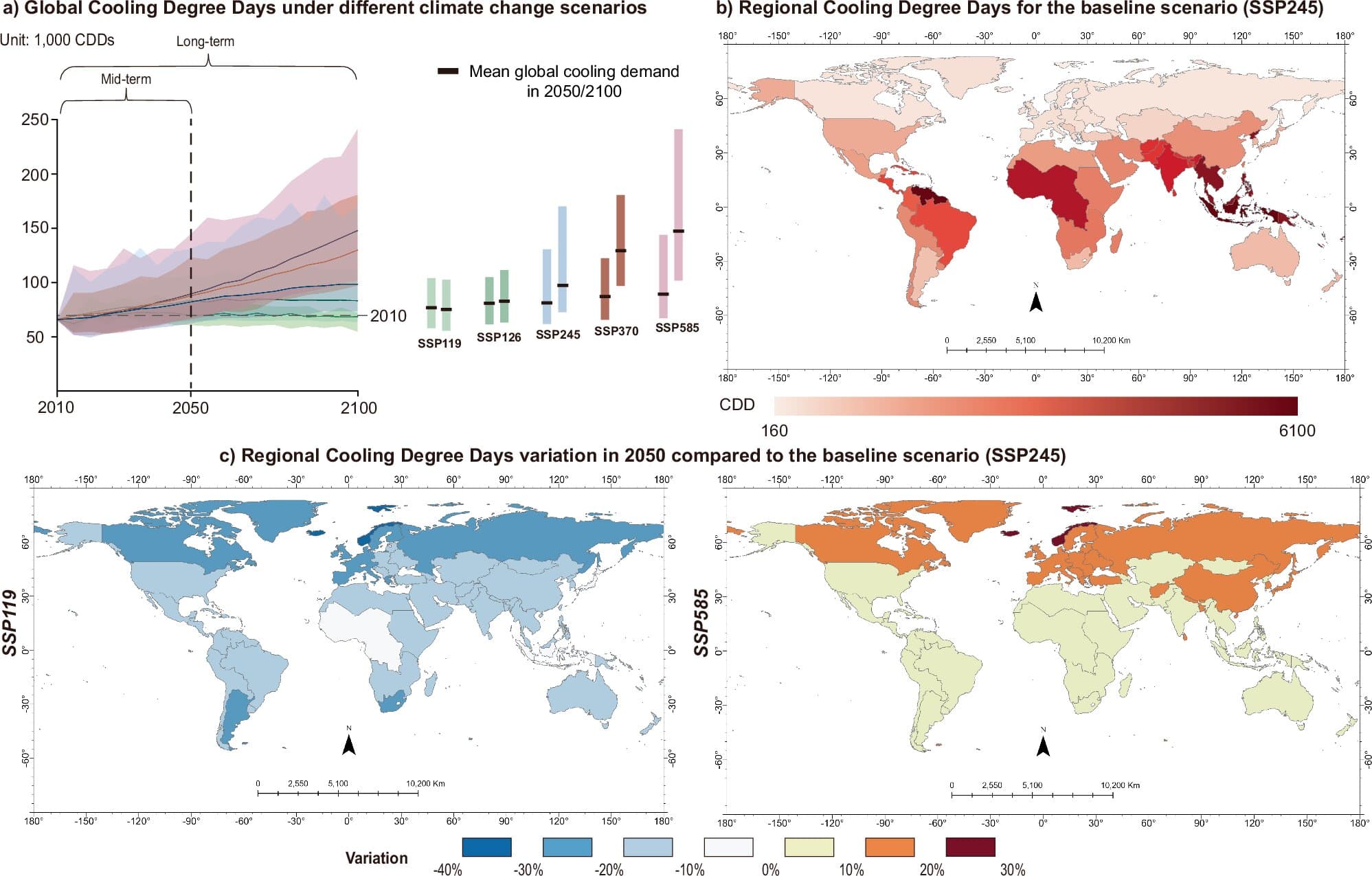
In their study, the researchers went beyond just looking at rising temperatures. They took a more holistic approach and examined how climate, cooling demand, and economic growth feed back into future warming. This involved measuring how humidity and rising incomes will drive future AC sales and using a climate simulator to calculate total warming.
The team also ran the math through five future climate pathways, which are what-if scenarios used by the Intergovernmental Panel on Climate Change. These range from a world that quickly adopts green energy to one that remains heavily dependent on fossil fuels.
The study found that the primary drivers of AC growth are rising incomes, urbanization, and falling appliance prices. In the SSP245 (middle-of-the-road) scenario, income accounts for 190% of the increase in global AC consumption by 2050. And while electricity use is a major factor, refrigerant leaks could represent up to 60% of all AC-related pollution by that year.
One of the key findings was the disparity between cooling needs and access to AC. High-income regions use most air conditioning despite not needing it as much, whereas countries that experience the most extreme heat often use less. But closing this cooling gap using current technologies would release between 14 and 146 billion tons of additional greenhouse gases.
The researchers highlighted this challenge by outlining how many units would be needed as wealth increased:
"Our analysis quantifies the potential increase in global AC demand resulting from rising incomes in low-income regions: an additional 94 million units at medium-income levels, 150 million units at high-income levels, and up to over 220 million units at the highest-income levels.
"Incorporating total AC stock expansions and extended usage durations, our estimates project additional GHG emissions that would induce an additional 0.003°C–0.05°C of warming even under the SSP119 scenario, highlighting the trade-offs between equitable cooling access and additional warming impact."
To counter this, the study authors suggest a two-pronged approach. First, we must accelerate the shift toward cleaner energy and phase out chemical refrigerants. Second, we need to improve building design and urban planning to reduce our reliance on AC.
Written for you by our author Paul Arnold, edited by Lisa Lock, and fact-checked and reviewed by Robert Egan—this article is the result of careful human work. We rely on readers like you to keep independent science journalism alive. If this reporting matters to you, please consider a donation (especially monthly). You'll get an ad-free account as a thank-you.
Hongzhi Zhang et al, Rising Air-Conditioning Use Intensifies Global Warming, Nature Communications (2026). DOI: 10.1038/s41467-026-69393-1
Citation: The climate cost of staying cool: How AC could impact global warming by 2050 (2026, February 28) retrieved 1 March 2026 from https://phys.org/news/2026-02-climate-staying-cool-ac-impact.html
This document is subject to copyright. Apart from any fair dealing for the purpose of private study or research, no part may be reproduced without the written permission. The content is provided for information purposes only.