
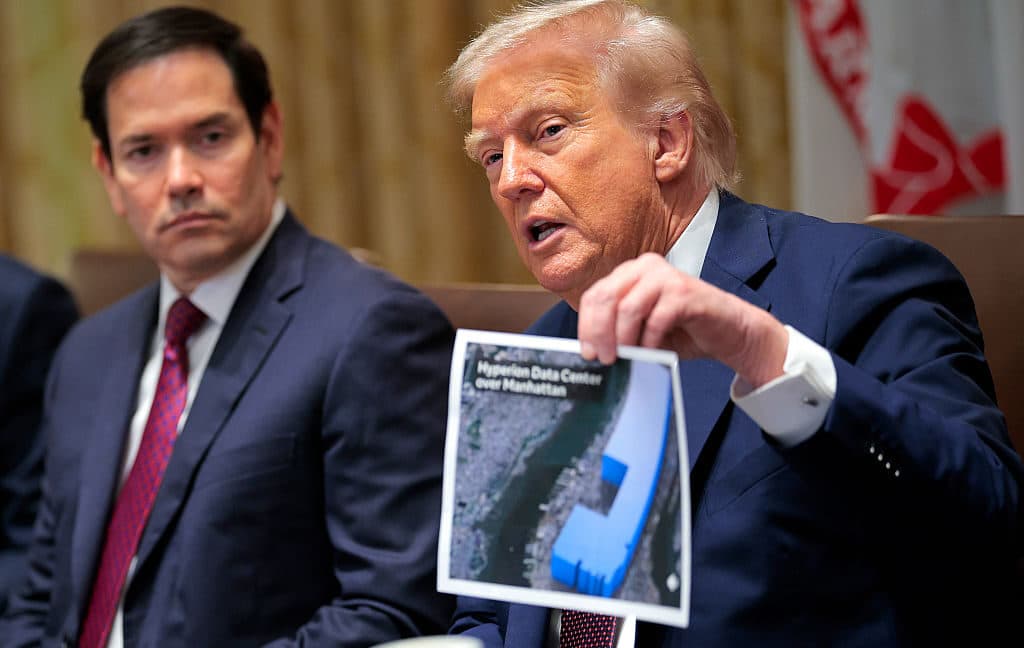
President Donald Trump’s ambitious plan to accelerate artificial intelligence (AI) development by fast-tracking US data center construction has hit a critical snag—not from foreign competition, but from his own administration’s tariffs. Citing new reporting from Bloomberg and market intelligence from Sightline Climate, nearly 50% of the nation’s data center projects slated for 2024 are now expected to be delayed or canceled, a direct consequence of the administration’s aggressive tariffs on Chinese-made power infrastructure components. These components—transformers, switchgear, and batteries—are essential for powering AI data centers, and for decades, China has dominated their global production. But with tariffs in place and US manufacturing unable to fill the gap, lead times have ballooned from two to five years, effectively stalling America’s AI ambitions at a pivotal moment in the global technology race.
- Nearly 50% of U.S. AI data center projects planned for 2024 face delays or cancellations due to tariffs blocking critical Chinese-made equipment.
- Transformers, switchgear, and batteries—key to powering AI data centers—now face five-year lead times, up from 24–30 months pre-2020.
- U.S. manufacturers cannot meet demand, leaving AI firms caught between tariffs and long waits for essential infrastructure.
- Trump’s 2023 executive order pushing rapid AI data center construction is undermined by supply chain bottlenecks.
- Sightline Climate data shows only one-third of the largest AI data centers planned for 2026 are currently under construction.
How Trump’s Tariffs Unintentionally Crippled America’s AI Infrastructure Push
In April 2023, President Trump signed a sweeping executive order titled 'Accelerating the Nation’s AI Leadership,' directing federal agencies to fast-track the construction of AI data centers. The move was framed as a strategic imperative to keep pace with China, which the White House has repeatedly warned is pulling ahead in the global AI race. But the initiative is being derailed by a supply chain crisis of the administration’s own making. By imposing steep tariffs on Chinese imports—including a 25% tariff on transformers and switchgear—Trump sought to bolster domestic manufacturing. Yet, as Bloomberg reported this week, the result has been catastrophic for the very industry the order aimed to supercharge: AI data centers.
The Critical Role of Power Equipment in AI Data Centers
Modern AI data centers are power-hungry facilities, often consuming more electricity than a small city. To operate at scale, they require specialized electrical infrastructure, including high-voltage transformers that step down power from the grid, switchgear that distributes it safely, and backup battery systems that ensure uninterrupted service during outages. For over 20 years, U.S. data center developers have relied on manufacturers in China, Taiwan, and South Korea for these components due to their cost-effectiveness and reliability. China, in particular, has dominated the global transformer market, producing an estimated 70% of the world’s medium and large power transformers. The sudden imposition of tariffs disrupted this supply chain, forcing developers to either absorb higher costs or endure prolonged lead times.
Prior to 2020, the typical lead time for these components was 24 to 30 months. By 2024, that window has stretched to five years in some cases, according to Bloomberg’s sources. This delay is not merely an inconvenience—it threatens the viability of entire AI projects. For instance, a hyperscale data center planned for Virginia or Texas may require dozens of transformers alone. If those transformers are delayed, the entire facility’s timeline collapses, leaving developers scrambling for alternatives.
The tariffs were intended to stimulate American manufacturing, but the unintended consequence is that we’re now seeing projects get delayed or canceled at an alarming rate. The U.S. supply chain for this equipment simply isn’t ready to meet the demand created by the AI boom.
Why Domestic Manufacturing Can’t Fill the Gap
Despite the tariffs, the U.S. manufacturing sector has struggled to scale up production to meet the sudden surge in demand for power infrastructure components. According to the U.S. Energy Information Administration, American transformer manufacturers produce approximately 30,000 units annually, but domestic demand exceeds 50,000 units per year. This shortfall is exacerbated by aging infrastructure and a shortage of skilled labor. Companies like Siemens Energy and ABB Inc. have announced expansions, but these efforts take years to materialize.
The situation is further complicated by regulatory hurdles. The Federal Energy Regulatory Commission (FERC) and the Department of Energy (DOE) have imposed stringent safety and efficiency standards on new transformers, requiring extensive testing and certification. While these regulations are critical for grid reliability, they add months or even years to the production timeline. Meanwhile, Chinese manufacturers, though subject to tariffs, have streamlined their certification processes and can still deliver components faster than U.S. plants.
The National Security Dilemma: Risk vs. Speed
Trump’s tariffs were justified, in part, by national security concerns over relying on Chinese-made infrastructure. The administration has repeatedly cited risks of espionage or supply chain sabotage, particularly in light of China’s dominance in AI hardware and software. However, the unintended consequence of these tariffs is that U.S. AI firms—many of which are working on sensitive defense and government contracts—are now forced to choose between security risks and operational delays.
According to sources cited by Bloomberg, some developers are paying the tariffs and accepting the perceived risks to secure components from China in order to meet project timelines. This has created a paradoxical situation where the administration’s own policies are driving companies to circumvent the very safeguards it sought to enforce. For example, a major cloud computing provider working with the Pentagon was quoted as saying, “We need these transformers now. We can’t wait five years. If that means paying the tariff, then that’s what we’ll do.”
The Broader Impact on the AI Race with China
The delays in U.S. AI data center construction come at a critical juncture in the global AI competition. A 2024 report by the Center for Security and Emerging Technology (CSET) found that China has made significant strides in AI infrastructure, with its data center capacity growing by 30% annually. Meanwhile, the U.S. has seen its growth rate slow to 15%, partly due to supply chain constraints. Analysts at Sightline Climate, whose data was cited by Bloomberg, estimate that only one-third of the largest AI data centers planned for 2026 are currently under construction in the U.S. This lag could give China a decisive advantage in training large language models and deploying AI-driven technologies in defense, healthcare, and finance.
The situation is particularly acute for U.S. tech giants like Nvidia, which supply the GPUs that power AI models. Nvidia’s revenue surged 262% in 2023, driven by demand for AI chips, but its ability to deploy those chips in new data centers is now limited by infrastructure bottlenecks. Meanwhile, Chinese firms like Huawei and Baidu are rapidly expanding their data center footprints, positioning themselves to dominate the next wave of AI applications.
Trump’s Response: Policy vs. Reality
Despite the growing crisis, Trump has not publicly acknowledged the role of tariffs in delaying AI infrastructure. In March 2024, he issued a new executive order requiring tech companies to “build, bring, or buy” the power for their data centers domestically. However, the order failed to address the core issue: the lack of domestic capacity to produce the necessary equipment. Instead, it placed the burden on private companies to solve a supply chain problem that lies squarely within the federal government’s domain.
Critics argue that the administration’s approach is reactive rather than strategic. “It’s like telling someone to build a house but not giving them the lumber,” said a senior analyst at Sightline Climate. “The tariffs are a blunt instrument that have disrupted a supply chain that took decades to perfect. Now, we’re paying the price in lost time and missed opportunities.”
Industry Reactions: Desperation and Adaptation
The data center industry is scrambling to adapt to the new reality. Some companies are exploring alternative sourcing strategies, such as partnering with manufacturers in India or Vietnam to bypass Chinese dependencies. Others are investing in modular data center designs that can operate with less infrastructure, though these solutions come with trade-offs in terms of scalability and efficiency.
One major cloud provider, which requested anonymity due to the sensitivity of the issue, told Bloomberg that it is considering relocating some AI workloads to Europe or Canada, where regulatory environments are more favorable and supply chains are less strained. “We’re not abandoning the U.S., but we have to be pragmatic,” the executive said. “If we can’t get the infrastructure here, we’ll go where we can.”
What’s Next for U.S. AI Infrastructure?
The path forward remains uncertain. The Biden administration, which has also prioritized AI infrastructure, has signaled willingness to ease some tariffs or provide subsidies to accelerate domestic production. However, political gridlock in Congress has stalled legislative efforts to address the issue. Meanwhile, the Federal Reserve’s monetary policy, which affects borrowing costs for data center construction, adds another layer of complexity.
For now, the AI data center boom in the U.S. is in a state of paralysis. Analysts warn that without urgent intervention—whether through tariff adjustments, direct investment, or regulatory streamlining—the country risks ceding its leadership in AI to China. The irony is palpable: a policy intended to secure America’s technological future may have inadvertently handed its adversaries a strategic advantage.
Expert Perspectives: A Broken Supply Chain and the Cost of Delay
To better understand the implications of this crisis, we spoke with several industry experts. Dr. Emily Carter, a senior fellow at the Brookings Institution and an expert in energy policy, emphasized the long-term risks. “The U.S. is at a crossroads,” she said. “Do we prioritize short-term protectionism or invest in a resilient, domestic supply chain? Right now, we’re doing neither.”
Mark Mills, a senior fellow at the Manhattan Institute and author of *The Cloud Revolution*, added that the delays could have cascading effects. “AI data centers are the backbone of the modern economy,” he said. “If we can’t build them fast enough, we’re not just losing a race—we’re handicapping our ability to compete in industries from pharmaceuticals to autonomous vehicles.”
Conclusion: A Self-Inflicted Wound in the AI Arms Race
President Trump’s push to accelerate AI data center construction was a bold gambit to ensure U.S. leadership in artificial intelligence. But the initiative has backfired spectacularly, exposing the fragility of America’s supply chains and the unintended consequences of protectionist trade policies. With nearly half of planned data centers facing delays or cancellations, the U.S. is squandering a critical advantage at a time when the AI race has never been more intense. The question now is whether policymakers can course-correct before the damage becomes irreversible—or whether China will seize the opportunity to dominate the next era of technological innovation.
Frequently Asked Questions
- Why are AI data centers so dependent on Chinese-made power equipment?
- For decades, China has dominated global production of critical power infrastructure components like transformers and switchgear due to lower costs, established supply chains, and economies of scale. The U.S. lacks sufficient domestic manufacturing capacity to meet demand, leaving developers with few alternatives.
- How did Trump’s tariffs make the problem worse?
- The 25% tariffs on Chinese imports disrupted supply chains, increasing lead times from 24–30 months to up to five years. This has delayed or canceled nearly 50% of planned U.S. AI data centers in 2024, despite the administration’s goal of accelerating AI infrastructure.
- What is the national security risk of relying on Chinese power equipment?
- The U.S. government has raised concerns about potential espionage, supply chain sabotage, or intellectual property theft from Chinese manufacturers. However, the tariffs have forced some AI firms to choose between these risks and operational delays, creating a paradoxical dilemma.

