
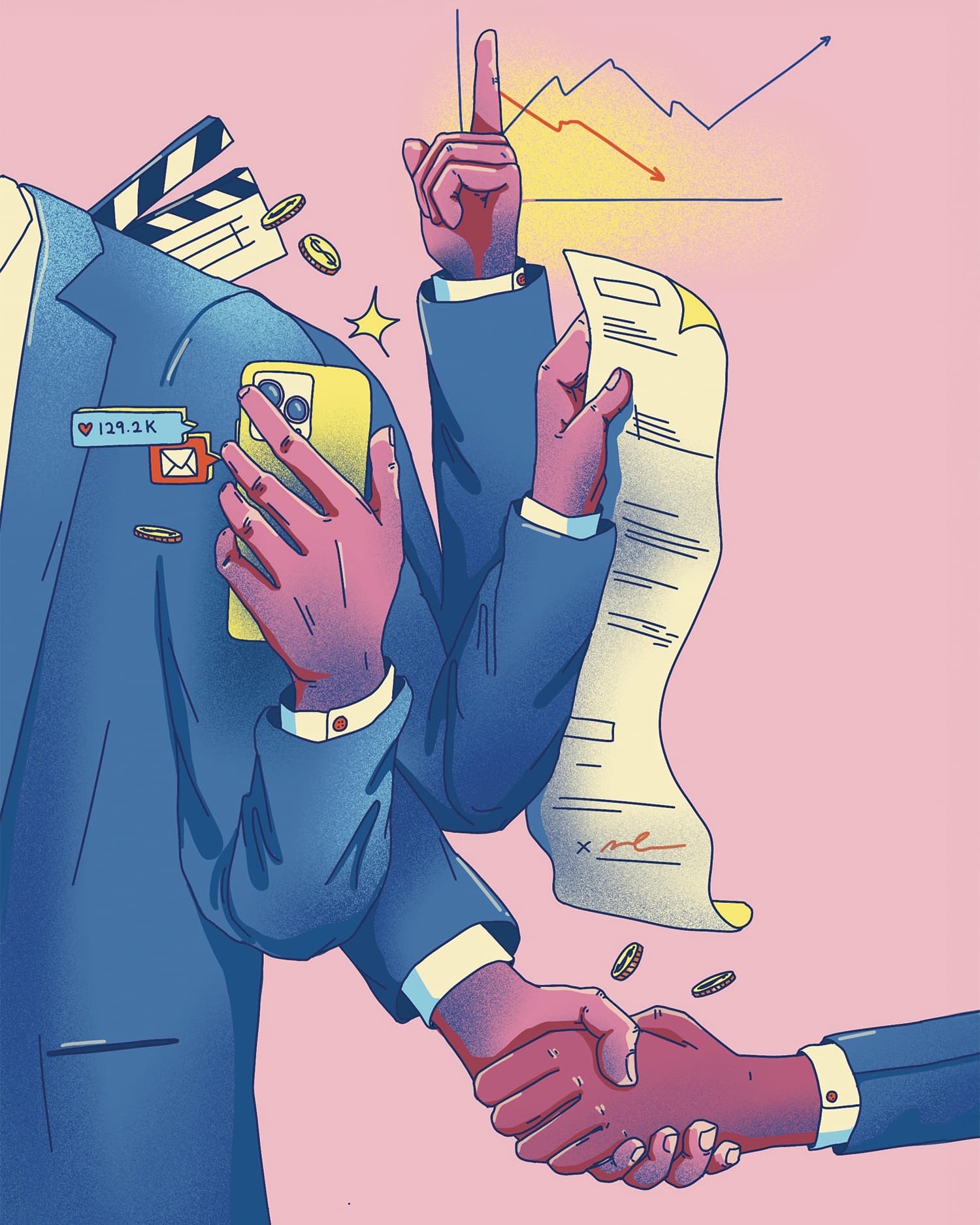
When the National Basketball Association was sketching out plans to host fan gatherings as part of its All-Star Weekend in Los Angeles, the league’s marketing leaders realized they were crafting the ultimate playground environment for sports-centric creators and influencers.
The NBA has worked closely with key social media mavens for more than a decade, but for the Feb. 13-15 All-Star Weekend festivities, the league tried something unprecedented. The NBA brought 200 handpicked creators to Los Angeles and gave them behind-the-rope access to the many high-gloss events the NBA hosted to celebrate basketball — from celebrity showcase games to immersive fan experiences.
The NBA’s courtship of influential voices is hardly unique. Over the past two years, demand among marketers for partnerships with personalities who specialize in social media content has skyrocketed. Digital-native stars like Jesser (who has 37.5 million YouTube followers) are able to strike six- and seven-figure deals with advertisers who are eager to draft off their popularity and the sense of authenticity that social media content can have compared with a traditional pitch in a 30-second TV commercial. The heat among creators in advertising and marketing has also elevated the status of creators among talent representation firms big and small.
“If I were to give a motto or a tagline to a creator economy for 2026, it would be ‘We’ve arrived,’ and that applies to every aspect of entertainment and media,” says Ali Berman, partner and co-head of creators at UTA. “There is definitely an inflection point in terms of how brands and partners are talking about their work with creators because of how effective it is. And we’ve also arrived at a time and place in this world where there’s no brand, event or otherwise that can be successful without a creator strategy.”
Berman’s sentiment is echoed by Bill O’Dowd, CEO of Dolphin Entertainment, a collection of marketing, PR and event management imprints. The art of the game in generating attention for anything these days is blending the legitimacy that traditional media coverage brings with the word-of-mouth effect that comes when influencers weigh in. The trick is to find the right mix of creators who have fans who are seen as likely consumers of a product or service.
“You can’t launch a restaurant, you can’t open a movie, you can’t launch an album if you don’t have influencer marketing to go with your PR,” O’Dowd says. “We’re getting smarter and smarter about how it can change the entire economics of movie launches, television show launches, live events.”
O’Dowd notes that the marketing approach with creators by definition has to be surgical in its precision. It’s not about blanketing the digital airwaves with a message, as with a traditional TV marketing campaign. It’s about hitting the bull’s-eye of a specific audience by finding the creators who reflect the same passions.
“The right mix is often not one big celebrity or one big influencer — it’s 50 nano-influencers that have engagement rates of over 50%,” O’Dowd says. “You add them up together, they cost half the money [of traditional ads], they get you twice as many eyeballs and their followers are more likely to engage. And that engagement can be measured by a click to buy.”
Ben Davis, co-head of digital for WME, sees the market changing for creators as the key players involved in sponsorship deals become more sophisticated about the value of creator content.
Demand among large national advertisers “has seemingly accelerated over the past year or two as the perception of creators has improved and the definition of what a creator is has broadened into anyone who controls their own audience,” Davis says. “Bigger brands are entering the space. They are slower to adapt to trends than smaller nimble ones.”
For the NBA, the opportunity to maximize the value of the All-Star backdrop to reach fans, particularly young fans who are glued to online platforms, was a no-brainer. It turned the annual showcase of teams and athletes into a canvas for the league’s biggest cheerleaders. The NBA expects to reap the rewards of having given dozens of creators VIP access during the All-Star schedule for weeks. The single biggest benefit in the eyes of the NBA is to keep the sport and its brightest stars relevant to today’s tweens and teenagers, who might never sit through an entire pro basketball game on TV but will watch highlights served up with amusing anecdotes by their favorite Twitch and TikTok stars.
“We try to really listen to the creators. They know what good content is, and they know what their fans care about,” says Bob Carney, the NBA’s senior VP of social and digital content. “The fascinating part about creators is that they are constantly working to optimize their content and look at the data. This is their entire livelihood, and they do it at such an unbelievably intense level. So they know what works to reach their fans.”
The heightened attention to leveraging the attention economy of the creator-verse is one of the clearest signals yet that Gen Z and Gen Alpha are increasingly beyond the reach of traditional TV, magazines and newspapers.
“It starts with the fragmentation of the consumption that exists. There’s no guarantee this audience is even going to be watching traditional linear television as part of their day to day,” Carney says. “Their day-to-day behaviors may be YouTube or may be TikTok or may be Instagram. It may be one of those. It may be none of those. It may be two of those. It’s just completely fragmented.”
NBCUniversal took a similar approach as the NBA to embracing creators as marketing machines during the past two Olympics — the 2024 Summer Games in Paris and the just-concluded Winter Games in Milan and Cortina.
NBCU and Visa gave sports-focused influencers Allison Kuch and Isaac Rochell (a former NFL player) insider access at the Olympics as well as during NBC’s telecast of the Super Bowl from Levi’s Stadium in Santa Clara on Feb. 8. It was the kind of doubleheader that the pair — known as Allie and Isaac — can put in perspective for fans in ways that NBC Sports anchors and correspondents simply cannot. Think Allie posting on Instagram about “Events We’re Obsessed With” or joking on her “Sunday Sports Club” podcast with fellow NFL wives and spouses about going to the Super Bowl with young kids, only to have to miss the last two minutes of the game because of a child’s “full meltdown.” Because social media content allows consumers to scroll on their own timetables, there are more chances to reach them.
NBCU’s advertising clients want to be part of the cultural conversations that unfold 24/7 across Instagram and other platforms, says Karen Kovacs, president of advertising sales and partnerships for NBCUniversal.
“Brands are looking to show up in these big [event] moments and connect with these authentic audiences,” she says. Partnering with Allie and Isaac “was an opportunity to really create some connective tissue across each of the moments and to tell different stories but through the lens of a creator.”
A sampling of major talent, marketing and media agencies that are fueling the rise of social media stars in pop culture and mainstream advertising
CAA: The agency has been active in digital media R&D and investment for years through its ventures in residence program and its CAA Evolution investment bank. Now CAA is revving its creator roster after hiring former UTA and Candle Media exec Brent Weinstein in 2025.
DIGITAL BRAND ARCHITECTS: Founder Raina Penchansky was early to realize the potential of social media personalities to launch brands and build e-commerce-friendly content franchises.
THE DIGITAL DEPT.: The influencer marketing agency that is part of the Dolphin Entertainment group represents more than 250 creator clients as talent managers, and they offer support services such as helping with brand strategy, experiential marketing and live events.
JELLYSMACK: The New York-based firm helps creators plug into brand deals and distribute content. It also serves as a holding company for Dan Abrams’ Law&Crime digital network, among others.
PARKER TALENT MANAGEMENT/SELECT MANAGEMENT GROUP: The creator talent firms are part of the larger content eco-system assembled by Ben Silverman and Howard T. Owens under the Propagate umbrella.
STUDIO71: The L.A.-based media firm specializes in helping creators and podcasters package ad inventory and distribute content optimized for each social media platform and protected from piracy.
UNDERSCORE TALENT: The L.A.-based firm focuses on creators in key disciplines including sports, comedy, culinary, entertainment, beauty, fashion and gaming.
UTA: The third-largest of Hollywood’s Big 3 talent agencies has invested in digital resources to support its creator clients and grow its corporate consulting activities.
WEBEDIA GROUP: Paris-based creator talent rep firm runs one of Europe’s largest creator networks and has aggressively moved into content production.
WHALAR GROUP: The creator agency founded in the U.K. in 2016 has grown quickly with representing talent, connecting clients to brands and facilitating content production and audience development.
WME: No. 1 of Hollywood’s Big 3 talent agencies has historically delivered big digital success stories for A-list clients. Under Ben Davis, the agency has beefed up its roster of digital native stars, particularly among podcasters.
The explosive growth of mainstream media and advertising opportunities for creators has spurred an echo-boom in demand for a very specific kind of talent representation services needed by those who ply their trade in the digital realm.
Some firms operate in the classic talent agent or manager representation role, from the biggest of the big (WME, CAA, UTA) to startups a la Digital Brand Architects and Underscore Talent. And then there are firms that offer creator support and distribution services such as Studio71 and Whalar Group. They specialize in giving promising creators the boost they need with advertisers and brand partners. And then there’s the Jellysmack model, where the company is doing a mix of all of the above and investing in content assets with key client partners such as Dan Abrams. It’s all a neon-flashing sign that this subset of the talent representation and support services marketplace has arrived. A revved-up creator economy has the potential to hatch a next generation of hybrid talent rep firms.
The most significant point that WME’s Davis makes to creator clients who are on the way up is that this is a new pathway to ownership that is defined in ways other than as backend points in a movie or TV show. This is turning content into your day job via YouTube, TikTok, Instagram, Twitch, et al — and owning it all at the end of the day.
The rising tide for creators and influencers is “all enabled by the do-it-yourself distribution. Money follows audience. If you have a YouTube channel, and 500,000 people watch a week, that is valuable,” Davis says. “We can connect the dots for whatever the client wants and allow them to launch creative projects and have ownership.”
Davis, who represents such digital heavyweights as Sean Evans of “Hot Ones” and Logan Paul, notes that the shift in tone around the creator economy has come around the same time that YouTube crossed over the 50% threshold of its viewing coming by TV sets versus mobile or desktop devices.
“It’s felt accelerated as YouTube has keyed into TV more. It’s effectively now self-distributed TV by our clients, as opposed to being hired by someone else to produce a show where the network controls the rights, the talent and the distribution,” Davis says.
WME and other talent rep firms have been forced to “evolve to meet the opportunity,” Davis says.
“In the past we did more traditional celebrity endorsement. We couldn’t sell the ads on their network or the integrations on Food Network. Now, that’s inventory for us,” he says. “We’re seeing brands come in that want to deficit-finance original series. We’re cutting out a TV middleman and going to direct to talent to create the formats in concert with the brand.”
Adam Boorstin, co-CEO of Studio71, on the other hand, says his firm’s focus is clear: “Drive reach and revenue for the world’s leading content creators.”
Studio71 has large creator content and podcast networks that clients can plug into for advertising and sponsor support that would be hard to command as individuals. What Studio71 does not do is play the classic talent agent role of having dedicated reps to guide long-term career decisions and help stars choose the best material.


