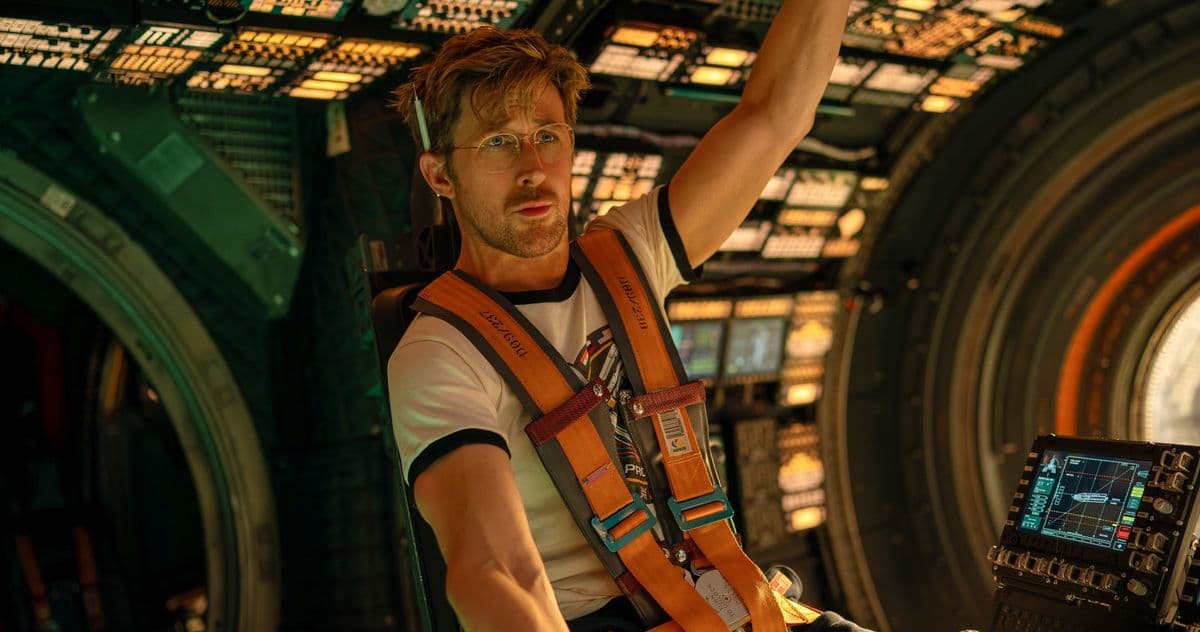
In a sprawling Hollywood adaptation that took six years, six feet six inches of A-list star power, and a battle over runtime, tone, and the integrity of Andy Weir’s bestselling novel, Drew Goddard has done it again. The Academy Award-nominated screenwriter, known for transforming hard science into crowd-pleasing cinema with *The Martian*, has now shepherded *Project Hail Mary*—a tale of a forgotten schoolteacher-turned-spacefarer tasked with saving Earth by reigniting the dying sun—into a $200 million Amazon/MGM tentpole. What emerges is not just a high-stakes sci-fi adventure but a deeply human story about empathy, collaboration, and the messy process of making art under the microscope of studio scrutiny. With Ryan Gosling starring as the bumbling yet brilliant Ryland Grace and Sandra Hüller as the mission’s earthbound commander, Goddard and his collaborators—directors Phil Lord and Chris Miller (*Spider-Man: Across the Spider-Verse*)—have crafted a film that dares to be smart, sentimental, and occasionally silly, all while trusting audiences to keep up.
From Los Alamos to the Cosmos: Drew Goddard’s Journey to the Stars
Drew Goddard’s path to *Project Hail Mary* traces back to the atomic city of Los Alamos, New Mexico, where he grew up among the rocket scientists who helped build the first nuclear weapons. Ironically, the town with the highest IQ per capita in America—where scientists like J. Robert Oppenheimer once worked—also nurtured Goddard’s love for storytelling. After graduating from the University of Colorado, Goddard cut his teeth in television alongside Joss Whedon on *Buffy the Vampire Slayer*, then transitioned into film with J.J. Abrams on *Alias*, *Lost*, and the monster mash-up *Cloverfield*. His knack for balancing wit, emotion, and high-concept sci-fi soon made him a sought-after writer, though his directorial debut, *The Cabin in the Woods*, proved he could helm films just as deftly as he could write them.
Goddard’s collaboration with Andy Weir began with *The Martian*, Weir’s 2014 novel about an astronaut stranded on Mars, which Goddard adapted into a 2015 film starring Matt Damon. The movie became a critical and commercial hit, grossing over $630 million worldwide and earning seven Oscar nominations, including Best Picture. It also established Goddard’s signature approach to sci-fi: making the science feel authentic without obscuring the emotional core. ‘It’s not about dumbing it down,’ Goddard said in a recent interview at Los Angeles’ Four Seasons Hotel. ‘It’s about trusting the audience to meet you halfway. The science is the skeleton, but the heart is what makes it breathe.’
Why 'Project Hail Mary' Is a Sci-Fi Love Letter to Empathy and Problem-Solving
At its core, *Project Hail Mary* is a story about ingenuity in the face of the impossible. Ryland Grace, played by Gosling, is not a trained astronaut but a high school science teacher revived from cryosleep with no memory of his mission—only to discover he must pilot a spaceship, master alien physics, and save humanity from a dying sun. His companion is Rocky, a crab-like extraterrestrial (voiced and motion-captured by a team of performers) with whom he shares no atmosphere, no language, and no immediate understanding of each other. Yet through trial and error, Grace and Rocky learn to communicate, collaborate, and ultimately, to trust one another.
The Power of the Everyday Hero
Goddard deliberately cast Gosling against type as Grace, a man whose competence is overshadowed by his self-doubt. ‘We’re not doing a story about the world’s greatest astronaut,’ Goddard explained. ‘We’re starting with a schoolteacher’s point of view. *The schoolteacher saves the universe* sounds preposterous—and yet it felt so right.’ This framing reflects Goddard’s fascination with fallible protagonists who triumph not through innate genius but through curiosity, persistence, and empathy. It’s a theme that resonates deeply in an era where blockbusters often rely on superpowered protagonists. ‘Human beings who are fallible and don’t know everything can still be ingenious,’ Goddard said. ‘That’s the story we’re telling: competence through struggle.’
Science as a Universal Language
Weir’s novel is dense with technical detail, from chemical equations to orbital mechanics, but Goddard and his team chose to streamline the science while preserving its emotional truth. ‘Andy is so good at the science that I don’t have to be,’ Goddard noted. ‘I can approach it from what I like to do, which is write about emotions.’ The film’s climax hinges on a revelation so audacious that Goddard admitted even he didn’t see it coming during his first read. ‘Things that we don’t know in the soul of the movie become a little more clear,’ he said. ‘It’s not just a surprise—it’s a moment of understanding.’ This balance between hard science and human connection is what sets *Project Hail Mary* apart from other sci-fi epics, where spectacle often trumps substance.
The Rocky Road to a Believable Alien: Bringing Rocky to Life
No challenge in *Project Hail Mary* was greater than making Rocky feel real. The alien, who communicates in clicks and whale-like sounds, shares no biomechanics with Grace—let alone the same atmosphere. To solve this, the filmmakers leaned on the visual language of animation, which Lord and Miller had mastered in *Spider-Man: Across the Spider-Verse*. ‘You don’t have your usual crutches,’ Goddard said. ‘He can’t talk. They don’t even have the same atmosphere. That’s preposterous, because you’ve got a boy in a bubble scenario without a face.’
The team experimented with Rocky’s design for years, ultimately settling on a creature that balanced whimsy and menace. ‘We wanted something that felt like it could exist in our universe but also be distinctly alien,’ Goddard explained. The result is a character that feels both scientifically plausible (within the film’s internal logic) and emotionally resonant. ‘The only way we’re going to get through this is to struggle to see from the other point of view,’ Goddard said. ‘Or the universe dies on a core level.’
A Six-Year Odyssey: Balancing Studio Pressure, Creative Vision, and Ryan Gosling’s Karaoke
*Project Hail Mary* took six years from greenlight to release—a gestation period that allowed Goddard and his collaborators to refine every joke, every scientific detail, and every emotional beat. The process was not without friction. Early studio screenings clocked the film at over three hours, prompting concerns about pacing. ‘The thing they loved the most is that we didn’t talk down to them,’ Goddard said. ‘We were talking up. It gives you a freedom to say, *Great, the audience is with us*.’
Goddard also faced pushback on the film’s eventual 156-minute runtime, with executives questioning whether audiences would tolerate such a long sci-fi movie. ‘There was some fear about *have you guys lost your minds?*’ Goddard recalled. ‘But we were trying to do something ambitious that would go beyond the usual disaster/save-the-world type of movie.’ The filmmakers’ steadfastness paid off: test audiences responded enthusiastically to the film’s blend of humor, heart, and high-stakes science.
Gosling’s influence extended beyond his performance. During a break in filming, the actor convinced Sandra Hüller—who plays mission commander Eva Stratt—to perform a karaoke rendition of Harry Styles’ *Sign of the Times* as a team-building exercise. ‘I was terrified before we cast that role,’ Goddard admitted. ‘Who are we going to find that the whole world unanimously goes, *Oh, let’s put her in charge without even questioning?*’ When Hüller agreed, Goddard said, ‘Oh, we have a movie, because their energies are so different.’ The chemistry between Gosling and Hüller became one of the film’s unexpected highlights, adding depth to Grace’s journey from isolation to connection.
Key Takeaways: What Makes 'Project Hail Mary' Stand Out
- Drew Goddard spent six years adapting Andy Weir’s novel, balancing hard science with emotional storytelling to create a 156-minute sci-fi epic.
- The film stars Ryan Gosling as Ryland Grace, a schoolteacher-turned-spacefarer tasked with saving Earth, and Sandra Hüller as the mission’s earthbound commander.
- Rocky, the crab-like alien, was a monumental challenge to design and integrate, requiring innovative animation techniques and a focus on nonverbal communication.
- Goddard and his team fought to preserve the novel’s ending and runtime, trusting audiences to engage with the film’s intellectual and emotional depth.
- The collaboration between Goddard, Gosling, Phil Lord, and Chris Miller resulted in a film that blends humor, heart, and hard science in equal measure.
The Collaborators: How Lord, Miller, Gosling, and Hüller Shaped the Film
No adaptation happens in a vacuum, and *Project Hail Mary* benefited from the combined talents of some of Hollywood’s most innovative creators. Phil Lord and Chris Miller, the Oscar-winning directors behind *Spider-Man: Across the Spider-Verse*, brought their signature blend of wit and visual inventiveness to the project. Their experience with blending genres and tones helped Goddard refine the film’s structure, allowing room for improvisation and humor.
Ryan Gosling, who also served as a producer, brought a unique energy to the set. ‘God bless them,’ Goddard said of Gosling and his improv-heavy approach. ‘They do not relent. They’re always trying to make that movie better.’ Gosling’s physical comedy and emotional range helped ground the film’s more outlandish elements, while Sandra Hüller’s casting as Eva Stratt—a role that required both authority and vulnerability—added unexpected depth to the story. ‘When she said yes, *Oh, we have a movie*,’ Goddard recalled. ‘Their energies are so different.’
The Science vs. The Soul: Goddard’s Approach to Adaptation
Goddard’s adaptation of *Project Hail Mary* faced a fundamental tension: how to honor the novel’s scientific rigor while making the story accessible and emotionally compelling. Weir’s book is a masterclass in hard science fiction, but Goddard knew that a direct translation would overwhelm all but the most dedicated readers. ‘It’s OK if they don’t understand,’ Goddard said. ‘As long as the emotional intent is pure, audiences will go with it. If they don’t fully understand, they can watch it again, they can look it up, make them an active participant.’
This philosophy guided Goddard’s decisions throughout the adaptation process. He simplified complex scientific concepts, trusting the audience to fill in the gaps, while focusing on the story’s emotional core. ‘What I care about is the love of science and the purpose of science—not the science itself,’ he explained. The result is a film that feels both intellectually rigorous and deeply human, a rare achievement in a genre often criticized for prioritizing spectacle over substance.
The Emotional Core: How 'Project Hail Mary' Became a Love Story
At its heart, *Project Hail Mary* is a love story—not between two people, but between two species. Grace and Rocky’s journey is one of mutual discovery, where the ability to empathize becomes the key to survival. Goddard’s own experiences as a father influenced this theme. ‘Some of this movie is me communicating with my son,’ he said. ‘It just filters through what you’re going through, and it comes out on screen. At its core, it’s a love story, and it’s also a tribute to the importance of empathy.’
This emotional layer is what elevates *Project Hail Mary* above typical blockbusters. The film’s climax, where Grace and Rocky share a moment of connection that transcends language and biology, is a testament to the power of understanding. ‘The importance of saying, *We’re from other sides of the galaxy. Not only do we not have the same language, we don’t have the same biomechanics*,’ Goddard said. ‘The only way we’re going to get through this is to struggle to see from the other point of view.’
Frequently Asked Questions About 'Project Hail Mary'
Frequently Asked Questions
- Is 'Project Hail Mary' a faithful adaptation of Andy Weir’s novel?
- *Project Hail Mary* stays true to the novel’s core premise and many of its key plot points, though the film simplifies some of the science and streamlines Grace’s character arc for cinematic pacing. Director Drew Goddard and the filmmakers made deliberate choices to enhance the emotional beats while preserving the story’s intellectual spirit.
- How did Ryan Gosling prepare for his role as Ryland Grace?
- Ryan Gosling underwent extensive training in scientific concepts, worked with NASA consultants, and collaborated closely with Drew Goddard to craft Grace’s bumbling-yet-brilliant persona. Gosling also contributed to the film’s humor and improvisation, including a memorable karaoke scene with Sandra Hüller.
- Why is 'Project Hail Mary' 156 minutes long?
- The extended runtime reflects the filmmakers’ decision to prioritize depth over conventional pacing. Drew Goddard and the directors fought to preserve the film’s ambitious scope, trusting audiences to engage with the story’s blend of science, humor, and emotion. Test screenings confirmed that viewers responded positively to the slower, more immersive approach.