
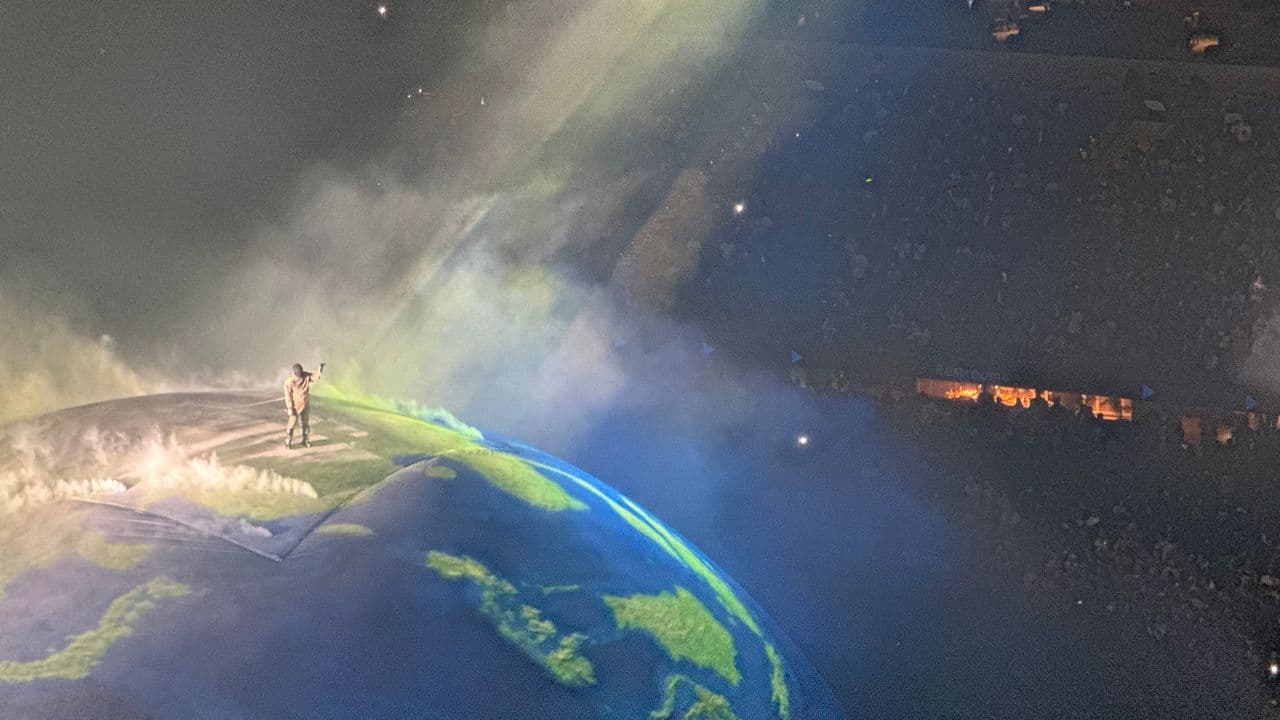
The crowd roared as the curtain fell at SoFi Stadium, revealing a colossal, globe-like stage bathed in thick haze and swirling lights. Kanye West, now styling himself as Ye, had returned to Los Angeles for his first full-scale U.S. concert in half a decade, promising a fresh start with his controversial 2024 album *Bully*. But by the time he finished, the evening had become a paradox: a spectacle of immense production value paired with a performance that felt listless, disjointed, and oddly devoid of the fire that once defined his live shows. The night was as much a reflection of Ye’s enduring, if diminished, fanbase as it was a barometer of his slipping relevance in an era where his name now carries more baggage than buzz.
The Paradox of Kanye West’s Comeback: Hype vs. Reality at SoFi Stadium
The numbers alone told a story of anticipation: two consecutive sold-out nights at SoFi Stadium, a venue capable of seating 70,000 fans per show. The demand was so high that secondary ticket prices for Ye’s California performances soared, with some seats changing hands for thousands of dollars. Yet, outside the diehard Yeezy faithful—those who still purchase limited-edition merch emblazoned with slogans like “Bully” or the iconic luchador mask from Ye’s past—there was a palpable sense of detachment. Even radio stations, once eager to play Ye’s anthems, now play his tracks sparingly, often prefacing them with caveats or ironic commentary.
This wasn’t Ye’s first rodeo. Over the past five years, he had sporadically surfaced at festivals like Rolling Loud 2024, where his appearance was more about spectacle than substance. But SoFi marked his most ambitious attempt at a full-scale return, complete with a stage design that seemed to defy gravity itself. The centerpiece was a massive, spherical orb suspended above the stage, its surface glowing with projections of Earth and cosmic imagery. Ye descended from its apex via a harness, tethered to the structure as if he were a cosmonaut readying for liftoff. The visuals were undeniably impressive—a testament to the creative vision that once made Ye a pioneer in live performance art.
A Stage Ready for a Show, But Not a Singer
Yet the stage was only half the equation. What followed was a performance that felt like a shadow of Ye’s former self. The opening salvo from *Bully*—a four-song burst that included the single “King” and the polarizing “Father”—was marred by long pauses, off-key ad-libs, and a disconcerting disconnect between the artist and his material. At one point, midway through “Father,” Ye paused for an excruciating silence before snapping at his tech team: *“Make the Earth move slower.”* The plea was telling. The visuals’ rotation had thrown off his timing, but the request also seemed to mirror his broader struggle—trying to slow down a world that had moved on without him.
The audience, a mix of longtime fans and curious onlookers, remained seated for much of the show. The energy that once propelled Ye’s concerts—where he would leap off risers, ad-lib with reckless abandon, and command the stage with an almost manic intensity—was absent. Instead, there were mechanical restarts (his team forced to replay “Good Life” four times due to lighting issues), awkward silences, and a setlist that leaned heavily on his 2000s and early 2010s catalog. Songs like “Jesus Walks,” “Blood on the Leaves,” and “Can’t Tell Me Nothing” were performed with all the urgency of a karaoke night, their revolutionary edges dulled by time and repetition.
“The first time I heard all these songs, they sounded so unbelievably fresh and new. These days, even the most ‘futuristic’ sounding albums of his golden run sound pretty distinctly of their time, and the backpacker classics are from an even more bygone generation.”
The Weight of the Past: Nostalgia vs. Current Controversies
Ye’s relationship with his audience has always been complicated, but never more so than in 2024. Once the enfant terrible of hip-hop, now he is a figure defined as much by his artistry as by his legal battles, public outbursts, and polarizing statements. The *Bully* album, released in September 2024, was marketed as a redemptive work—a chance for Ye to reintroduce himself after years of turmoil. Yet its reception has been lukewarm at best. Critics and fans alike have struggled to reconcile the album’s vague apologies (“the new me”), its cryptic references to “political and social issues,” and its almost taunting refrain that *“it still could’ve been worse.”*
The contradictions of Ye’s career were on full display at SoFi. He performed “Carnival,” a track from his 2021 album *Donda 2*, and kept the line *“Now I’m Ye Kelly bitch/Now I’m Bill Cosby, bitch/Now I’m Puff Daddy rich/That’s Me Too me rich.”* The verse, originally a joke about his shifting personas, now reads as a dark punchline given his ongoing legal troubles. Ye faces multiple lawsuits, including allegations of sexual assault and employee abuse, which he has not denied. The juxtaposition of his stage presence—at once vulnerable and defiant—with the gravity of those accusations created an unsettling tension throughout the night.
Even his interactions with the crowd felt scripted. This was not the Ye who would stop mid-song to reminisce about his Chicago upbringing or riff on the crowd’s energy. Instead, there were perfunctory acknowledgments, like when he introduced his daughter North, who performed a cover of “Piercing on My Hand,” and Don Toliver, who appeared briefly to add vocal texture. The moments of genuine connection—when they occurred—felt like artifacts from a bygone era.
What’s Left of Kanye West? The Fading of a Cultural Giant
It’s been over a decade since Ye released *My Beautiful Dark Twisted Fantasy*, an album that redefined what pop music could be. Since then, his legacy has been a rollercoaster of innovation, controversy, and self-sabotage. His pivot to Yeezy fashion, once a billion-dollar empire, collapsed in 2022 after antisemitic remarks and a series of public meltdowns. His 2024 album *Vultures 1*, a collaborative project with Ty Dolla $ign, was met with lukewarm reviews and minimal cultural impact. And *Bully*, despite its grand rollout, has struggled to recapture the zeitgeist.
The SoFi Stadium show underscored a harsh truth: Ye is no longer a cultural force so much as he is a figure of fascination—a guilty pleasure for those who remember his golden years. The backlash to his unfiltered persona has calcified into something more permanent, while his music, once revolutionary, now feels dated. Even his most devoted fans seem to be attending out of ritual rather than genuine enthusiasm. As one attendee near me muttered during a long pause after “Father,” *“I don’t even know why I’m still standing.”*
The Business of Comebacks: Gamma Media and the Calculus of Redemption
Ye’s professional rebound has been as carefully managed as his stage production. In 2023, he signed with Larry Jackson’s Gamma, a media company that promised to help rebrand his public image. The move suggested a strategic pivot—one that would combine music, fashion, and multimedia projects under a more controlled, “professional” umbrella. Yet the SoFi shows revealed the limits of such calculations. The performances lacked the spontaneity and raw energy that once made Ye’s concerts unforgettable. Instead, the night felt like a product demonstration: a showcase of stagecraft with little soul.
Gamma’s involvement has also raised questions about the commercialization of Ye’s comeback. Tickets for the SoFi shows ranged from $150 to over $1,000, with VIP packages selling for upwards of $5,000. The pricing reflected not just demand but a calculated gamble—that enough fans would pay to witness history, regardless of the quality. Yet history, in this case, felt more like a cautionary tale than a triumphant return.
Key Takeaways: What the SoFi Show Revealed About Ye’s Future
- Kanye West’s first full U.S. comeback in five years at SoFi Stadium drew a sold-out crowd of 70,000, but his performance was disjointed, with long pauses, misfired lyrics, and a setlist heavy on nostalgia over new material.
- The elaborate stage design—a globe-like orb with cosmic projections—showcased Ye’s signature visual flair, but the production outshined the performance, highlighting his diminished stage presence.
- *Bully*, Ye’s 2024 album, has failed to recapture his former cultural relevance, with critics and fans struggling to reconcile its vague apologies and polarizing messaging amid ongoing legal controversies.
- Ye’s ongoing lawsuits, including allegations of sexual assault and employee abuse, cast a long shadow over his performances, creating an unsettling tension between his art and his public persona.
- The SoFi show underscored Ye’s fading cultural relevance, with even his most devoted fans appearing more out of ritual than genuine enthusiasm, signaling a potential decline in his influence.
The Broader Implications: Where Does Ye Go From Here?
The SoFi Stadium show was more than just a concert—it was a cultural Rorschach test. For some, it was a chance to reconnect with the music that shaped their youth. For others, it was a reminder of why they’d moved on. And for Ye himself? It may have been a step toward rehabilitation, but it was also a step into uncertainty. The music industry has evolved, and the appetite for unfiltered, boundary-pushing art has waned in the face of streaming algorithms and corporate branding. Ye’s challenge now is to find a lane that isn’t just nostalgic or controversial but genuinely innovative.
There are precedents for artists making comebacks after long absences or controversies. Britney Spears’s 2023 residency in Las Vegas proved that audiences are willing to forgive and forget—if the product is compelling enough. But Spears’s comeback was carefully curated, with a team behind her to ensure every note and dance move was polished to perfection. Ye, by contrast, seems to be operating on instinct, and his instincts have often led him astray. The question now is whether he can adapt or if this moment will be remembered as the beginning of the end for one of hip-hop’s most polarizing figures.
Frequently Asked Questions About Kanye West’s SoFi Stadium Comeback
Frequently Asked Questions
- Why did Kanye West’s SoFi Stadium show feel so disjointed?
- The performance suffered from long pauses, misfired lyrics, and a lack of energy, suggesting Ye is struggling with both his mental health and his connection to his material. The elaborate stage design, while visually stunning, couldn’t compensate for the disjointed delivery.
- What is the significance of Kanye West’s *Bully* album in his career?
- *Bully* was marketed as a redemptive work, but it has failed to recapture Ye’s former cultural relevance. Critics and fans have struggled with its vague apologies and polarizing messaging, leaving its reception lukewarm.
- How has Kanye West’s legal situation affected his career?
- Ye faces multiple lawsuits, including allegations of sexual assault and employee abuse, which have overshadowed his music and public appearances. These controversies have made it difficult for fans and critics to separate his art from his personal life.


