
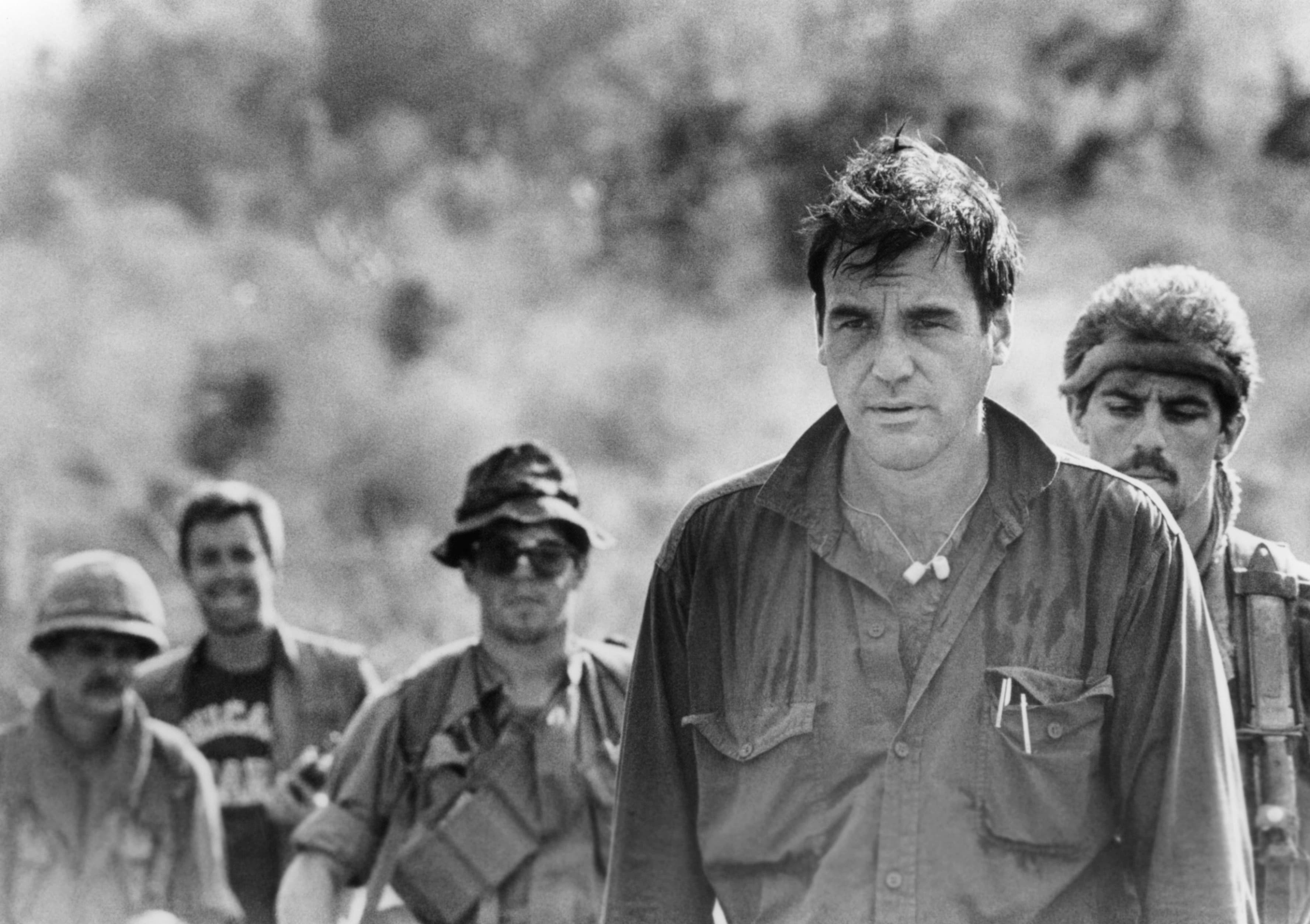
There has never been a war film quite like “Platoon.”
Hollywood delivered powerful combat stories about the brutality of battle, but nothing came close to matching Oliver Stone’s depiction of America’s tragic Vietnam chapter. This drama about an idealistic recruit (Charlie Sheen) confronting the savagery, the chaos, the true horror of war, was a searing corrective to jingoistic action movies like “Rambo.” In “Platoon,” the enemy is largely unseen — the Vietnamese soldiers masked by dense jungle — but the camera does not shy away from the depiction of the mangled bodies of the servicemen who draw their fire. Stone, who served in 1967 and 1968, was the first Vietnam vet to direct a movie about his experience, giving the picture greater authenticity.
Filmed for just $6 million and featuring a cast of then largely unknown actors like Willem Dafoe, Forest Whitaker and Johnny Depp, “Platoon” was a smash hit, earning $137.9 million to become the third-highest-grossing film of 1986. It went on to sweep the Oscars, picking up six Academy Awards including best picture and best director. To mark “Platoon”’s 40th anniversary, Stone talked to Variety about his struggles to get the movie made, his sadness over America’s unbreakable attraction to foreign conflicts and his fears that his outspoken beliefs derailed his Hollywood career.
We were rejected for 10 years. People thought the script was a bummer. You have to realize, this picture was made in a market that was unfriendly to anti-Vietnam statements. I was truth-telling and clearing out some of the lies being told about Vietnam.
I’m hardly a sociologist; all I can say is that I was very surprised. We made an independent, low-budget film in the Philippines, but by the time we were done, something in the national consciousness had changed. We’d just gone through the “Rambo” films and that Chuck Norris movie “Missing in Action” that were hardcore and like, “Let’s go back to Vietnam and do it again!” I was coming out of this wholly different point of view that war is hell and that Vietnam was a lost cause. We had no business being there.
It’s just ridiculous that we’re back in this state of loving war again. We haven’t learned anything from Vietnam — we just continue to militarize and build up our defense budget. We continued to dominate and bully and threaten. The war in Iraq was the greatest disaster since Vietnam. George Bush, the worst single president we’ve ever had. What did Iraq get us? It drained our wealth and made us callous as a nation. And now Mr. Trump is [starting] a war in Iran, and he’s playing the same game with Cuba and Venezuela. It’s like the Roman Empire. We never learn our lesson.
I feel frustrated. I’ve certainly been loud in sharing my beliefs over the years, and my career has suffered for it. I’ve learned my lesson: Keep your views quiet.
When I got back, I was disoriented for a long time. Drugs didn’t help. Marijuana didn’t help. And then I wrote a screenplay in 1969 called “Break,” which was very surrealistic. It’s about someone who enlists. And it becomes a blend of sci-fi and LSD — it’s very, very phantasmagoric. It’s a very Jim Morrison kind of movie. And I sent it to Morrison — actually, Morrison had it in his apartment in Paris when he died. The script was returned to me years later, when I made “The Doors,” written by his road manager. That script was not “Platoon,” but it became the basis for “Platoon.”
“Coming Home” was very powerful. But it was told from the point of view of Jane Fonda as the veteran’s wife. I thought it was pretty accurate, but that was not my experience. “Apocalypse Now” I admired as a movie. But the story seemed mythological, and I couldn’t square that at all with what I saw as a soldier. It’s all secret ops and a strange mission on a riverboat. And the same with Michael Cimino’s movie [“The Deer Hunter”]. It didn’t reflect what I had been through.
Initially, we set up the movie in 1984, and Charlie’s brother Emilio Estevez was going to play the main role. But it fell apart. And when it came back around in 1986, Emilio was older. He no longer had quite the look. Charlie was 19 or 20, and he has a lot of the same mannerisms as Emilio. And I liked him a lot. He hadn’t done much work. But he had a naive quality, like I had when I was back in Vietnam.
In a young man’s way, he did. Nothing serious. I sent the whole cast to boot camp. I wanted them to look like infantry when we started filming. Of course, I got much criticism for it, because it was a 24/7 deal, and that’s not allowable in SAG contracts, but we did it.
They dropped out before it started when they were asked about it. I think four or five people quit, but we just replaced them and forged ahead. We started shooting the day the camp ended, and they came out looking pretty tired, which was great for the film. And we shot 48 straight days. It was really rough conditions in the Philippines.
That’s a bit of a war story. It sounds good — you know, the veteran who can’t forget the past. Like I’m Charles Laughton in “Mutiny on the Bounty” or something. I had a vision, I knew what I wanted, and was only disappointed with myself in that sometimes I couldn’t achieve it.
There were times when I had the feeling of living this again. Of course, you have to work inside the limitations of the camera. In movies, when you hear gunfire, you expect to see the result. In real life and in real battle, you hardly ever see who you kill. But that’s unfilmable. Audiences would reject that, so you have to use some conventions.
No. Most of the films that came after are ridiculous and stupid. I mean how many Iraqis does Mark Wahlberg kill in “Lone Survivor”? And that’s supposed to be a true story, right? If you look at the recent movies, they’re so militaristic. And that’s because they’re made with the cooperation of the Pentagon; you need access to their equipment. To get one of those choppers on “Black Hawk Down,” you’ve got to make a deal with them, and they will pay for everything. And for that matter, the CIA is involved too.
I’ve been pretty busy setting up this lower-budget feature called “White Lies,” which I’ve tried to do for many years. It’s off and on. It’s a script I keep working on. It’s a personal story about people and relationships — husbands, wives, children, grandparents. It’s about three generations of a family, and hopefully I’ll pull it off. I’m very close.
Every day was memorable. But on the last day of the shoot, I had this feeling that we’d done something important. I didn’t know whether anybody would see the film. I didn’t know that it’d be a success. But my conscience was clear. I felt I had achieved something in my life that could withstand the test of time. I didn’t expect everything that came after it. That was beautiful, but I don’t want to make that the peak of my life. I think the peak is coming.


