
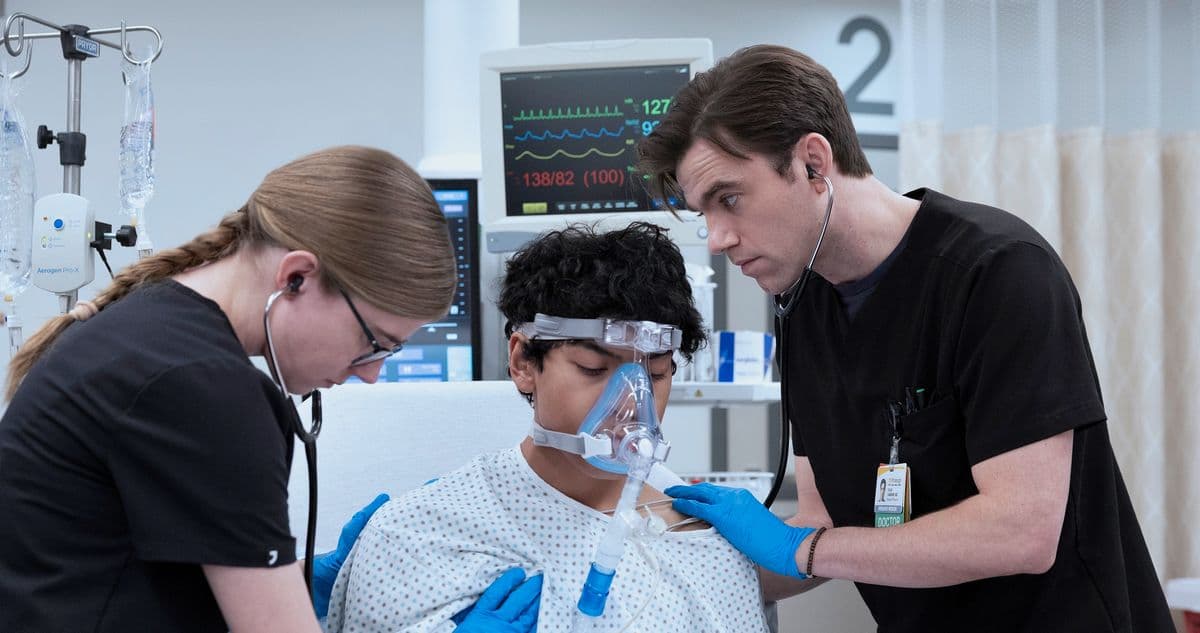
The emergency department at Pittsburgh Medical Center (PTMC) is a pressure cooker of human suffering, professional exhaustion, and systemic failures—but for the first time in weeks, the night shift is fully staffed. Fresh-faced residents Dr. Abbot, Dr. Shen, Dr. Ellis, and Dr. Mateo, alongside new intern Dr. Nazely Toomarian and senior resident Dr. Crus Henderson, arrive to find their exhausted day-shift colleagues barely holding it together. While the new team brings much-needed energy, their arrival also highlights the fragility of emergency medicine: physicians stretched thin, patients slipping through cracks, and a healthcare system where even life-saving care is commodified. This is the reality of The Pitt Season 2, Episode 13, titled ‘7:00 PM’ , a gripping hour that exposes the emotional toll of modern medicine, the consequences of bureaucratic negligence, and the raw vulnerability of those sworn to save lives.
Key Takeaways from The Pitt Season 2 Episode 13: Medical Errors, Systemic Failures, and Robby’s Breaking Point
- The night shift’s arrival exposes the exhaustion of the day shift, revealing how overworked physicians struggle to provide optimal care.
- Medical errors and systemic failures—such as a cyberattack, lost Medicaid coverage, and delayed surgeries—lead to devastating patient outcomes, including the death of Mr. Green.
- Dr. Robby Merritt’s mental health deteriorates visibly, culminating in an emotional confrontation with Chief Dana Whitaker about his potential resignation.
- Patient Orlando Diaz’s case raises urgent questions about medical debt, suicide risk, and the long-term prognosis of severe traumatic brain injuries.
- Dr. Crus Henderson emerges as a standout character, using ultrasound technology to diagnose patients rapidly, while Dr. Samira Mohan grapples with the emotional weight of medical mistakes.
The Night Shift Arrives: A Fresh Perspective or Another Burden?
For the first time in weeks, PTMC’s emergency department is fully staffed with fresh-faced residents ready to tackle the night’s chaos. Dr. Abbot, Dr. Shen, Dr. Ellis, and Dr. Mateo—joined by new intern Dr. Nazely Toomarian—bring much-needed energy to a department that has been operating on fumes. Their arrival is not just a narrative device but a reflection of a harsh reality in emergency medicine: physicians cannot sustain peak performance indefinitely. The day shift, led by the beleaguered Dr. Langdon, is physically and emotionally drained, with some doctors teetering on the edge of burnout. The contrast between the two teams underscores a critical issue in healthcare: the cyclical nature of staffing shortages and the human cost of understaffed shifts . As one exhausted day-shift physician mutters, "We don’t always get everything right the first time," the night shift’s presence becomes a double-edged sword—necessary for patient safety, yet another reminder of the system’s failures.
Dr. Crus Henderson: The Night Shift’s Unexpected Hero
Among the night shift’s ranks, Dr. Crus Henderson stands out—not just for his confidence but for his unconventional brilliance. A senior resident with a reputation for taking control, Henderson earns the admiration of attendings with his catchphrase, "The night shift’s on Crus control." His diagnostic prowess is on full display when he uses an ultrasound to diagnose multiple patients who have been waiting hours for X-rays. In one particularly striking moment, he identifies a pneumothorax in a young asthma patient, Grady, preventing a catastrophic intubation attempt by Dr. Langdon. Henderson’s ability to think outside the box—using technology and intuition to bypass bureaucratic delays—positions him as a potential leader in emergency medicine. His presence also highlights a growing trend in modern medicine: the increasing reliance on point-of-care ultrasound (POCUS) to improve patient outcomes when traditional imaging is delayed or unavailable .
Medical Errors and Systemic Failures: The Human Cost of Bureaucracy
The episode’s most haunting subplot revolves around the tragic death of Mr. Green, a patient whose aneurysm went untreated due to a combination of systemic failures. Mr. Green had been diagnosed with a small triple-A (abdominal aortic aneurysm) a year and a half prior, but his follow-up ultrasounds were never scheduled. The cyberattack that crippled PTMC’s computer systems for weeks prevented any reminders from being sent, and the breakdown in communication between departments allowed the oversight to slip through the cracks. When Mr. Green’s condition worsened during surgery—where he ultimately died—Dr. Samira Mohan and med student Ogilvie were left to process the avoidable tragedy. "If the systems had been up, we would have seen this right away," Mohan laments, her voice shaking with grief. The incident is a microcosm of a larger problem in American healthcare: how administrative inefficiencies, underfunded public health systems, and the prioritization of profit over patient care lead to preventable deaths . Mohan’s devastation is palpable, and her emotional breakdown serves as a stark reminder of the emotional toll medical errors take on healthcare providers.
The Case of Orlando Diaz: Medical Debt, Suicide Risk, and Long-Term Disability
Orlando Diaz, a patient Mohan fought to keep in the hospital, suffers a severe traumatic brain injury (TBI) after a 20-foot fall from a catwalk. His case is complicated by the revelation that he may have attempted suicide due to overwhelming medical debt—$100,000—and guilt over burdening his family. The episode forces viewers to confront uncomfortable questions: How often do medical bankruptcies push patients to the brink? Why do systems fail to connect mental health resources to patients in crisis? Chief of Neurosurgery Dr. Conley (played by Mary McCormack, a veteran of ER) takes charge, performing a life-saving external ventricular drain (EVD) procedure with Dr. Javadi’s hesitant assistance. Conley’s calm demeanor and teaching moments provide a glimmer of hope amid the chaos. However, the episode delivers a gut-punch statistic: one-third of TBI patients die, and half of survivors face long-term disabilities . For Mohan, the weight of Orlando’s prognosis—and the realization that her efforts to keep him hospitalized may not have been enough—pushes her to the brink of emotional collapse.
Robby Merritt’s Emotional Breaking Point and the Looming Exit
Dr. Robby Merritt, PTMC’s chief of emergency medicine, is a man on the edge. His erratic behavior—snap decisions, public outbursts, and a growing detachment—signals a man teetering on the verge of a relapse into substance abuse. His emotional breakdown reaches its peak during a heated confrontation with Chief Dana Whitaker, who has become a surrogate family figure for him. "I’m worried about the people that I care about," Robby confesses, his voice cracking as he fights back tears. "Yeah? What if I don’t come back?" The vulnerability in his question is heartbreaking, revealing the depth of his trauma. Whitaker’s response—"They will manage until you come back. They always do"—is both reassuring and a stark reminder of the cyclical nature of emergency medicine: physicians burn out, leave, and are replaced, but the system grinds on. Robby’s crisis is not just personal; it’s a reflection of the broader epidemic of physician burnout in the U.S., where nearly half of emergency physicians report symptoms of burnout , according to a 2023 study by the American College of Emergency Physicians (ACEP).
The Collapse of Healthcare Infrastructure: Medicaid Gaps, Cyberattacks, and the Cost of Care
The episode’s most infuriating subplot involves the systemic failures that extend beyond the hospital walls. Grady, a young asthma patient, arrives at PTMC in respiratory distress—only for his mother to reveal that the family lost their Medicaid coverage due to a redetermination letter sent to their old apartment. The letter was never forwarded, and without coverage, the family couldn’t afford Grady’s Symbicort inhaler, which costs $400 a month out of pocket. The scene is a brutal indictment of the U.S. healthcare system’s fragility, where Medicaid redetermination processes and bureaucratic hurdles can mean the difference between life and death . Naomi, Grady’s mother, recounts months of fighting to reinstate coverage, only to hit wall after wall of red tape. "It’s infuriating," Dr. Mohan seethes, echoing the frustrations of millions of Americans who navigate a system designed more for denial than care. The subplot also highlights the intersection of medical debt and mental health: Orlando Diaz’s story is a tragic reminder of how financial ruin can push patients to desperate measures.
The Emotional Weight on Dr. Samira Mohan: Grief, Guilt, and Professional Trauma
Dr. Samira Mohan, one of PTMC’s most compassionate physicians, is pushed to her emotional limits in this episode. Her patient Orlando Diaz’s devastating outcome leaves her questioning her competence, while the death of Mr. Green—whose aneurysm went untreated due to systemic failures—adds another layer of guilt. The episode does not shy away from depicting the psychological toll of medical errors. When Orlando’s wife arrives and learns her husband is now permanently disabled, Mohan is forced to confront the human cost of her profession’s failures. The scene is a masterclass in emotional storytelling, capturing the guilt, shame, and helplessness that physicians often carry in silence. Mohan’s breakdown is not just about Orlando or Mr. Green; it’s about the cumulative weight of a system that prioritizes efficiency over empathy, profit over patients, and paperwork over people.
The Next Generation: Med Students, Interns, and the Future of Emergency Medicine
The episode also shines a spotlight on the next generation of physicians, from wide-eyed interns like Dr. Nazely Toomarian to med student Ogilvie, who is visibly shaken by the death of Mr. Green. Ogilvie’s struggle—watching a patient die due to a preventable error—mirrors the experiences of many young doctors who enter medicine with idealism, only to be ground down by reality. Chief Whitaker’s conversation with Ogilvie is a poignant moment, where he shares the story of Mr. Milton, a patient from Season 1 who died waiting for care. "You’ve got to find balance," Whitaker advises, emphasizing the need to process death without letting it consume you. For Ogilvie, the lesson is stark: emergency medicine is not just about saving lives; it’s about learning to live with the ones you couldn’t save. The scene underscores a critical issue in medical education: how to instill resilience in young doctors without numbing their empathy .
The Broader Implications: What The Pitt Reveals About American Healthcare
The Pitt is more than a TV drama; it’s a mirror held up to the broken pieces of the U.S. healthcare system. In a single episode, the show tackles a staggering array of systemic issues: understaffed shifts, medical debt, cyberattacks crippling hospital operations, Medicaid redetermination failures, and the emotional toll on physicians . The cyberattack subplot, in particular, feels eerily prescient in an era where hospitals are increasingly targeted by ransomware attacks, disrupting critical care for weeks. The episode’s portrayal of Mr. Green’s death—due to a failure to follow up on a known aneurysm—is a chilling reminder of how bureaucratic inefficiencies can have lethal consequences. Meanwhile, the Medicaid gap that leaves Grady without his inhaler highlights the precariousness of relying on a patchwork system of public and private insurance. The Pitt doesn’t just entertain; it educates, forcing viewers to confront the real-world consequences of policies that prioritize cost-cutting over patient care.
Character Spotlight: Dr. Crus Henderson and the Rise of Point-of-Care Ultrasound
Dr. Crus Henderson’s rise as a fan-favorite character is not just a product of good writing; it reflects a growing trend in emergency medicine: the adoption of point-of-care ultrasound (POCUS). Henderson’s ability to diagnose patients rapidly using ultrasound—rather than waiting hours for X-rays—is a game-changer in high-pressure environments like the ER. His confidence and skill position him as a potential leader in the field, especially as hospitals seek to reduce costs and improve efficiency. The use of POCUS is not just a narrative device; it’s a reflection of real-world medical advancements. Studies show that POCUS can reduce time to diagnosis by up to 50% in emergency settings , making it an invaluable tool for physicians working in under-resourced hospitals. Henderson’s catchphrase, "The night shift’s on Crus control," may be a joke, but it also underscores the growing importance of ultrasound in modern emergency care.
Frequently Asked Questions About The Pitt Season 2 Episode 13
Frequently Asked Questions
- What is the significance of Dr. Robby Merritt’s breakdown in Episode 13?
- Dr. Robby Merritt’s emotional breaking point highlights the severe mental health crisis facing physicians, particularly in emergency medicine. His vulnerability reflects real-world data showing that nearly 40% of emergency physicians report burnout, with many struggling with substance abuse or suicide. His confession to Chief Whitaker—"What if I don’t come back?"—underscores the human cost of a system that pushes physicians to their limits.
- How does The Pitt address systemic healthcare failures in Episode 13?
- The episode tackles multiple systemic failures, including a cyberattack that delayed patient care, a Medicaid redetermination process that left a child without life-saving medication, and administrative oversights that led to a patient’s death from an untreated aneurysm. These plotlines mirror real-world issues like hospital cybersecurity vulnerabilities, insurance gaps, and the consequences of underfunded public health systems.
- What role does medical debt play in Orlando Diaz’s storyline?
- Orlando Diaz’s case explores how medical debt can push patients to the brink of despair. His $100,000 debt and guilt over burdening his family suggest a possible suicide attempt after a fall, raising ethical questions about the intersection of financial ruin and mental health. The storyline reflects a harsh reality: in the U.S., medical debt is the leading cause of personal bankruptcy, with over 60% of bankruptcies tied to healthcare costs.


