
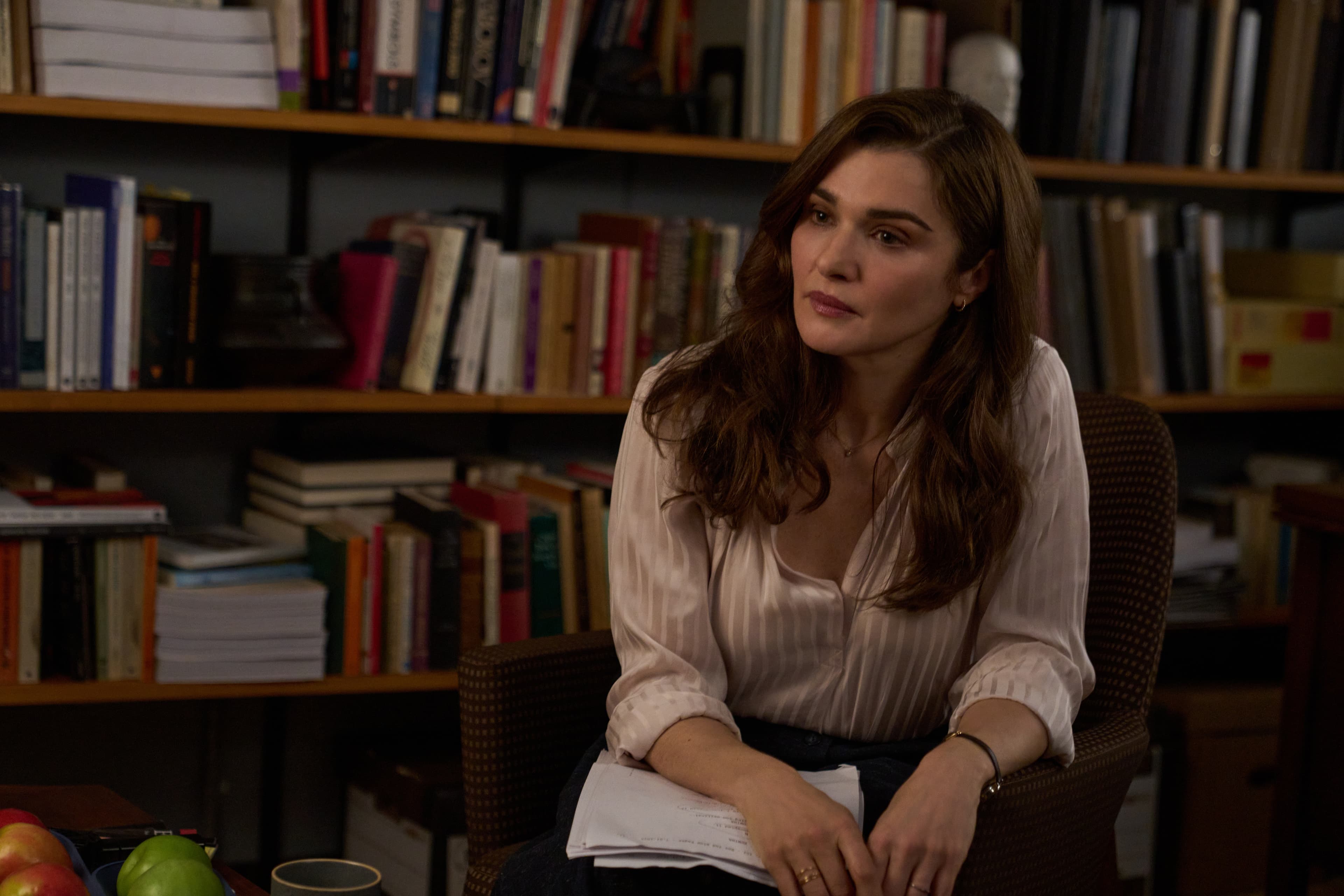
“Vladimir” may be one of the most literary TV shows in memory — but don’t take that to mean that it isn’t hot-blooded. Our unnamed protagonist, played by Rachel Weisz, is consumed by the idea that she’s a heroine of fiction — fueled by the literature she teaches as a college professor. And her sexual obsession with a colleague named Vladimir (played by Leo Woodall) plays out as a sort of metafiction, with her imagination running wild even as Vladimir sends signals that are mixed at best. It represents an escape from her vexed marriage to John (John Slattery), who’s facing potential discipline for an inappropriate relationship with a former student.
The Netflix limited series, out March 5, is based on a sensational 2022 novel by Julia May Jonas, a Brooklyn-based author and playwright. Jonas also created the series, writing and executive producing, bringing the book’s erotic charge and its sense of shifting reality to the streamer. “Vladimir,” the book, drew rave reviews for its ability to convey the inner life — and the pulsing erotic imagination — of a woman in late middle age. Writing for the screen for the first time, Jonas transfers that internal monologue into confessions that Weisz speaks aloud; the only caveat, of course, is that what Weisz’s character tells us may not in fact be true.
Jonas spoke to Variety about adapting her own work, the eerie feeling of life in small college towns — and why she rejects comparisons between this complex academic heroine and Cate Blanchett’s Lydia Tár.
No, I wanted it to be its own thing. I don’t want to be disingenuous; I’m aware that things get optioned. But in terms of the form of how I was writing the book — I like the form of a novel, and I wanted it to feel singular to itself.
It was really just assumed that I would do the adaptation. No one even asked me — because I come from theater, that was taken as a given, and I just didn’t correct anybody. It wasn’t something I had to actively advocate for.
The way the pilot got developed and got made was through scripts. I went out with the first one as a script, and then they commissioned a second episode, and that’s when they decided to do the series, based on my writing of it.
[In theater], you have to have a discipline to be concise. I always say that every single line of dialogue should be doing at least two things — hopefully three. You’re showing character, you’re moving action forward, and then you’re doing one more thing. You’re being funny.
One of the reasons that I got really interested in doing it is because we discussed this idea about her direct address having this different flavor than ones we’ve seen before. She was unreliable. Most direct addresses, like Shakespearean addresses, are where I’m turning to you and saying, This is the real truth. Here we have someone who is actually trying to spin the truth in front of you. There’s a bit of insecurity on the part of the viewer about whether she’s being straight with you or not, in the moments that she’s talking to you, or how deluded she is.
I hope that it is a slow burn, that feeling. Because you need to, at first, be on her side — you want to be inside of her experience. I’m most interested in how people lose perspective. That’s a fascinating thing when you can be so consumed with something that you can lose objective reality of what a circumstance is. I was really interested in how she loses perspective by virtue of not just her desire for Vlad but also the stress in her life.
I think she thinks of herself as a kind of literary heroine, so I wanted to have a world of ready references to support that — you know, “The Age of Innocence.” She’s desperate to have something happen, and that’s supported by her existing in the world of books. I also think there’s just so many generational differences in an academic setting, and I wanted to talk about generational differences in terms of relationships to sexuality and feminism and all of those kinds of issues. Depending on when you grew up, you had a very different experience of what those institutions were.
And all the shifts in power. At one point, it would be absurd to think that the professor was not the most powerful person in the room, but we absolutely feel like it isn’t. It is a reminder of your aging all the time to be around 18- to 20-year-olds, because, when we went to college, we were forming our identities and senses of self. And then you see these new people forming their identities. You still feel so close to that, but they’re clearly so much younger.
When you teach in a small college town, you are so conspicuous. You see people at the Target, and you are running into students in every aspect of your life. I’ve had that experience, and I know even more so from certain friends who have taught at very small universities and felt like they were in a fishbowl.
I get asked about this all the time — not necessarily this, but, you know, “50-year-old women are sexy now, what’s the trend?” When it comes to something like “Tár” — why is “Tár” not compared with “Maestro,” as opposed to “Vladimir”? That’s a story about a composer, and the pitfalls of their ego. What I’ve been interested in with “Vladimir” is: How can I present a complex hero of a story, have them have all the social circumstances of being a female in the world, but have them go on a tragic story and seek something they want?
Well, yeah — if Oedipus is.
This interview has been edited and condensed.


