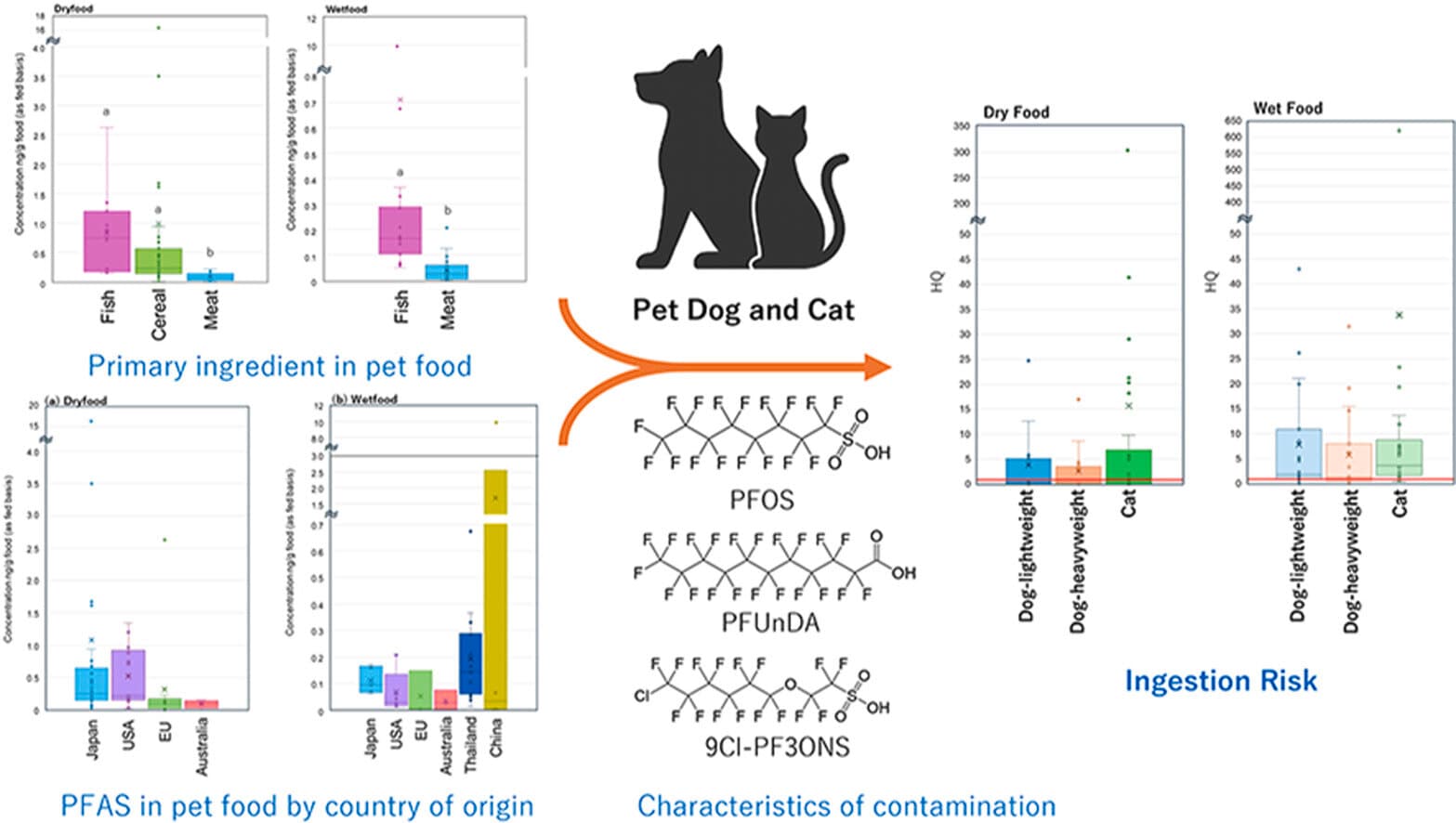
Ehime University investigators measured 34 per- and polyfluoroalkyl substances in 100 commercial dog and cat foods sold in Japan and detected PFAS across many products, with higher concentrations in fish-based foods and dry products, and higher estimated intake from wet products.
PFAS persists in the environment and appears in water, soil, wildlife, and humans worldwide. Companion animals share indoor environments with humans and can carry measurable PFAS in their blood. Pet food has been poorly assessed as a potential exposure route.
In the study, "Widespread PFAS contamination in pet food: Dietary sources and health risks to companion animals," published in Environmental Pollution, researchers analyzed 100 commercial pet food products sold in Japan to quantify 34 target PFAS and evaluate how concentrations and estimated exposure varied by product characteristics and feeding amounts.
Pet food purchases occurred in Japan between 2018 and 2020, covering 48 dog foods and 52 cat foods. Product selection was based on national import volumes and sales rankings. The sample set included both dry and wet formulations.
Measured PFAS concentrations varied widely across pet food products. Dog dry foods ranged from below the method detection limit to 1.7 ng per gram, with a median concentration of 0.2 ng per gram and a mean of 0.4.
Cat dry foods ranged from below the detection limit to 16 ng per gram, with a median of 0.18 and a mean of 1.0.
Wet foods showed lower concentrations, with the caveat of having higher serving sizes, which resulted in greater exposure. Dog wet foods ranged from below the detection limit to 0.67 ng per gram, with a median of 0.036 and a mean of 0.11.
Cat wet foods ranged from 0.021 to 9.9 ng per gram, with a median concentration of 0.11 and a mean of 0.56.
Ingredients stood out when products were grouped by the first listed. Fish-based products carried significantly higher total PFAS than meat-based products, while grain-based products also showed elevated levels with fish-derived secondary ingredients.
Estimated exposure rose for wet foods because recommended feeding amounts were larger, even when concentrations were higher in dry foods on an as-fed basis.
Species-specific toxicokinetic information for dogs and cats is limited and the screening relied on EFSA reference values derived for humans. Authors called for regulatory oversight and toxicological evaluation tailored to companion animals as sentinels of co-exposure in domestic environments.
Written for you by our author Justin Jackson, edited by Gaby Clark, and fact-checked and reviewed by Robert Egan—this article is the result of careful human work. We rely on readers like you to keep independent science journalism alive. If this reporting matters to you, please consider a donation (especially monthly). You'll get an ad-free account as a thank-you.
Kei Nomiyama et al, Widespread PFAS contamination in pet food: Dietary sources and health risks to companion animals, Environmental Pollution (2026). DOI: 10.1016/j.envpol.2026.127779
Citation: PFAS exposure greater in wet pet food, study suggests (2026, February 28) retrieved 2 March 2026 from https://phys.org/news/2026-02-pfas-exposure-greater-pet-food.html
This document is subject to copyright. Apart from any fair dealing for the purpose of private study or research, no part may be reproduced without the written permission. The content is provided for information purposes only.