
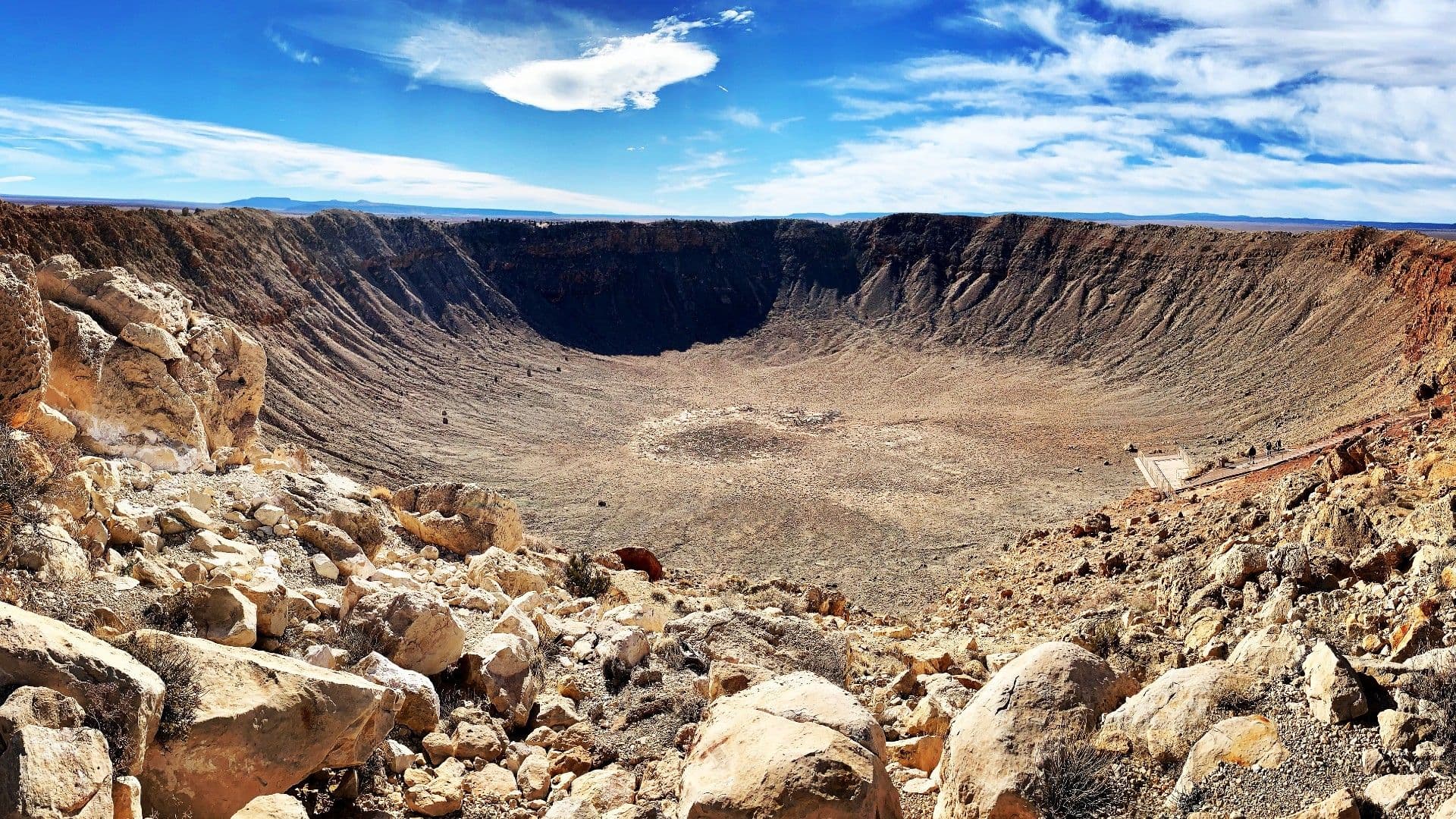
Arizona’s Meteor Crater, a dramatic scar etched into the desert landscape, and similar impact sites around the globe, are proving to be far more than just geological curiosities. They are invaluable repositories of information, offering scientists a unique window into the violent history of our planet and the broader solar system. These remnants of cosmic collisions continue to yield new secrets, underscoring the importance of ongoing research and study.
The Formation and Significance of Meteor Crater
The Meteor Crater, also known as Barringer Crater, formed approximately 50,000 years ago when a nickel-iron meteorite, estimated to be about 150 feet in diameter, slammed into the Arizona desert at a speed of roughly 26,000 miles per hour. The resulting impact excavated a massive crater, now measuring an impressive 700 feet deep (213 meters), over 4,000 feet across (1,219 meters), and 2.4 miles (3.9 kilometers) in circumference. Its exceptional preservation makes it the best-exposed and most studied meteor impact site on Earth, providing a rare opportunity to examine the immediate aftermath of such a cataclysmic event.
Why Meteor Crater Remains a Vital Research Site
Research scientist Dan Durda of the Southwest Research Institute (SwRI) in Boulder, Colorado, emphasizes the crater’s unique value. “Meteor Crater is the best-preserved and exposed impact crater on Earth,” Durda explains. “That makes it the perfect natural laboratory for impact crater studies. The crater is still providing new insights every year, so continued studies there are really important.” The accessibility and relatively undisturbed state of the crater allow scientists to directly observe and analyze the geological processes triggered by hypervelocity impacts, providing crucial data for understanding similar events on other planets and moons throughout the solar system.
The Barringer Crater Company and Supporting Research
The Barringer Crater Company (BCC), led by Christian Koeberl of the University of Vienna’s Department of Lithospheric Research, plays a vital role in facilitating this research. Koeberl chairs the BCC’s scientific advisory committee and has established grant programs to support students and early-career researchers focused on terrestrial impact craters. These grants aim to foster a deeper understanding of crater formation and encourage the next generation of scientists to pursue this critical field of study. Applications and awards are administered by The Meteoritical Society and are due by April 1.
The Challenge of Identifying Impact Craters on Earth
Identifying impact craters on Earth is a surprisingly difficult task. Unlike the relatively pristine surfaces of the Moon or Mars, Earth’s active geological and atmospheric processes – erosion, sedimentation, and tectonic activity – tend to obscure or erase the impact record over geologically short timescales. This makes it challenging to distinguish impact craters from other geological formations. As Christian Koeberl notes, “The recognition of impact craters on the Earth is difficult, because active geological and atmospheric processes on our planet tend to obscure or erase the impact record in geologically short time periods.”
Impacts and Their Profound Effects on Earth's History
Despite the scarcity of visible impact craters, scientists know that impacts have played a significant role in shaping Earth’s geological and biological evolution. Koeberl highlights the dramatic example of the Cretaceous-Paleogene (K-Pg) extinction event, approximately 66 million years ago, which marked the end of the dinosaur era. This event is widely attributed to a large asteroid impact in the Yucatán Peninsula, Mexico. “Despite limited information about the early impact record we know that impacts had severe effects on the geological and biological evolution on Earth,” Koeberl stated. “For example, a large impact event on Earth marks the transition from the Cretaceous to the Paleogene eras, about 66 million years ago.” The dinosaurs, Koeberl wryly observes, “literally had no chance.”
Identifying Impact Structures: Shock Metamorphism and Meteoritic Components
Identifying potential impact structures requires careful investigation. Researchers utilize morphological and geophysical surveys to detect anomalous subsurface features that might represent deeply eroded craters or entirely sediment-covered impact structures. Detailed investigations involve searching for “shock metamorphic effects” in minerals and rocks, and/or the presence of a meteoritic component within these rocks. Koeberl explains that “shock metamorphic effects are uniquely characteristic of shock levels associated with hypervelocity impact.” These effects, created by the extreme pressures and temperatures generated during an impact, are distinct from those produced by other geological processes.
The Growing Field of Impact Crater Studies
To date, approximately 200 confirmed impact craters have been identified on Earth. The field of impact crater studies has grown significantly in importance over the years, evolving into an interdisciplinary effort that draws on expertise from geology, physics, astronomy, and other fields. Koeberl encourages young researchers from around the world to submit grant proposals, emphasizing the need for continued exploration and understanding of these powerful geological events. “Impact crater studies have actually grown in importance over the years and are an interdisciplinary effort. We encourage young researchers from all over the world to submit grant proposals.”
- Meteor Crater is exceptionally well-preserved, offering a unique opportunity to study the immediate aftermath of a hypervelocity impact.
- Impact events have significantly shaped Earth's geological and biological history, including the extinction of the dinosaurs.
- Identifying impact craters on Earth is challenging due to erosion and other geological processes, requiring specialized techniques like shock metamorphic analysis.
- Ongoing research and international collaboration are crucial for expanding our understanding of impact cratering and its implications for planetary science.
About the Author: Leonard David
Leonard David is an award-winning space journalist with over 50 years of experience reporting on space activities. Currently serving as Space.com's Space Insider Columnist, he has authored numerous books on space exploration, including 'Moon Rush: The New Space Race' and 'Mars: Our Future on the Red Planet.' David has previously contributed to SpaceNews, Scientific American, and Aerospace America, and received the Ordway Award for Sustained Excellence in Spaceflight History in 2015.
Frequently Asked Questions
- How common are impact craters on Earth?
- While estimates vary, scientists believe that Earth has experienced many more impacts than the roughly 200 confirmed craters we've identified. Erosion, vegetation cover, and geological processes often obscure or erase evidence of these impacts over time, making them difficult to detect.
- What is 'shock metamorphism' and why is it important?
- Shock metamorphism refers to the unique changes in minerals and rocks caused by the extreme pressures and temperatures generated during a hypervelocity impact. Identifying these shock metamorphic effects is a key indicator that a geological feature is an impact crater, distinguishing it from other formations.
- Why is studying Meteor Crater important for understanding other planets?
- Meteor Crater provides a valuable terrestrial analog for studying impact craters on other planets and moons, like Mars and the Moon, where erosion is less prevalent. By understanding the processes that occur during and after an impact on Earth, we can better interpret observations of impact features elsewhere in the solar system.


