Formula 1's first race weekend with brand new cars and engines was a massive learning curve for everyone.
Here's what the Australian Grand Prix revealed about F1 2026, and where it was most surprising.
A new kind of racing to master
The energy regime is now king. It's now no longer enough to get ahead and stay there by the next corner to consolidate your position. Instead, you must get ahead and know the state of charge of your battery is sufficient to ensure your rival doesn't simply breeze back past.
Some have likened it to high-speed chess. Charles Leclerc says while it used to be "more about who is bravest at braking latest", now "there's more of a strategic mind behind every move".
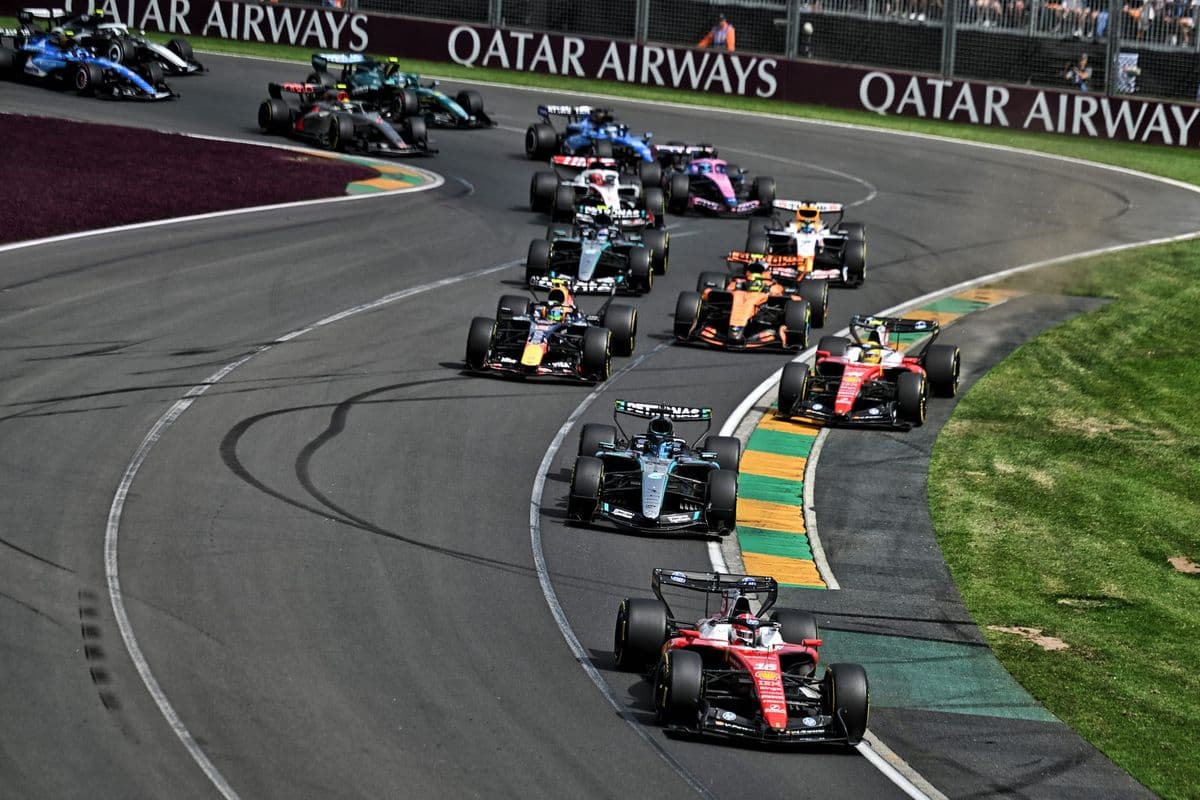
This made for a dramatic race in Australia. Leclerc and George Russell swapped positions multiple times while battling for the lead, but the Ferrari driver was effectively always ahead because of what Russell called a yo-yo effect.
The trouble is, as Red Bull team principal Laurent Mekies pointed out, it won't take long for teams to get on top of this and work out the ideal combination of timing, battery level and deployment strategy for a driver to get ahead and make it stick.
So don't expect too many more frenetic lead battles like Russell and Leclerc's.
Mercedes' rivals always feared it would turn things up for qualifying in Australia.
But the eight-tenths margin that Russell had in Q3 over the nearest non-Mercedes driver - Red Bull's Isack Hadjar - proved to be a surprise even to its customer teams.
With harvesting and deployment patterns laid bare in qualifying, the Mercedes works teams unlocked much more performance from better energy management.
And that, as Williams team principal James Vowles said, caught Mercedes' customers "off guard" because there seemed to be a knowledge gap in maximising these new power units.
There is no suggestion that Mercedes is giving its customers inferior equipment or software, but the flow of information is not as free as they anticipated...
Yes, we're just one race into the season yet F1 chiefs and teams are already considering changes to the 2026 rules after just one more race.
The season opener received a mixed response from drivers and fans, with the energy-starved engines and the "artificial racing" created as a result the key criticism.
F1 didn't want to make knee-jerk reactions before the first race, but it is now ready to introduce any urgent changes after the upcoming Chinese GP.
Those would be in place before round three at Suzuka at the end of March, and there's now likely to be a big April gap where further changes could be implemented, with the Bahrain and Saudi Arabia races likely to be cancelled.
Those changes could include increasing the potency of super clipping - when drivers are harvesting energy while on full throttle - as well as a potential decrease to the overall electrical power that can be deployed.
There's talk too of increasing the power of the internal combustion engine, taking F1 2026 further away from its theoretical 50/50 internal combustion engine and electrical energy split.
Arvid Lindblad produced one of the great F1 debuts, and not just because he became the third-youngest point scorer in F1 history behind Max Verstappen and Kimi Antonelli.
It made a mockery of questions about whether the 18-year-old had been promoted to F1 prematurely after a patchy single season in Formula 2.
He is the seventh driver to score points on debut over the past decade, which seems good if unremarkable, but what really caught the eye was how complete his weekend was.
Lindblad was fast from the off, and had a slight underlying pace advantage over more experienced Racing Bulls team-mate Liam Lawson even though he qualified behind after a problem on his sole Q3 lap.
He briefly jumped to third on the opening lap, before settling into the midfield pack, racing big names including Lewis Hamilton and Max Verstappen along the way.
Lindblad wasn't able to keep Ollie Bearman at bay, but held the Haas driver off for a long time and managed to stay ahead of Gabriel Bortoleto's Audi.
"I don't think I've really made any mistakes this weekend," said Lindblad after the race.
It was, by any measure, an outstanding start to his F1 career.
Audi enjoyed a point-scoring debut in F1 and the opening weekend suggests it can be a real factor at the front of the midfield in its maiden season as a works team.
But it still has work to do with a package that seems pretty brisk but not super reliable.
At least one R26 was in the top 10 in all but one of the weekend's sessions and Gabriel Bortoleto made it into Q3, which was great, but couldn't take part because his car stopped in the pits with a "technical issue".
Nico Hulkenberg was then unable to even take part in the race because of, again, a technical issue that prevented Audi having a genuine shot at a double-points finish in the grand prix.
Frustratingly, Audi is not communicating particularly openly, so the nature of its problems in Australia remains vague.
Hopefully that improves because this looks like a season in which Audi could have a good story to tell about its long-awaited F1 debut.
Honda could have lasted the race
The speculation that Aston Martin and Honda planned on doing the bare minimum in the Australian GP aged very poorly - although the reality still wasn't much to celebrate.
Not only did the two Aston Martins start the race, and complete more than a few laps, Lance Stroll was actually still running at the finish!
He wasn’t classified, though, as he only completed 43 of 58 laps due to some downtime in the garage while the team performed various checks.
Fernando Alonso retired early, after 21 laps, but this decision was made to save parts, not because something failed.
The countermeasures to mitigate the severe vibrations suffered in testing worked well enough that Aston Martin and Honda were actually "quite confident", in the words of Aston Martin chief trackside officer Mike Krack, that the cars could have lasted the whole race.
But they played it very safe because mileage is critical as they work through problems right now and any failures here could have stopped them doing anything meaningful in China.