A complete position breakdown on what you need to know before you draft
Mar 6, 2026 at 8:28 am ET • 12 min read
What is it that makes picking pitchers for Fantasy so tricky? In part, it's the injuries – upwards of 40% of pitchers go on the IL in any given season, and MLB data shows that, while the rate might be slowing down, it isn't reversing. Throwing a baseball 100 times at max effort once or twice a week just isn't something our elbows and shoulders are built to handle without bending and eventually breaking.
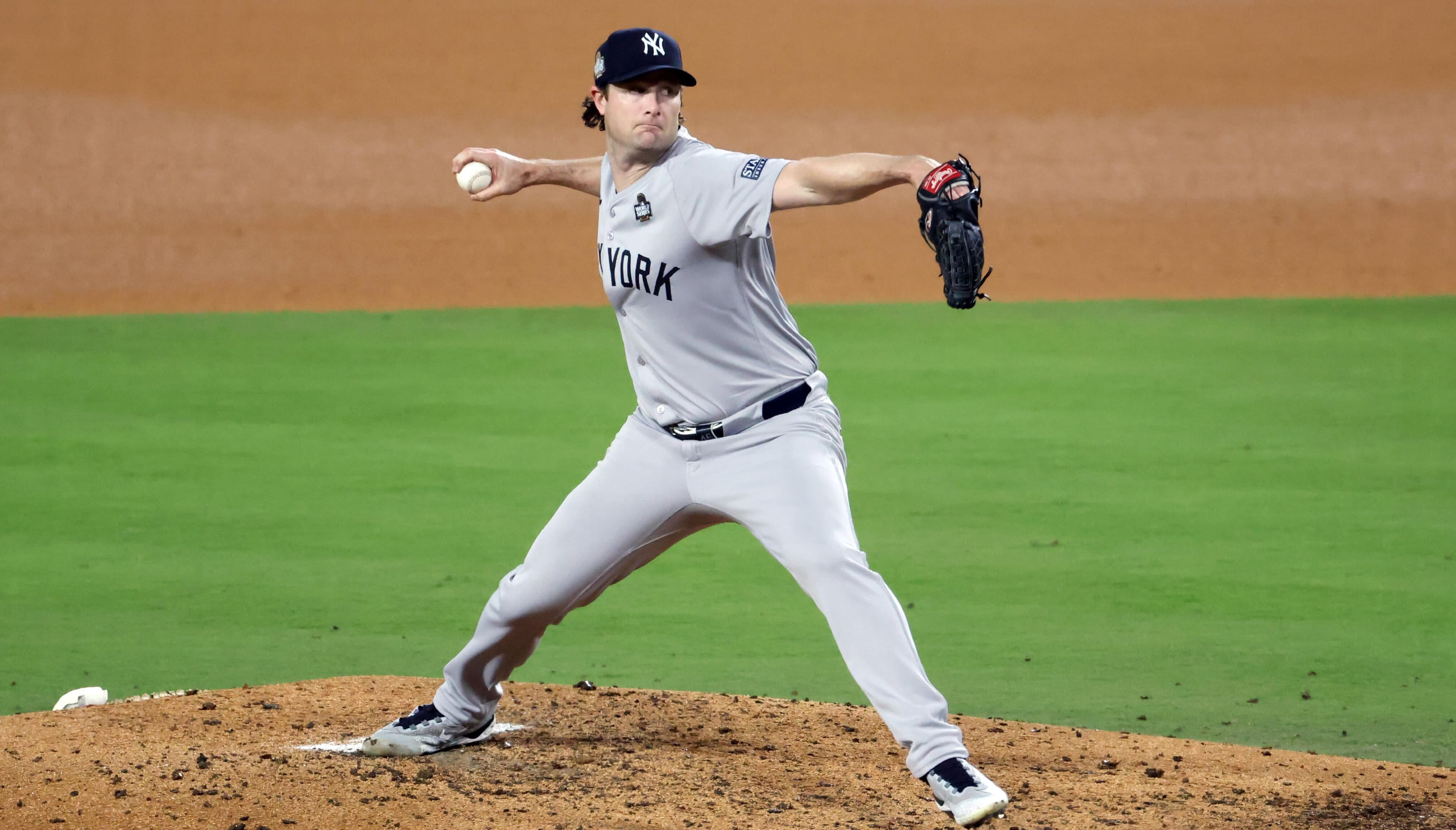
But it's not just the injuries. It's also that identifying pitcher talent is harder than with hitters. Pitchers only have so much control over how many outs they record; the highest qualifying strikeout rate in MLB history was Gerrit Cole's 39.9% mark in 2019, and he still needed the defense behind him to account for 49% of the outs he recorded. For a typical starter, that number is likely to be closer to 65-70% of their outs. An especially good defense, like the Cubs', can make their pitchers look a lot better than they actually are; a poor defense like the Nationals can be tough to overcome even for the best pitchers.
And then there's this: Pitcher talent is almost never static. Velocity fluctuates from one start to the next, and pitchers are constantly tweaking grips and arm angles and everything else to try to find the best way to attack hitters. Sometimes, guys will add a pitch and immediately level up, like when Logan Gilbert added the splitter in 2023 that has since become one of the best putaway pitches in baseball. Other times, pitchers will lose their feel for their best pitch and become less effective; it feels like Framber Valdez goes through this for a month or two every season with his curveball.
The best pitchers are the ones who have shown they can weather the various storms that come with the position for multiple seasons, and those guys tend to be the highest pitchers drafted every year. This season, that includes Garret Crochet, Paul Skenes, and Tarik Skubal, who have spent the past two seasons terrorizing hitters and have pushed their way into the first round in most drafts. Deservedly so.
After that, things get a lot messier. Research I did last spring shows that starting pitcher values tend to drop off at a linear rate for the first three rounds of drafts, and then it's just chaos; on average pitchers drafted in the fourth round from 2015 through 2024 return $20 or more in value just around 12% of the time; in the 10th round, it's about 10% of the time. Pitchers drafted in the 40 range of drafts generally offer better returns than those in the 10th round, but not nearly enough to justify the price difference.
This is what I've taken to calling "The SP Dead Zone." That's not to say you shouldn't take pitchers in the fourth, fifth, and sixth rounds, but that's the range of the draft where I need to feel like I'm getting a pretty obvious value to pull the trigger. Because history shows I'm not likely to get a better pitcher there than the ones I'll take around the 100th pick or later.
Why does that happen? I have some theories, and you can see them at play in this year's player pool. At the very top, we have those multi-year aces with (relatively) few recent injury question marks. And once Skenes, Crochet, and Skubal are off the board, you're immediately met with the likes of Yoshinobu Yamamoto, Cristopher Sanchez, and Bryan Woo, according to ADP – all good pitchers, but none of whom have multiple years of true ace production to their name. After them, you get Logan Gilbert (missed time with an elbow injury in 2025), Chris Sale (lengthy injury history), and Cole Ragans (missed significant time in 2025 with a shoulder injury).
Which is to say: None of those guys are perfect pitchers. That's not to say they don't deserve to be ranked where they are, but it is to say that there are big questions about all of them. They're all super talented and might be aces, but we don't have that multi-year track record of performance and health to bet on. And this year, we have an especially wide second tier, with the gap between SP4 and SP15 looking a lot smaller than ever before.
And that's also true for the tiers after them. I can probably get close to 50 names deep into the SP pool before I run out of pitchers I really like. Attrition will wreck a lot of that depth, but that's also a good reason to make sure you aren't paying a premium over and over. This year, more than ever, I'm content to just take the values at starting pitcher; the tiers are wide and comparable, so I just don't see much justification in consistently jumping ahead of ADP to get "My Guys" these days.
There's plenty of talent available as long as you don't totally neglect the position, so don't sweat it. You're gonna deal with injuries, and you're going to get some stuff wrong; so will your leaguemates. Why pay extra for the privilege?
- Position Previews: C | 1B | 2B | 3B | SS | OF | SP
- Position Tiers (v. 2.0): C | 1B | 2B | 3B | SS | OF | SP | RP
- Position Strategies: C | 1B | 2B | 3B | SS | OF | SP | RP
DET Detroit • #29 • Age: 29
You can't go wrong with any of the top three SPs, but Skubal's multi-year track record of excellence gives him the edge for me. It's consecutive 190-inning seasons with an ERA below 2.50 and a WHIP below 0.93; let's not overthink this too much. This is as good as it gets.
BOS Boston • #35 • Age: 26
Crochet managed 205.1 innings in 2025, a frankly stunning number for a guy with his history of injuries and workload limitations. Does it mean he'll do it again? Of course not, there are always ways for things to go wrong. But once you've shown you can get to 200 innings, that ceiling is in play, and the skill set here is nearly as good as Skubal's. Like I said, you can't go wrong.
PIT Pittsburgh • #30 • Age: 23
You can quibble about the win potential or the slightly smaller workload or lighter strikeout numbers, but that's all kind of silly when we're talking about a guy who opened his career with consecutive sub-2.00 ERA seasons. The margins between these top three SPs are tiny, and someone has to be third, but don't take that as a knock against Skenes. He should be a first-rounder in every draft, too!
LAD L.A. Dodgers • #18 • Age: 27
This is also a case where someone has to be the No. 4 SP, and Yamamoto has become the default choice. His absolute upside is never going to be as high as some of the guys behind him because he's going to be in a full-time six-man rotation, but he also seemingly carries a very high floor thanks to a stable mix of skills. He's not my No. 4 SP, and I don't think it makes sense to push his price much higher than the rest of this next tier of starters, but I don't think you're likely to be disappointed in Yamamoto, either.
SEA Seattle • #36 • Age: 28
Last year's flexor strain and slightly elevated ERA are red flags in the profile, but if Gilbert stays healthy, I think he's going to be a monster. The emergence and refinement of his splitter has taken his strikeout skills to the next level, and he has the upside to lead the league if he pitches 190 innings again, something he did in both 2023 and 2024. And his home park should help keep the ERA low at least half the time. Gilbert is my personal choice for SP4.
ATL Atlanta • #51 • Age: 36
The injury history is extensive, but it isn't as concerning as you might think – since his return from Tommy John surgery in 2023, Sale has gon on the IL just once with an arm injury. The skills have been remarkably consistent over the past two seasons, and his per-inning upside isn't far from the Big 3. He'll just do it for 20 fewer innings or so.
PHI Philadelphia • #61 • Age: 29
Sanchez dialed up his velocity without sacrificing control, shrugged off a forearm injury scare in April, and emerged as a legitimate ace. The per-inning strikeout rates are a step behind some of the other high-end pitchers, and he only really has the one season of pitching like an ace to go on. But his combination of a dominant sinker and changeup gives him a very high floor, and the ceiling can get pretty impressive too, as he showed in 2025. I'm worried about some regression, but not enough to actually fade him; he just isn't one of my targets.
SEA Seattle • #22 • Age: 26
I don't question the skills. He's the next in that Zack Wheeler/Brandon Woodruff lineage of guys with an unusual ability to throw both an elite four-seamer and sinker, which gives him an absurdly strong base on which to build the rest of his arsenal out from. The question is whether his mostly healthy 2025 season (he did deal with a lat injury late) puts all or most of the injury questions behind him. I want to believe that's the case here, but I'm not so convinced that I'm willing to pay his newly elevated price every time out.
HOU Houston • #58 • Age: 27
This is definitely the "Let's see you do it again" tier of SPs, and I am varying degrees of out on all of them. Brown does the "two good fastballs and a wide arsenal behind them" trick, but I'm not sure I buy the big jump in strikeout rate we saw from him in 2025 – his swinging strike rate didn't back it up, and we saw real regression in the second half. He's a very good pitcher, but I'm not sure I feel as comfortable with Brown as a true difference maker as some of the guys going behind him.
NYY N.Y. Yankees • #54 • Age: 32
Fried stayed healthy, and the Yankees rewarded him with the trust to pitch deep into games and the 19 wins that went along with it. You can't expect Fried to repeat those 19 wins, but his skill set remains remarkably stable. The history of so-far minor arm issues is a red flag here, but Fried feels very easy to project as long as he stays on the mound. But the ceiling is lower than with some other pitchers in this range.
TEX Texas • #48 • Age: 37
deGrom is going to be the poster boy for "velocity isn't everything" for a long time. He took 1.6 mph off his peak fastball velocity and managed to stay healthy for the first time since 2020. He wasn't quite as dominant as his best, but a sub-3.00 ERA and elite WHIP made up for what he lacked in strikeouts. deGrom still had the third-highest swinging strike rate in baseball, so there is probably a bit more strikeout upside he can unlock here. There is still some elevated injury risk, given the history, but it's more in the normal range than it has been for a long time for deGrom, and the strikeout upside makes him a fine target this year.
KC Kansas City • #55 • Age: 28
If you guaranteed every starting pitcher the same number of innings, I think Ragans might be every bit as good as those three guys at the top. Yes, he had an elevated ERA in 2025, but it came with a 2.67 xERA and 2.50 FIP with the best strikeout rate among starters. But Ragans has only ever reached even 140 innings once as a professional, and he missed most of last season with a shoulder injury, so the risks are obvious. If I'm waiting for my first starting pitcher, he's my favorite target, because at that point, it's all about upside, and few pitchers can match his.
SF San Francisco • #62 • Age: 29
He's the boring guy you settle for. Nobody is ever excited to draft Webb, despite what is usually a pretty good ERA, tons of innings, plus an elevated strikeout rate in 2025. The biggest problem is the 1.24 WHIP, which is a pretty big anchor in a Roto league, given the innings Webb usually contributes. But he's a legitimate ace in a points league, and he's a rock-solid option in Roto, albeit one whose limitations you do have to account for.
SEA Seattle • #68 • Age: 28