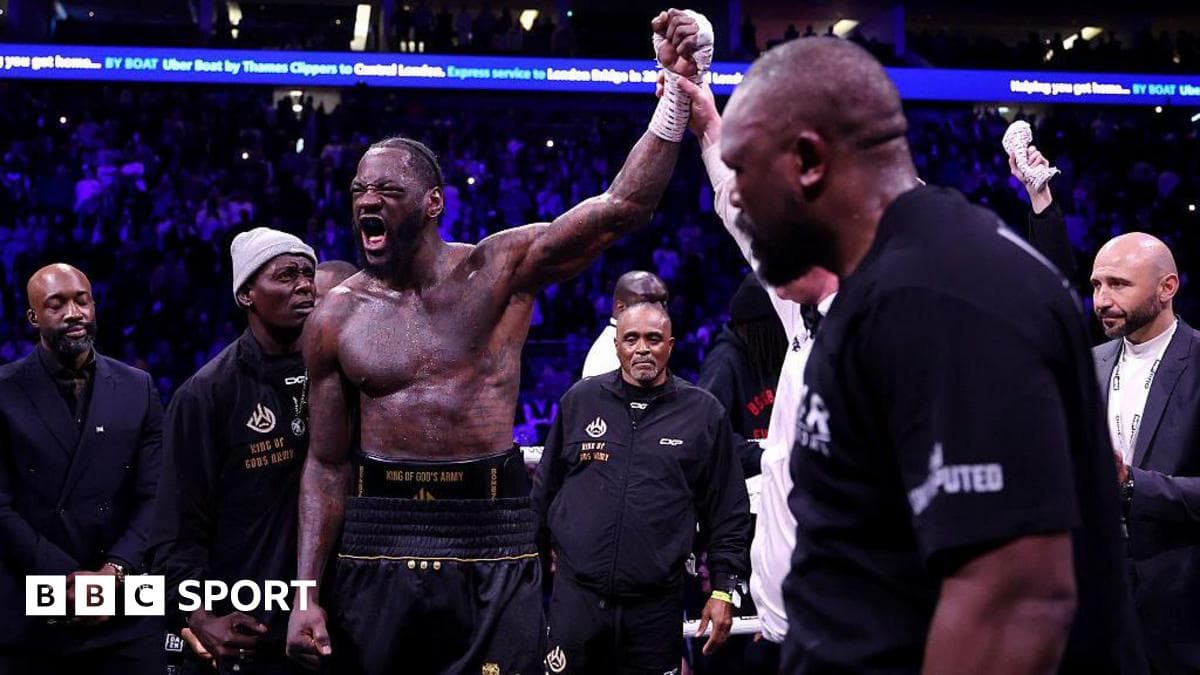
In a night of heavyweight drama that lived up to its billing, Derek Chisora—one of Britain’s most enduring and polarizing fighters—suffered a split-decision defeat to American rival Deontay Wilder in a brutal, chaotic 12-round war at London’s O2 Arena. The 42-year-old Londoner, who had announced this would be his final professional bout, was dropped in the eighth round and nearly stopped multiple times before rallying to survive the late rounds. Wilder, 40, was awarded the victory on scores of 115–111 and 115–113, while one judge scored the bout 115–112 for Chisora. The decision was contentious among fans and pundits, but the fight itself was undeniably unforgettable—chaotic, violent, and filled with moments that defied logic as both men staggered through the ropes in a clash that felt more like a survival test than a championship performance.
A Career Closes: Chisora’s Journey from Contender to Cult Icon
Derek Chisora’s career has been a study in contradictions: a fighter who never captured a world title but remained one of boxing’s most bankable attractions, a man whose resilience in the ring was matched only by his controversies outside it. Born in Harare, Zimbabwe, and raised in London, Chisora turned professional in 2007 and quickly established himself as a gatekeeper in the heavyweight division—facing and often defeating top contenders while falling just short against elite champions. His resume includes two world title challenges (against Vitali Klitschko in 2011 and 2012) and victories over respected names like Kevin Lerena and Razvan Cojanu, but it also features 14 professional losses, including defeats to Tyson Fury, Anthony Joshua, and Oleksandr Usyk.
The Late-Career Resurgence That Defied the Critics
For years, boxing observers questioned why Chisora continued to fight, especially after a 2010 conviction for assaulting his then-partner and a 2012 ban for biting an opponent during a weigh-in brawl with David Haye. Yet, in the twilight of his career, Chisora found unexpected late momentum. Between 2020 and 2023, he racked up wins over fringe world-level contenders like Christian Hammer and Kevin Lerena, proving that ring IQ and durability could still overcome declining physical tools. His 2023 victory over Hammer in Manchester drew over 700,000 pay-per-view buys in the UK, a testament to his enduring draw as a ‘gatekeeper’—a fighter who could sell tickets and fill arenas even without a title to his name. ‘He’s been a warrior in the ring,’ said former rival Dereck Chisora, ‘but his story is bigger than boxing.’
Controversy as a Second Career: Chisora’s Off-Field Legacy
Chisora’s public persona has always been as complex as his in-ring résumé. In 2010, he was convicted of assaulting his then-girlfriend and served a suspended prison sentence, a stain that followed him for years. The following year, he was suspended for biting Hasim Rahman Jr. during a weigh-in altercation. His feud with David Haye culminated in a pre-fight brawl in 2012 that saw both men trade punches in a broadcast studio, an incident that briefly overshadowed their anticipated rematch. Chisora’s unapologetic swagger and willingness to confront opponents—both in and out of the ring—earned him a reputation as a showman, but also a figure whose behavior at times eclipsed his achievements. ‘He’s a polarizing character,’ said Sky Sports analyst Johnny Nelson. ‘You can’t take your eyes off him, for better or worse.’
Wilder’s Final Statement: A Night of Reminders in a Fading Era
The Fight Itself: A 12-Round War Defying Logic and Expectations
From the opening bell, the fight defied conventional boxing logic. The first round saw both heavyweights become tangled on the ropes, trading wild punches while the referee’s instructions to break were ignored. A member of Chisora’s corner even climbed into the ring before order was restored—a bizarre moment that set the tone for a night of chaos. Chisora, fighting at the O2 for the 11th time, started sluggishly, his signature jab nearly invisible. But in the fifth round, he uncorked an overhand right that sent Wilder reeling, prompting a chorus of ‘uppercut!’ shouts from Anthony Joshua ringside. Wilder recovered, however, and began to impose his will, landing thunderous right hands that threatened to end the fight prematurely.
Chisora’s Eighth-Round Survival and Wilder’s Finishing Punch
The fight’s most dramatic sequence unfolded in the eighth round. Wilder connected with a right hand that sent Chisora crashing through the ropes, his legs nearly giving out as he beat the count at eight with glazed eyes. Wilder, docked a point for pushing, then spent the next four rounds stalking his opponent, landing power shots at will. Both men tumbled to the canvas again in the 11th round, though neither knockdown was officially scored. How Chisora survived to hear the final bell remains one of the most surprising moments in recent heavyweight history. ‘I had an adorable opponent,’ Wilder said post-fight. ‘I knew Derek was going to bring everything he had. In the ring, I saw his temple start to swell. I said, *You’ve got to live for your kids.* Too many lives have been lost in this ring. Nobody gives a damn about us. Us fighters have to look out for each other.’
The Wilder Paradox: A Fading Star or a Late Rebirth?
Deontay Wilder, once the most feared heavyweight in the world, has seen his stock plummet since his trilogy with Tyson Fury between 2018 and 2020. In that brutal rivalry, Wilder was floored five times and stopped twice, a humbling fall from grace for a man who had previously dominated the division with 43 first-round knockouts in 44 wins. Since then, Wilder has struggled to recapture his prime, losing to Fury, Joshua, and Luis Ortiz before rebounding with a knockout win over Robert Helenius in October 2022. This victory over Chisora—his first over a top-15 heavyweight since 2017—was a step back in the right direction, though it lacked the dynamism of his earlier years. ‘There were flashes tonight,’ said ESPN analyst Dan Rafael. ‘But the explosiveness isn’t what it used to be. Still, a win is a win, and Wilder proved he can still compete at a high level.’
What’s Next for Boxing’s Aging Warriors?
For Chisora, the writing appears to be on the wall. The 42-year-old has hinted at retirement multiple times before, only to return to the ring. But with this defeat, and after 50 professional fights spanning 17 years, the end seems inevitable. ‘I’ve given everything I have,’ Chisora said in the post-fight press conference, his voice hoarse. ‘This was my last dance.’ For Wilder, the path forward is less clear. At 40, with a record of 43-2-1, he remains a marketable name, and speculation has swirled about potential future bouts—including a proposed clash with former UFC champion Francis Ngannou, who made his professional boxing debut in 2023. A victory over Chisora keeps those possibilities alive, though Wilder’s camp has not confirmed any immediate plans. ‘I’m not done yet,’ Wilder told reporters. ‘I’ve got more fire left in me.’
- Chisora’s 50th professional fight marked the end of a British heavyweight’s iconic, if controversial, career that spanned 17 years and included battles with Klitschko, Fury, and Usyk.
- Wilder’s split-decision win over Chisora was his most impressive performance in years, reviving his profile in a division dominated by younger champions.
- The chaotic nature of the bout—including multiple knockdowns, referee interventions, and both men crashing through the ropes—overshadowed what was otherwise a competitive brawl.
- Chisora leaves the sport as a ‘gatekeeper’ who could fill arenas and sell tickets despite never winning a world title, while Wilder’s future may hinge on crossover opportunities or a final hurrah against elite competition.
The Cultural Impact: Chisora and Wilder as Boxing’s Last Wild Cards
In an era where heavyweight boxing is increasingly dominated by polished, technical fighters like Oleksandr Usyk and unified champion Tyson Fury, Chisora and Wilder represented the sport’s last true wild cards—men who thrived on chaos, controversy, and sheer physicality. Chisora’s ability to draw crowds, even in defeat, was unmatched among British heavyweights of his generation. Wilder, meanwhile, once carried the torch for American heavyweight boxing, filling stadiums in Las Vegas and London during his prime. Their rivalry, though brief, added a layer of unpredictability to a division that often feels scripted. ‘These are the kind of fights that keep boxing alive,’ said promoter Frank Warren. ‘You don’t get them every day. These men bring something different to the table.’
‘He’s been a warrior in the ring, but his story is bigger than boxing. Derek’s journey has been about resilience—both inside and outside the ropes.’ — Johnny Nelson, former cruiserweight world champion and Sky Sports analyst.
Key Takeaways: What This Fight Tells Us About Heavyweights Today
- Derek Chisora’s career reflects the paradox of the British heavyweight—unable to secure a world title but indispensable as a gatekeeper who could sell out arenas and draw casual fans.
- Deontay Wilder’s victory over Chisora, while not elite, suggests he may still have a role to play in the sport, whether against elite competition or in crossover bouts with athletes like Francis Ngannou.
- The chaotic nature of the fight underscored the physical toll of heavyweight boxing, where durability often outweighs skill in determining outcomes, especially in the later rounds.
- Both fighters leave legacies that extend beyond their win-loss records: Chisora as a cult icon and Wilder as a symbol of a fading but still dangerous era of American heavyweight boxing.
Frequently Asked Questions About Derek Chisora vs Deontay Wilder
Frequently Asked Questions
- Will Derek Chisora retire after this fight?
- Chisora has strongly hinted that this was his final professional bout, telling reporters in the post-fight press conference that ‘I’ve given everything I have.’ However, he has made similar statements before, so his retirement is not yet officially confirmed.
- Could Deontay Wilder still fight for a world title?
- While Wilder’s loss to Chisora was not a title fight, his recent victory keeps his name in the conversation for potential high-profile bouts. However, at 40, his window for a world title challenge appears to be closing.
- What was the most controversial moment in the Chisora vs Wilder fight?
- The first round saw both men become tangled on the ropes, trading punches while ignoring the referee’s instructions to break—a bizarre and dangerous start to a fight that set the tone for the chaos that followed.