The Los Angeles Lakers, long dismissed as a non-factor in the Western Conference despite rostering one of the NBA’s most dangerous offensive talents, have suddenly emerged as serious championship contenders. Luka Doncic, the Dallas Mavericks’ All-NBA superstar, has delivered one of the most dominant stretches in league history—averaging over 40 points per game during an eight-game winning streak that includes a 60-point explosion against the Miami Heat—while LeBron James has seamlessly transitioned into a leadership role, and DeAndre Ayton has rediscovered his form. The sudden transformation has silenced skeptics who questioned whether the Lakers could coalesce around their two ball-dominant stars, proving that the team’s offensive firepower may now outweigh its defensive liabilities.
The Luka Doncic Surge: A Historic Offensive Onslaught Transforms the Lakers
For much of the 2024-25 NBA season, the Los Angeles Lakers operated in the league’s periphery, overshadowed by the rise of Victor Wembanyama in San Antonio, the resurgence of the Detroit Pistons, and the chaos surrounding the Los Angeles Clippers. Yet lurking beneath the surface was a roster built to maximize one of basketball’s most unstoppable offensive forces: Luka Doncic, the 2023-24 MVP runner-up whose calculus-defying skill set has redefined the pick-and-roll era. For weeks, Doncic’s individual brilliance was undeniable, but the Lakers’ collective identity remained fragmented, leaving observers to question whether a team featuring two primary ball-handlers could ever reach its ceiling.
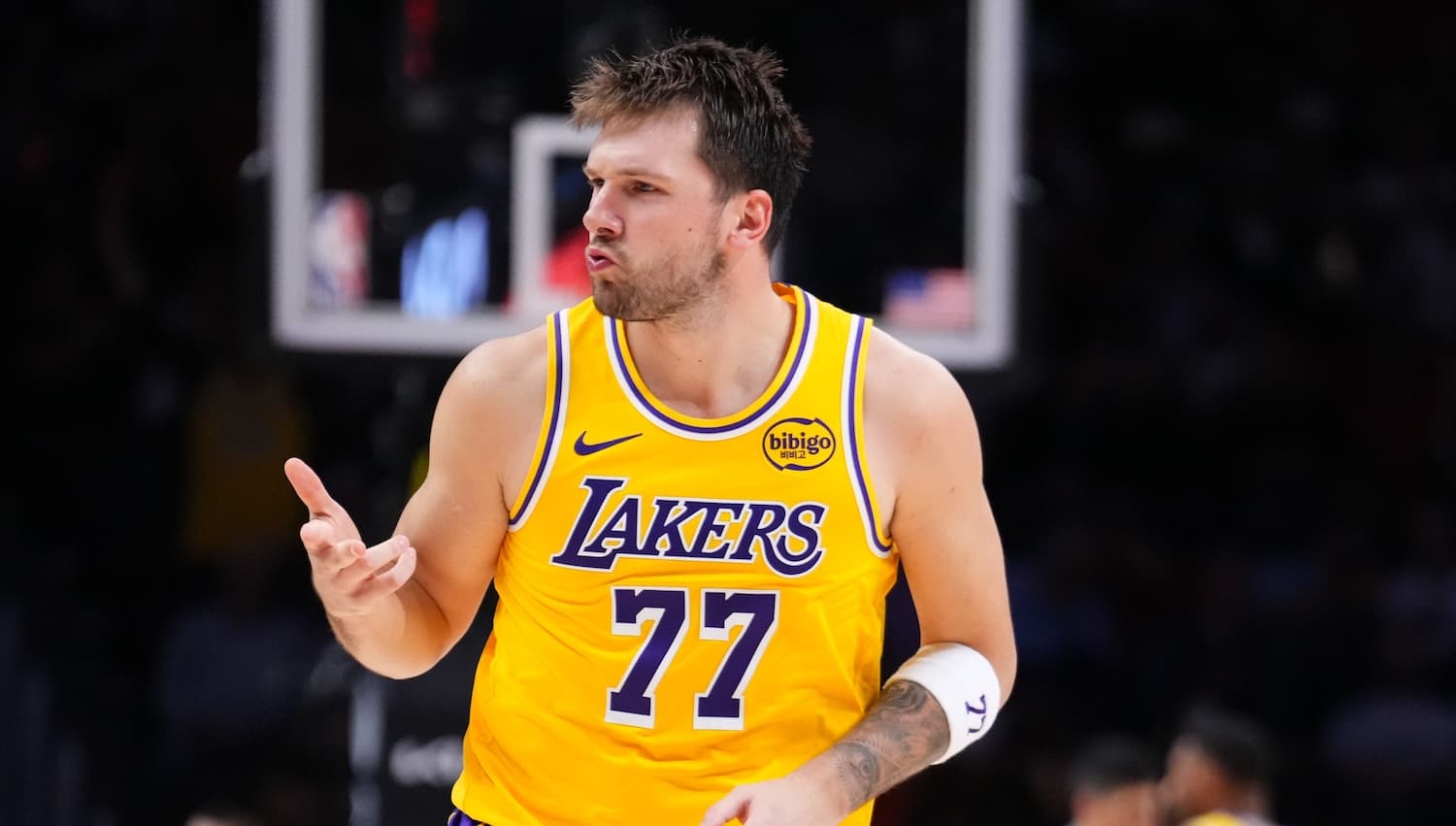
That all changed in early March. Over an eight-game stretch, Doncic has been nothing short of unstoppable, averaging 41.1 points per game while leading the Lakers to an undefeated record. His most recent masterpiece—a 60-point outburst against the Miami Heat on March 6—came just hours after landing in Florida at 5 a.m. following a cross-country flight, a feat that underscored his ability to dominate regardless of external distractions. Doncic’s performance wasn’t just prolific; it was surgical. He scored 60 points on 30 shots, a 50% shooting clip that defied conventional defensive schemes. Opponents have thrown everything at him—trapping, double-teaming, sagging off to prevent drives, and even targeting his weaknesses—but nothing has worked.
Why No Defense Can Contain Doncic’s Genius
The NBA has seen its share of transcendent offensive players, but few have mastered the art of making mediocre looks look unstoppable quite like Doncic. Against Miami, Heat guard Davion Mitchell, one of the league’s most tenacious defenders, managed to strip Doncic at the sideline and force a contested fall-away—only for the Mavericks’ star to swish the shot with ease. Such sequences highlight a fundamental truth: Doncic’s combination of size (6’7”), basketball IQ, and unparalleled feel for the game allows him to manipulate defenses into submission, regardless of their schemes.
His pick-and-roll partnerships with Austin Reaves have become a nightmare for opponents. Reaves, a rising star in his own right, thrives as Doncic’s screener, using his elite shooting gravity to drag defenders away from the paint. The Lakers’ offense, once bogged down by indecision, now flows seamlessly, with Doncic dictating tempo and Reaves providing secondary playmaking. Coach JJ Redick, a former NBA sharpshooter himself, has marveled at Doncic’s impact, noting that his gravity alone elevates the play of his teammates.
As great as Doncic has been, a critical element to the story of the Lakers' success over the past three weeks has been the team finally finding its ideal form. His patience, knowing he's going to get the ball and he's going to have transition opportunities and he's going to have plays called for him—JJ Redick, Lakers head coach
LeBron James’ Evolution: From Alpha to Architect in the Lakers’ Resurgence
The narrative surrounding LeBron James entering the 2024-25 season was one of uncertainty. At 39 years old, with his contract expiring and the Lakers mired in mediocrity, speculation swirled that James might finally exit Los Angeles. Yet instead of fading into retirement or chasing another ring elsewhere, James has embraced a role he has perfected throughout his career: the elder statesman who elevates those around him. His transition from primary ball-handler to secondary facilitator has been the key to unlocking the Lakers’ newfound chemistry.
James’ ability to adapt is unparalleled in NBA history. Unlike many aging superstars who struggle to cede control, James has thrived in a tertiary role, using his court vision and physical dominance to set screens, initiate fast breaks, and exploit mismatches. His efficiency has remained elite—in a recent win over Houston, James shot 13-of-14 from the field, including six dunks, showcasing how a pre-designed offense can maximize his strengths while minimizing his weaknesses.
The Psychological Shift: How James’ Sacrifice Fueled Teammates’ Breakout Moments
Austin Reaves, once an afterthought in the Lakers’ rotation, has blossomed into a borderline All-Star, in part because James’ willingness to defer has given him the freedom to operate. Similarly, DeAndre Ayton, long criticized for his effort and decision-making, has rediscovered his All-Star form under James’ influence. Ayton, who once demanded touches in crunch time only to mismanage them, has embraced a more defined role as a rim-running finisher and defensive anchor—a transformation he described as a moment of self-realization.
I just started looking in the mirror and said 'Yo bro, … you're not that guy. You don't need to be on this team doing that at all,' And I'm having fun with it, I'm not gonna lie.—DeAndre Ayton, Lakers center, after a 25-point, 12-rebound performance
DeAndre Ayton’s Redemption: From Frustration to Fully Realized Role
Ayton’s journey with the Lakers has been one of the most frustrating storylines of the season. Signed in the 2023 offseason as a high-upside big man capable of spacing the floor and protecting the rim, Ayton instead found himself squeezed out of closing lineups in favor of Jaxson Hayes and the ghost of Maxi Kleber, a center known more for his three-point shooting than his defensive presence. The lack of touches and role clarity led to visible frustration, with Ayton often looking disinterested or even sulking when the ball wasn’t in his hands.
But over the past month, Ayton has undergone a remarkable transformation. Under coach JJ Redick’s system, he has embraced a more physical, less flashy role—setting hard screens, rolling to the rim, and anchoring the defense. His effort level has improved dramatically, and his statistics reflect it: in the Lakers’ last 10 games, Ayton is averaging 14.2 points, 9.5 rebounds, and 1.8 blocks per game while shooting 62% from the field. His presence in the paint has allowed James and Reaves to operate with more freedom, while his rim protection has stabilized a defense that was once a major liability.
Ayton’s turnaround is particularly notable given the Lakers’ previous struggles to find consistent production from their frontcourt. The team’s front office, led by president of basketball operations Nico Harrison, made a calculated gamble by acquiring Ayton, hoping his size and athleticism would complement their star guards. That gamble is now paying off, proving that sometimes, the difference between a role player and a contributor is less about skill and more about fit.
Can the Lakers’ Offense Overcome Their Defensive Liabilities?
Despite the Lakers’ offensive firepower, their defensive frailties remain a glaring concern. Reaves and Doncic, while elite scorers, are not known for their defensive intensity. Reaves, in particular, has been a liability in pick-and-roll coverages, often gambling for steals that leave him out of position. Doncic, meanwhile, has long been criticized for his indifference to perimeter defense, a weakness that often rears its head in playoff series against teams with elite backcourts.
Historically, the Mavericks have struggled defensively in the playoffs, a trend that dates back to Doncic’s rookie season. However, there are reasons to believe the Lakers may buck that trend. Redick, a defensive-minded coach with a deep understanding of scheme, has implemented a system that prioritizes communication and effort. The Lakers have also added depth in the form of Marcus Smart, the 2022 Defensive Player of the Year, whose presence in the backcourt has provided a stabilizing influence.
Still, the question remains: can an offense capable of averaging 120 points per game offset the occasional defensive breakdowns that come with playing two non-traditional defenders in the backcourt? The answer may lie in the Lakers’ ability to scheme around their weaknesses. Redick has experimented with switching schemes and zone defenses, though the effectiveness of these adjustments remains to be seen in high-stakes moments. For now, the Lakers’ offensive brilliance has masked their defensive flaws, but the NBA playoffs are a different beast—and their ability to tighten up on that end of the floor will determine their ultimate ceiling.
The Western Conference Landscape: Where Do the Lakers Stand?
The Lakers’ sudden rise comes at a pivotal moment in the Western Conference, where the Oklahoma City Thunder, Denver Nuggets, and Minnesota Timberwolves are all vying for the top seed. The Thunder, led by Chet Holmgren and Jalen Williams, have been the league’s hottest team, while the Nuggets, despite injuries to Jamal Murray, remain a title contender thanks to Nikola Jokic’s generational playmaking. The Timberwolves, with Anthony Edwards and Karl-Anthony Towns rounding into form, are also legitimate threats.
Where the Lakers fit into this hierarchy is still uncertain. Their recent surge has catapulted them into the conversation, but their defensive inconsistencies and lack of a true third option beyond Doncic and Reaves could be liabilities in a seven-game series. That said, the Lakers’ offensive firepower is undeniable. Doncic, in particular, has shown that he can take over games in ways few players in NBA history ever have. If he can maintain this level of play while the rest of the roster continues to gel, the Lakers could be a formidable opponent in the playoffs.
The path to the Finals is fraught with challenges, but the Lakers now have a clear identity: they are a team built to score, with Doncic as the engine and James as the architect. Whether that’s enough to overcome the league’s deepest teams remains to be seen—but for the first time this season, the Lakers must be taken seriously.
Key Takeaways: Why the Lakers’ Recent Surge Matters
- Luka Doncic’s historic eight-game stretch, averaging over 40 points per game, has transformed the Lakers from a non-factor into a legitimate Western Conference contender.
- LeBron James’ seamless transition into a leadership role has unlocked the potential of Austin Reaves and DeAndre Ayton, proving that his ability to adapt remains unmatched.
- DeAndre Ayton’s breakout performance, characterized by a newfound commitment to defense and efficiency, has stabilized the Lakers’ frontcourt and provided a critical third option.
- The Lakers’ offensive brilliance—centered around Doncic’s pick-and-roll mastery—has so far outweighed their defensive liabilities, but their ability to tighten up on that end will determine their playoff fate.
- With the Western Conference more competitive than ever, the Lakers’ recent surge has thrust them into the title conversation, making them a team to watch in the coming months.
Frequently Asked Questions About the Lakers’ Resurgence
Frequently Asked Questions
- How has Luka Doncic’s recent performance changed the Lakers’ outlook?
- Doncic’s eight-game streak averaging over 40 points has propelled the Lakers from the NBA’s periphery into title contention. His offensive dominance has masked the team’s defensive flaws, making them a legitimate threat in the Western Conference.
- What role is LeBron James playing this season?
- James has transitioned from primary ball-handler to a secondary facilitator, using his court vision and physical dominance to elevate his teammates. His efficiency and leadership have been critical to the Lakers’ recent success.
- Is DeAndre Ayton finally living up to his potential with the Lakers?
- After a frustrating start to the season, Ayton has embraced a more defined role as a rim-running finisher and defensive anchor. His improved effort and statistics suggest he has rediscovered his form.