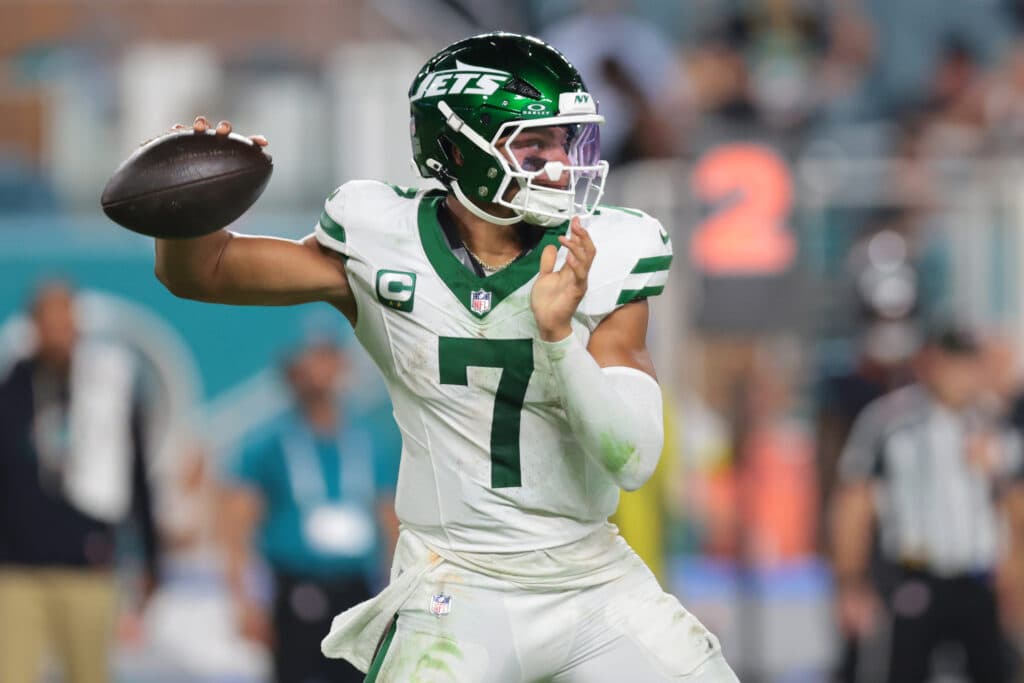
The New York Jets have officially closed the book on Justin Fields’ brief and tumultuous tenure as the team’s starting quarterback, finalizing a trade that sends the former first-round pick to the Kansas City Chiefs in exchange for a late-round draft asset. The deal, first reported by ESPN’s Adam Schefter and later confirmed by NFL Network’s Ian Rapoport and Tom Pelissero, marks the end of an era that lasted just nine games in New York—and sets the stage for a new chapter in Kansas City, where Fields will now serve as the insurance policy behind Patrick Mahomes as the two-time MVP continues his recovery from a torn ACL.
How the Justin Fields Trade Reshapes the Chiefs’ Quarterback Depth Chart After Mahomes’ Injury
The Kansas City Chiefs were in desperate need of a reliable quarterback after losing both of their top backup options in the span of a week. Veteran Gardner Minshew signed with the Arizona Cardinals as a free agent, while third-stringer Chris Oladokun was waived earlier in the month. That left Chiefs head coach Andy Reid with a roster void that needed to be filled quickly—and with Mahomes’ recovery timeline still uncertain, the urgency was palpable. Enter Justin Fields, who will now compete for first-team reps in Kansas City’s offseason program while Mahomes works through his rehabilitation.
Fields’ arrival in Kansas City comes with a significant financial advantage for the Chiefs, who entered Monday with just $10 million in cap space—a fraction of what the Jets had available. By taking on Fields at a reduced rate, Kansas City avoids overcommitting to a backup role while still securing a player who has starting experience at both the collegiate and professional levels. The Chiefs’ front office, known for its savvy roster construction, managed to add depth without mortgaging their financial future, a delicate balance in an era where quarterback play often dictates a team’s ceiling.
Fields’ Path to Becoming the Chiefs’ Primary Backup
Prior to Mahomes’ injury, the Chiefs had planned to lean heavily on Minshew as their No. 2 quarterback, but the Cardinals’ aggressive pursuit of the veteran changed the calculus. With Minshew now in Arizona and Jake Haener serving as the third-stringer, Fields will immediately step into a role where he can compete for first-team reps during offseason practices—a rarity for a recently acquired veteran who isn’t signed to a long-term deal.
Fields’ presence in Kansas City also provides the Chiefs with a dual-threat option who can contribute in both the passing and running games, a skill set that could prove valuable if Mahomes’ recovery extends into the regular season. While Fields has never been a traditional pocket passer, his ability to extend plays with his legs and make off-scheme throws could give Reid additional flexibility in game planning. The Chiefs’ coaching staff has already indicated that they will evaluate Fields’ readiness to step in as the primary starter if necessary, though such a scenario remains speculative at this stage.
Why the Jets Chose to Move On from Justin Fields After Just One Season
For the New York Jets, the decision to trade Fields was not just about performance—it was about financial flexibility and a clear path to a quarterback of the future. Fields, who signed a two-year, $30 million guaranteed deal last spring, struggled mightily in his nine starts for the Jets, averaging just 139.2 passing yards per game while posting a league-worst 6.2 yards per attempt. His inability to consistently deliver in the passing game, combined with public criticism from owner Woody Johnson and a coaching staff overhaul, made his long-term future in New York uncertain from the moment he took snaps under center.
The Rise of Geno Smith and the Jets’ New Quarterback Era
The Jets’ trade for Fields was made possible by their simultaneous acquisition of Geno Smith, who was brought back to New York in a cost-controlled deal that saw his 2026 compensation slashed to just $3.3 million. The move signaled a clear shift in the team’s quarterback hierarchy, with Smith now slated to compete for the starting job in training camp. While Smith’s career resurgence under head coach Aaron Glenn last season was impressive—he threw for over 4,000 yards and 22 touchdowns—Fields’ inability to replicate that success in 2025 left the Jets with little choice but to explore other options.
The Jets also saved $11 million in cap space by trading Fields, though they incurred $12 million in dead money charges, effectively neutralizing the financial benefit. Still, the move allowed New York to avoid the burden of paying Fields’ full $10 million salary in 2026, making him a more cost-effective option for the Chiefs as a backup. The Jets’ front office, led by general manager Joe Douglas, has prioritized flexibility in recent years, and the Fields trade is the latest example of that philosophy in action.
The Financial Breakdown: How the Trade Works for Both Teams
The trade structure is a textbook example of a cost-controlled move designed to benefit both parties. The Jets, who are retaining $7 million of Fields’ $10 million guaranteed salary for 2026, will absorb the remaining $3 million as part of the deal. In exchange, Kansas City receives a sixth-round pick in the 2027 NFL Draft, a late-round asset that provides long-term value without immediate roster strain.
Chicago’s Loss Is Kansas City’s Gain: Fields’ Journey from Draft Day to Backup Role
Fields’ career trajectory has been defined by instability, from being drafted by the Chicago Bears as the No. 11 overall pick in 2021 to his brief but turbulent stint with the Jets. Despite flashes of brilliance—including a rookie season where he rushed for over 400 yards and four touchdowns—Fields never fully established himself as a franchise quarterback. His time in New York was marked by inconsistency, culminating in a benching in favor of Tyrod Taylor and Brady Cook. Yet, Fields’ reputation as a high-ceiling talent and his preference to join the Chiefs suggest he remains a player with untapped potential.
What This Means for the Chiefs’ 2026 Season and Beyond
For the Chiefs, the addition of Fields is a calculated risk that could pay off if Mahomes’ recovery stalls or if injury strikes again. With a roster that includes tight end Travis Kelce, wide receiver Chris Olave, and a stout defense, Kansas City remains a Super Bowl contender even with uncertainty at quarterback. However, if Fields is called upon to start, the Chiefs will need to adapt their offensive scheme to maximize his strengths, which include elite athleticism and improvisational ability.
The trade also sets up an intriguing dynamic in the AFC West, where the Chiefs’ division rivals—including the Las Vegas Raiders and Denver Broncos—will now have to account for Kansas City’s revamped quarterback depth chart. Fields’ presence gives the Chiefs a safety net that few teams in the league possess, and his ability to step in and perform could be the difference between a deep playoff run and an early exit in 2026.
Key Takeaways from the Justin Fields Trade to the Chiefs
- The Jets traded Justin Fields to the Chiefs for a 2027 sixth-round pick, retaining $7MM of his $10MM 2026 salary to facilitate the deal.
- Fields joins Patrick Mahomes as Kansas City’s new QB2 after Gardner Minshew left for the Cardinals in free agency.
- The Jets’ move to acquire Geno Smith last week made Fields’ departure inevitable, as New York sought financial flexibility and a clear quarterback hierarchy.
- Fields averaged just 139.2 passing yards per game for the Jets in 2025, posting a career-low 6.2 yards per attempt and drawing public criticism from owner Woody Johnson.
- The Chiefs now have three viable quarterbacks on their roster—Mahomes, Fields, and third-stringer Jake Haener—with Fields positioned to compete for first-team reps in offseason practices.
Reactions and Fallout: How the NFL’s Quarterback Market Shifts After the Trade
The trade has sent ripples through the NFL’s quarterback market, particularly among teams in need of veteran depth. Fields’ preference to join the Chiefs—reported by Adam Schefter—suggests that his future as a starter may hinge on his performance in Kansas City, where he’ll have the opportunity to prove he can still be a franchise quarterback. Meanwhile, the Jets’ decision to move on from Fields so quickly underscores the volatility of the quarterback position in today’s NFL, where even high draft picks can flame out in a matter of months.
For the Chiefs, the trade is a low-risk, high-reward move that aligns with their philosophy of surrounding Mahomes with talent while maintaining financial prudence. The move also highlights the Chiefs’ depth at the position, a luxury few teams can afford. As the NFL continues to prioritize quarterback play, the Fields trade serves as a reminder that even the most talented players are not guaranteed long-term security in an era where results matter above all else.
Frequently Asked Questions About the Justin Fields Trade
Frequently Asked Questions
- Why did the Jets trade Justin Fields after just one season?
- The Jets traded Fields due to his inconsistent performance and his inability to live up to the expectations set by his $30 million guaranteed contract. With Geno Smith brought back at a reduced cost, New York saw no long-term future for Fields in their quarterback room.
- How much of Justin Fields’ salary is the Jets retaining in the trade?
- The Jets are retaining $7 million of Fields’ $10 million guaranteed salary for the 2026 season, making him a more cost-effective backup for the Chiefs. Kansas City will only be responsible for the remaining $3 million.
- What does this trade mean for Patrick Mahomes’ recovery timeline?
- The trade doesn’t directly impact Mahomes’ recovery from his ACL injury, but it provides the Chiefs with a high-upside backup who can step in if Mahomes is unable to play in 2026. Fields’ presence gives Kansas City added insurance as Mahomes rehabs.