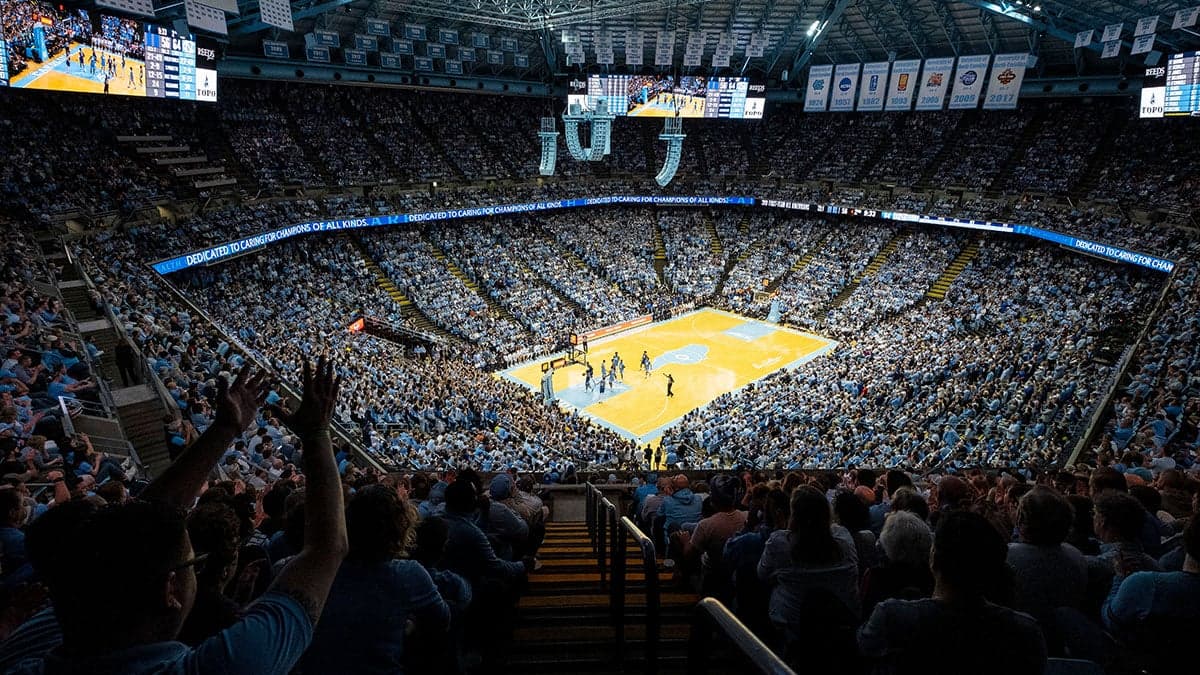
Three arena options have emerged as top contenders in the evolution of Carolina basketball, senior associate athletic director Rick Steinbacher told Jones Angell and Adam Lucas on the second episode of “The Arena Discussion” segment of the “Carolina Insider” podcast.
Those include renovating the Dean E. Smith Center and building a new arena at either Odum Village or the new campus expansion site in Carolina North.
Carolina has studied arena options for years, Steinbacher said, commissioning a host of agencies to help evaluate everything from fan experience to traffic flow, ticket sales and even where the team would have to play during a renovation.
The University worked with financial planning and architectural firms that build new arenas, as well as firms experienced in renovating old arenas, to gain as much information as possible. During the process, Carolina officials met with the University of Kansas about Allen Fieldhouse and the University of Kentucky about Rupp Arena — both, along with the Smith Center, considered among the sport’s most historic buildings — and the University of Texas about the Moody Center, which opened in 2022 as the new home of the Longhorns.
“We’ve talked to a lot of them. It’s helpful and informative, but nobody is Carolina basketball. Nobody is the University of North Carolina,” said Steinbacher.
Since 2022, the University has spent $1.3 million on studies to gather the information Steinbacher laid out this week.
“I think we’ve developed a good kind of charge or mission statement,” said Steinbacher. “Let’s do what’s best for Carolina basketball while maximizing what it provides to the Carolina athletics department and the University community. I think we’ve got a clear North Star.”
According to Steinbacher, the research is focused on finding the best arena option that meets six guiding principles:
- Deliver the premier basketball-first arena in the history of college sports
- Preserve the legacy and tradition of Carolina basketball
- Best-in-class training facilities for both men’s and women’s basketball programs
- Improve student seating for maximum in-game impact
- Revenue generation to fund and sustain the basketball program at an elite level while also supporting fielding 26 other sports in partnership with Carolina football
“The basketball program, student participation, our donor base and our fan base are key to where we’re headed,” said athletic director Bubba Cunningham. “So now we’re exploring with them, how do we fulfill this charge of ensuring the future success of Carolina basketball? There’s emotion, logic and finance. I think now we’re starting to get more to the logic and finance with everyone and sharing that information. If we’re doing a $600 to $800 million project, the University community has to be behind it. The students, alumni and season ticket holders. It’s the whole community.”
According to Steinbacher, seven options have been heavily considered in the studies, but three stand out in the discussions: Renovate the current Smith Center, build a new arena in Odum Village across from the hospital or build at the new Carolina North campus.
Renovation is the hardest to quantify, as it comes with numerous complicated decisions: Where will the team play during construction? Does it make more sense to play a few seasons in an alternate location? How much will temporary facilities cost?
“We’d have to operate with limited seating, limited resources, limited concessions,” Steinbacher said of keeping the team in the Smith Center during renovation. “There’d be a significant revenue cost to that, so you’re spending a lot of money on things that ultimately aren’t going to be in the finished product.”
In contrast, a new arena, whether at Odum Village or at the Carolina North campus, would be a blank canvas, so the University feels more confident in financial projections, construction timelines and their ability to offer premium fan amenities like multiple concourses and student tickets in the lower bowl.
What are the financials for the leading options?
Here is the financial breakdown of the different arena projects:
- Smith Center renovation: Around $591 million in total project costs; $4 million in annual net cash flow. This estimate does not include lost revenue during renovation.
- New arena at Odum Village: Around $703 million in total project costs; $25 million in annual net cash flow. This estimate does not include revenue generated from mixed uses adjacent to the new arena.
- New arena at Carolina North: Around $786 million in total project costs; $26 million in annual net cash flow. This estimate does not include revenue generated from mixed uses adjacent to the new arena.
- All financials are based on a number of assumptions and estimates and will continue to be refined by new information and projections.
- *Assumes fully honoring Permanent Seat Rights
- The University is continuing to evaluate what type of State Support may be attainable for each option.
- Renovate figures do not yet include lost revenue during renovation (reduced capacity, concessions, venue impacts).
- Odum Village, Friday Center and Carolina North figures do not yet include additional revenue that should be generated from an entertainment district and/or mixed-use net revenue (high with Carolina North, moderate with Odum Village and Friday Center).
Ticket sales play a major role in the long-term financials of all the options. The Smith Center currently boasts 21,750 seats and averages around 20,000 in attendance per game — the best attendance rate in the country.
A new arena is estimated to hold between 16,200 and 17,700 seats. Decreasing the total number of seats helps increase the fan experience, allowing for wider seats, premium seating, more leg room, more restrooms as well as upgraded, and more concessions. Steinbacher says some of those amenities can be added with renovation at the Smith Center but can be increased to a greater extent with a new arena.
Permanent seat rights, for donors who contributed to the original Smith Center built in the 1980s, account for 4,300 seats, with just more than half the lower bowl.
Endowment donors, the fans who bought into the Smith Center after it was built, make up 2,100 seats, 82% of which are in the lower bowl.
Longtime fans and donors will continue to play a vital role in the future arena – whether that’s a renovation or a new build. Weighing those seating needs alongside the desire to create more seats for students on the floor is a delicate balancing act.
A renovation of the Smith Center could alter seating configurations. If the seating configuration were to change, the general consensus is that permanent seat rights would be retained. In a new arena, original seats and seat rights will not transfer. A new arena will offer a variety of premium and general seating options, and The Rams Club will work with current seat rights holders to secure seating options that are best for them based on seating configuration and pricing.
Transportation is another key component. The North Carolina Department of Transportation was involved in studying the three main arena options to determine how quickly fans would be able to get to their vehicles and on their way home.
Egress time, the duration required for fans to exit the arena safely, was a key metric. The Smith Center currently has a 54-minute egress time, a new arena at Carolina North would have a 42-minute egress time and Odum Village would have a 35-minute egress time. All sites would have a mix of parking lots and decks.
Steinbacher said the University is currently in talks with stakeholders, trustees, donors, students and a player council of 11 former Carolina basketball players.
“I had someone comment to me that this is way different from the process they undertook when they moved from Carmichael to the Smith Center and that there were not quite as many voices involved,” said Steve Newmark, executive associate athletic director. “My response was that was also in the early 1980s, lots of things have changed since that time, so we’re adapting to the times as well.”
More information and ways to listen are available on the “Carolina Insider” page and on YouTube.