In a race that lived up to its reputation as one of cycling’s most grueling and unpredictable monuments, Tadej Pogačar delivered a masterclass in power and timing to claim the 2026 Tour of Flanders crown. The 27-year-old Slovenian, already a two-time Tour de France champion and multiple Monument winner, shattered the field on the final ascent of the Paterberg—Flanders’ most feared cobbled climb—to secure a commanding solo victory ahead of Dutch phenom Mathieu van der Poel and Belgian prodigy Remco Evenepoel. The race, held on a crisp April afternoon in and around the Flemish countryside, unfolded in dramatic fashion, with Pogačar’s tactical brilliance and explosive climbing ability proving decisive in the final 20 kilometers.
Tour of Flanders 2026: A Monument Rewritten with Pogačar’s Tactical Genius
Sunday’s edition of the Ronde van Vlaanderen—known affectionately as ‘De Ronde’—was not just another stop on the cycling calendar. It marked a pivotal moment in the 2026 Classics season, where the battle for supremacy among the sport’s elite riders reached a fever pitch. Pogačar, riding for UAE Team Emirates, had arrived in Flanders with a target on his back, having dominated early-season races and entered the event as the overwhelming favorite. Yet, as the peloton navigated the treacherous cobbled sectors and punishing climbs, it became clear that the 2026 edition would be anything but a procession.
The Rise of the ‘Big Three’: Pogačar, Van der Poel, and Evenepoel Define a New Era
The startlist for the 2026 Tour of Flanders read like a who’s who of men’s professional cycling, with four of the sport’s most electrifying talents taking the line: Tadej Pogačar, Mathieu van der Poel, Wout van Aert, and Remco Evenepoel. Together, these four riders—often dubbed the ‘Big Three’ (with van Aert rounding out the quartet)—have reshaped the landscape of modern road racing, combining explosive power, tactical cunning, and an almost supernatural ability to attack in the most unexpected moments. Their rivalry has become the defining narrative of the sport, with each Monument race serving as a stage for their latest chess match.
“He’s one level above all the rest.” — Mathieu van der Poel, after rejecting favorite status ahead of the race, acknowledging Pogačar’s perceived superiority in the lead-up to the 2026 Ronde.
Yet, van der Poel’s humility belied his own ambitions. The Dutch champion, a three-time Tour of Flanders winner himself, had arrived in Belgium with a point to prove after a frustrating spring campaign marred by mechanical issues and missed opportunities. His Alpecin-Premier Tech team, known for its aggressive, no-holds-barred approach, was determined to disrupt Pogačar’s dominance. Meanwhile, Remco Evenepoel—riding in his debut Tour of Flanders—had spent weeks preparing for the challenge, even going so far as to temporarily step away from social media to sharpen his focus.
“I deliberately got rid of my social media for two weeks.” — Remco Evenepoel, addressing the pre-race drama surrounding his surprise debut at the Ronde, emphasizing his commitment to the challenge.
Evenepoel’s decision to skip the traditional opener to the Classics season, Omloop Het Nieuwsblad, and instead opt for Flanders caught many by surprise. But the Belgian, riding for Red Bull-Bora-Hansgrohe, had made no secret of his ambition. “I wouldn’t be starting if victory wasn’t possible,” he declared in an interview ahead of the race, signaling his intent to make an immediate impact on the world’s most prestigious one-day event.
The Race Unfolds: Wave After Wave of Attacks, but No Breakthrough
From the neutral zone in Bruges to the first cobbled sectors of the Flemish Ardennes, the 2026 Tour of Flanders was a race of relentless motion. Riders launched attack after attack, only for the peloton to systematically reel them back in, a testament to the collective strength of the favorites and their teams. The headwind, which blew across the flat sections of the course, proved a formidable obstacle, sapping the energy of any breakaway attempts. For the first hour, the racing was frenetic but ultimately futile—each move swallowed by the chasing pack, led by teams like UAE Team Emirates, Ineos Grenadiers, and Visma-Lease a Bike.
The Break Finally Forms: A 12-Man Group Gains Momentum
After nearly 90 minutes of relentless attacking, a 12-man break finally managed to slip away, including riders from Movistar, Groupama-FDJ, and Tudor. The group built a lead that stretched beyond two and a half minutes, with UAE Team Emirates’ Nils Politt and Mikkel Bjerg marshaling the peloton in pursuit. The breakaway, however, was not without its drama. Belgian rider Jasper De Pooter, struggling to remove his overshoes amid the high pace, became a temporary symbol of the chaos that defines Flanders.
By the time the break reached the foot of the Oude Kwaremont—one of the race’s most iconic climbs—the gap had swollen to over three minutes. The peloton, now reduced to a select group led by Pogačar’s UAE squad and van der Poel’s Alpecin team, began to accelerate. The tension was palpable. Every rider knew that the decisive moment of the 2026 Ronde was approaching.
The Paterberg: Pogačar’s Masterstroke Seals the Victory
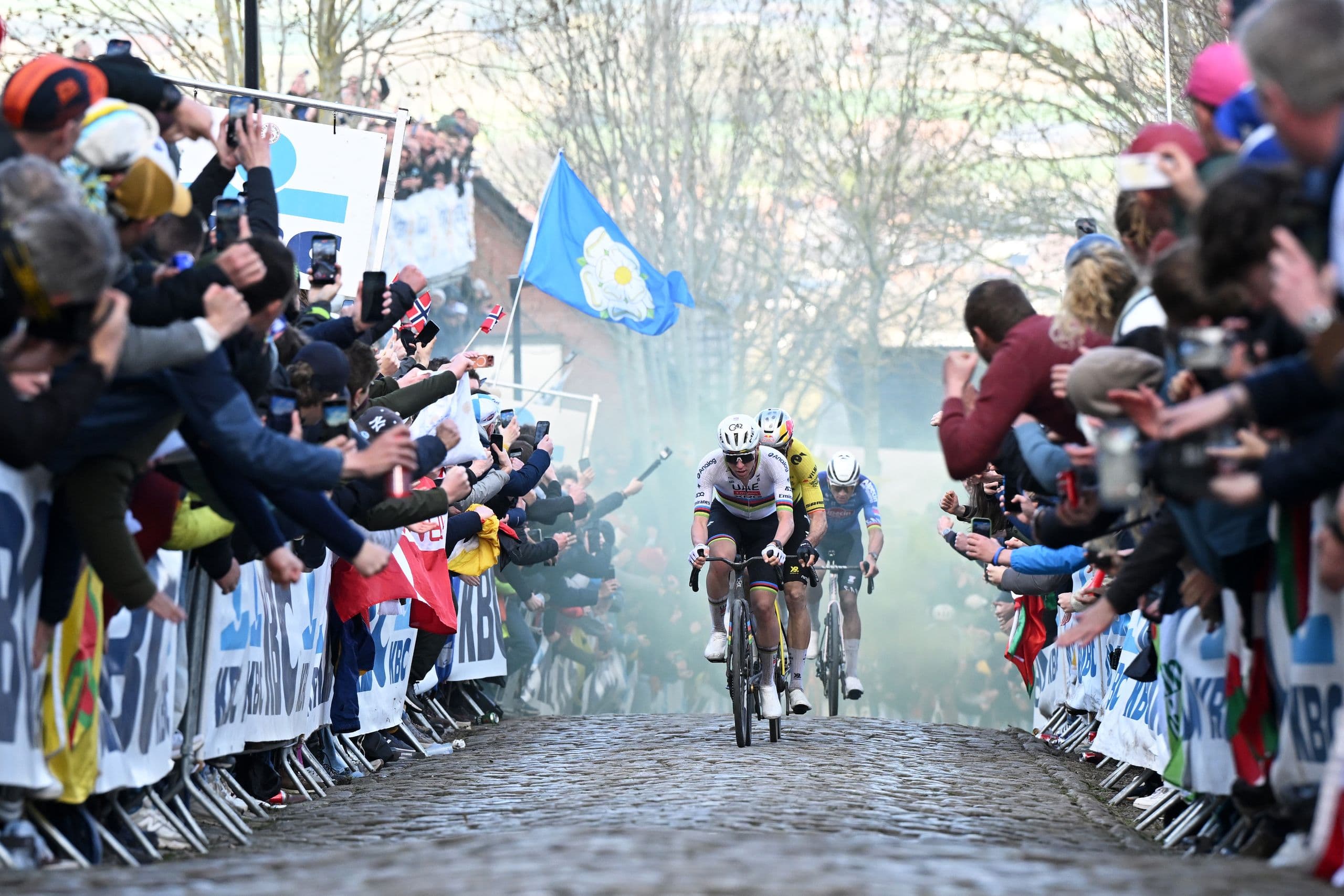
The Paterberg, a steep, short, and brutally uneven cobbled climb, has long been the graveyard of champions. In 2026, it became the stage for Pogačar’s coronation. As the peloton crested the Oude Kwaremont for the final time, the Slovenian launched a devastating attack, leaving van der Poel and Evenepoel gasping in his wake. With just 15 kilometers remaining, Pogačar rode away from the field with the ease of a man who had spent the entire race biding his time.
The gap ballooned. By the time Pogačar reached the summit of the Paterberg, his lead stretched beyond 40 seconds. The chase group, now a desperate trio of van der Poel, Evenepoel, and a fading Wout van Aert, could only watch as the rainbow stripes of the reigning world champion faded into the distance. Pogačar crossed the line alone, arms raised in triumph, his third Monument victory in as many years—a feat not achieved since the legendary Eddy Merckx in the 1970s.
Remco Evenepoel’s Debut: A Star Is Born in the Flemish Fields
While Pogačar’s victory dominated the headlines, Remco Evenepoel’s performance in his Tour of Flanders debut was the story that captured the imagination of cycling fans worldwide. The 24-year-old Belgian, already a double world champion in the time trial discipline, had entered the race as an unknown quantity in the cobbled Classics. By the finish, he had announced himself as a force to be reckoned with.
Evenepoel’s Early Attacks and Tactical Awareness
From the moment the race began, Evenepoel was a thorn in the side of the peloton. He launched multiple attacks in the early sectors, testing the resolve of his rivals and keeping teams like UAE Team Emirates and Alpecin-Premier Tech on the defensive. His unpredictability was noted by none other than Pogačar himself, who admitted in pre-race interviews that Evenepoel’s “random” attacks made him a wildcard in the tactical equation.
“He can attack in the most random places.” — Tadej Pogačar, reflecting on Evenepoel’s tendency to strike at unexpected moments during the race.
Evenepoel’s fifth-place finish—just 1 minute and 12 seconds behind Pogačar—was a statement. He bridged across to van der Poel’s group on the Paterberg, proving that he could match the best in the world on cycling’s toughest terrain. His performance not only announced his arrival in the cobbled Classics but also signaled the emergence of a new rivalry that could define the sport for years to come.
Mathieu van der Poel’s Relentless Pursuit of Greatness
For Mathieu van der Poel, the 2026 Tour of Flanders was another chapter in his ongoing quest to cement his legacy as one of cycling’s all-time greats. The Dutch champion, already a three-time winner of the Ronde, had endured a spring plagued by bad luck—mechanical failures, crashes, and missed opportunities. Yet, when the race reached its climax, van der Poel was there, pushing hard in pursuit of Pogačar, ultimately securing a hard-fought second place.
Van der Poel’s post-race demeanor was one of quiet satisfaction. He had led the chase group for much of the final 50 kilometers, dragging Evenepoel and a fading van Aert in his slipstream. His second-place finish was a testament to his resilience and tactical acumen, even if it fell short of his ultimate goal.
Wout van Aert’s Humility and the New Guard of Cycling
Wout van Aert, once considered the golden boy of the cobbled Classics, entered the 2026 Tour of Flanders in a more subdued role. The Visma-Lease a Bike rider, now 33, has transitioned from the sport’s prodigious young talent to a seasoned veteran, a role he embraces with characteristic humility. In interviews ahead of the race, van Aert downplayed his own chances, stating bluntly: “I don’t consider myself in the big four.” His ninth-place finish, while not the result he might have hoped for, underscored the shifting dynamics of professional cycling—a sport now dominated by a new generation of superstars.
Why the 2026 Tour of Flanders Matters: A Turning Point for Cycling’s Future
The 2026 Tour of Flanders was more than just a race; it was a cultural moment for professional cycling. The clash between Pogačar, van der Poel, and Evenepoel—three riders who represent the pinnacle of power, endurance, and tactical brilliance—has captivated fans and pundits alike. Their rivalry has injected new energy into the sport, drawing comparisons to the golden eras of Merckx, Hinault, and Anquetil. Yet, unlike those legendary duels, this one is playing out in an era of unprecedented media coverage, global fandom, and commercial growth, ensuring that every twist and turn of their battles is scrutinized by millions.
The 2026 Ronde also highlighted the increasing professionalization of cycling. Teams like UAE Team Emirates, Red Bull-Bora-Hansgrohe, and Alpecin-Premier Tech have invested heavily in data analytics, nutrition science, and athlete development, creating an environment where marginal gains can mean the difference between victory and defeat. Evenepoel’s debut, in particular, underscored the sport’s global appeal, with the Belgian’s rise mirroring the growing influence of riders from outside the traditional cycling strongholds of Western Europe.
- Tadej Pogačar secured his first Tour of Flanders victory in dominant fashion, attacking on the Paterberg to claim a solo win ahead of Mathieu van der Poel and Remco Evenepoel.
- Remco Evenepoel announced himself as a force in the cobbled Classics with a fifth-place debut, proving he can compete with the sport’s elite on cycling’s toughest terrain.
- Mathieu van der Poel, despite a spring plagued by bad luck, delivered a strong second-place finish, reaffirming his status as a Monument specialist.
- The 2026 Tour of Flanders marked a generational shift, with Pogačar, van der Poel, and Evenepoel defining a new era of rivalry that has captivated global cycling fans.
- The race underscored the increasing professionalization of cycling, with teams leveraging data, science, and strategic precision to gain an edge.
What’s Next for the ‘Big Three’? A Look Ahead to Paris-Roubaix and Beyond
With the 2026 Tour of Flanders in the books, the cycling world now turns its attention to the next major test: Paris-Roubaix. Held just one week later, the ‘Hell of the North’ is the final Monument of the spring Classics season and a race tailor-made for the strengths of Pogačar, van der Poel, and Evenepoel. Pogačar, with his explosive power and climbing ability, could thrive on the cobbled sectors, while van der Poel’s aggressive style and Evenepoel’s all-round versatility make them serious contenders on the uneven pavé.
Beyond Roubaix, the focus will shift to the Grand Tours. Pogačar, already a two-time Tour de France champion, will likely target the 2026 Tour as his next major goal, while van der Poel and Evenepoel may look to the Vuelta a España or the World Championships in Glasgow later in the season. Regardless of the outcome, one thing is certain: the rivalry between these three riders will continue to shape the sport for years to come.
Key Takeaways from the 2026 Tour of Flanders
- Pogačar’s tactical brilliance and climbing prowess secured him a commanding solo victory on the Paterberg, his third Monument win.
- Evenepoel’s fifth-place debut announced his arrival in the cobbled Classics, proving he can compete with the sport’s elite.
- Van der Poel’s resilience shone through with a strong second-place finish, reaffirming his status as a Monument specialist.
- The 2026 Ronde highlighted the generational shift in cycling, with Pogačar, van der Poel, and Evenepoel defining a new era of rivalry.
- The race underscored the increasing professionalization of the sport, with teams leveraging data and strategic precision to gain an edge.
Frequently Asked Questions About the 2026 Tour of Flanders
Frequently Asked Questions
- How many Tour of Flanders titles has Tadej Pogačar won?
- Tadej Pogačar claimed his first Tour of Flanders title in 2026, adding to his growing tally of Monument victories alongside his two Tour de France wins.
- Did Remco Evenepoel compete in his first Tour of Flanders in 2026?
- Yes, Remco Evenepoel made his Tour of Flanders debut in 2026, finishing fifth in a strong showing that announced his arrival in the cobbled Classics.
- Who are the ‘Big Three’ in professional cycling in 2026?
- The ‘Big Three’ in 2026 refers to Tadej Pogačar, Mathieu van der Poel, and Remco Evenepoel, three riders who have dominated the spring Classics and reshaped the landscape of modern road racing.