
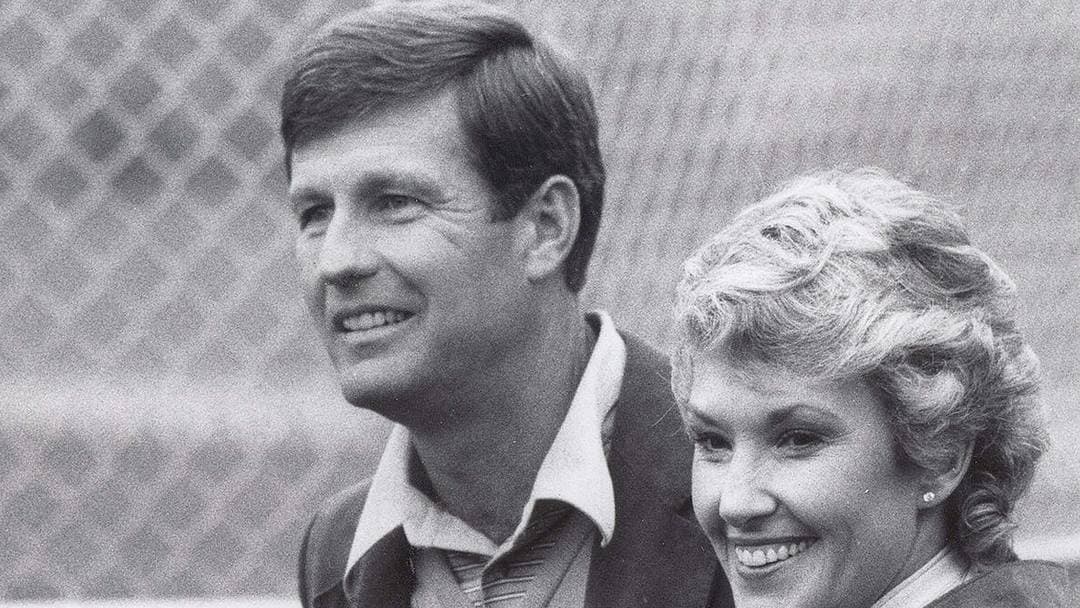
Days before his death, John seemed to know the end was near. After missing the Yankees' Old-Timers' Day on August 8, he posted a farewell to fans on social media: "I will never forget you."
The Surgery That Changed Baseball Forever
In 1974, at age 31, John suffered what was then considered a career-ending injury: a torn ulnar collateral ligament in his left pitching elbow. He faced a stark choice, described years later by his surgeon, Dr. Frank Jobe: go back to Terre Haute, Indiana, or gamble on an operation with a high risk of failure.
Jobe put the odds of success at 1 in 100.
On September 25, 1974, during a four-hour procedure, Jobe drilled holes in the humerus and ulna bones of John's left arm and anchored a tendon in a figure-eight pattern. Recovery was brutal. John's left hand was shriveled at first, and he lacked feeling in several fingers from damage to the ulnar nerve, requiring a second procedure to reroute it. His arm spent four months in a cast.
By spring training of 1975 he had full range of motion. He spent that season rebuilding strength and learning a new grip with the help of teammate Mike Marshall, who held a doctorate in kinesiology.
Then "The Bionic Man" pitched 14 more seasons and won 164 more games.
From 1-in-100 Gamble to Baseball Routine
The procedure that bears his name is now commonplace. Roughly 80% of pitchers who undergo Tommy John surgery return to their previous level or better, according to Dr. Neal ElAttrache, the Dodgers' lead physician, and the American Medical Association estimated in 2024 that about 35% of active major league pitchers have had the operation.
The list of stars saved by the surgery reads like an All-Star roster: Shohei Ohtani, Tarik Skubal, Justin Verlander, Chris Sale, Gerrit Cole and Jacob deGrom, twice.
"The first thing that comes to mind is just how much of a trail blazer he was and what great perseverance he had," said Cole, who had the procedure in 2025. John, he said, ventured "into the unknown" and wrote "the script for how to push through it and overcome it."
"If you put it in dollars and cents, I think there's no question that Tommy John is the most valuable reconstructive procedure there is," ElAttrache said in 2024.
John himself gave the credit away. "Thanks to Dr. Jobe, who saved my arm & made it possible for me to continue pitching," he wrote in his August 8 farewell. "That surgery has since gone on to save the careers of countless pitchers, including many of the very best in the game today."
A Career the Surgery Overshadowed
The Yankees made a point of it in their tribute: the surgery's fame eclipsed just how good the pitcher was.
"While his incredible longevity and post-surgery achievements changed the fortunes and trajectory of countless athletes around the world, it also overshadowed his excellence as a pitcher," the team said, remembering him as "a bedrock of our rotation" and praising "his competitiveness and skill, his penchant for conversation, his kind and gracious nature, and his stature as an athletic and medical pioneer."
The numbers back it up. John finished 288-231 with a 3.34 ERA and 2,245 strikeouts across 26 seasons, tied for third-most seasons in MLB history. Among left-handers all time, he ranks second in starts (700), third in innings (4,710), fifth in shutouts (46) and seventh in wins.
He won 20 games three times: 20-7 with the Dodgers in 1977, 21-9 with the Yankees in 1979 and 22-9 in 1980. He made three straight All-Star teams from 1978 to 1980 and finished runner-up for the Cy Young Award twice, in 1977 and 1979, without ever winning it.
His longevity produced one stat that may never be matched: he was the Opening Day starter for the 1966 White Sox and the 1989 Yankees, 23 years apart.
The Championship That Got Away
John reached the World Series three times, with the Dodgers in 1977 and 1978 and the Yankees in 1981, compiling a 2.67 ERA in those series. He never won a ring. In a twist of fate, all three losses came against the Dodgers or the Yankees, the two franchises he starred for.
His 288 wins are the second-most of any pitcher since 1900 not elected to the Hall of Fame. He spent 15 years on the ballot from 1995 through 2009, never topping 31.7% of the vote, far short of the 75% needed. The Hall did honor John and Jobe together in 2013 for their contributions to the game, and in June 2022, John donated the original cast from his surgery to the Smithsonian Institution, signed by his 1974 Dodgers teammates, Jobe and announcer Vin Scully.
Tommy John From Terre Haute, Indiana
Born Thomas Edward John Jr. on May 22, 1943, in Terre Haute, Indiana, he starred in baseball and basketball at Gerstmeyer High and graduated as valedictorian in 1961, though he did not give the commencement speech because of a stutter. Recruited by Kentucky to play basketball, he chose baseball and signed with Cleveland, debuting in the majors in 1963.
In his final message to fans, John shared the words his father gave him the day he left home: "Whether you make it big in the big leagues or you don't, you'll always just be Tommy John from Terre Haute, Indiana. I've never forgotten those words."
After his playing days, John broadcast for the Minnesota Twins and Yankees in the 1990s and managed the Bridgeport Bluefish from 2007 to 2009. His later years brought health battles, including a COVID-19 hospitalization in December 2020 and Guillain-Barré syndrome that left him paralyzed in his lower extremities for several months.
John is survived by his second wife, Cheryl; his children Tamara, Tommy III and Travis; and son-in-law Patrick Mannelly, a retired NFL long-snapper who played 16 years for the Chicago Bears. His son Taylor died in 2010 at 28. His oldest son, Tommy III, became a chiropractor and wrote a book on protecting young athletes from the kind of major surgery his father endured.
The Tributes
The Dodgers honored John with a pregame video and a moment of silence before Sunday's game.
"Tommy was an exceptional pitcher throughout his career in Major League Baseball, and his courageous role in becoming the first to have surgery that would go on to bear his name can't be overstated," Dodgers president and CEO Stan Kasten said. "His impact both on and off the field has been felt by ballplayers of all ages and will be for generations to come."
Frequently Asked Questions
- How did Tommy John die?
- No cause of death was announced. John, 83, died Saturday at his home in Bradenton, Florida. He had been in hospice and was diagnosed with bladder cancer and other ailments in recent years.
- What is Tommy John surgery?
- Ulnar collateral ligament reconstruction, first performed on John by Dr. Frank Jobe in 1974. A tendon is anchored through holes drilled in the elbow bones in a figure-eight pattern. Recovery typically takes 12 to 18 months.
- How good was Tommy John as a pitcher?
- He won 288 games with a 3.34 ERA over 26 seasons, made four All-Star teams, won 20 games three times and twice finished runner-up for the Cy Young Award.
- Is Tommy John in the Hall of Fame?
- No. His 288 wins are the second-most of any pitcher since 1900 not elected. He peaked at 31.7% of the vote during 15 years on the ballot.
- Which current stars have had Tommy John surgery?
- Shohei Ohtani, Tarik Skubal, Justin Verlander, Chris Sale, Gerrit Cole and Jacob deGrom, who had it twice. About 35% of active MLB pitchers have undergone the procedure.


