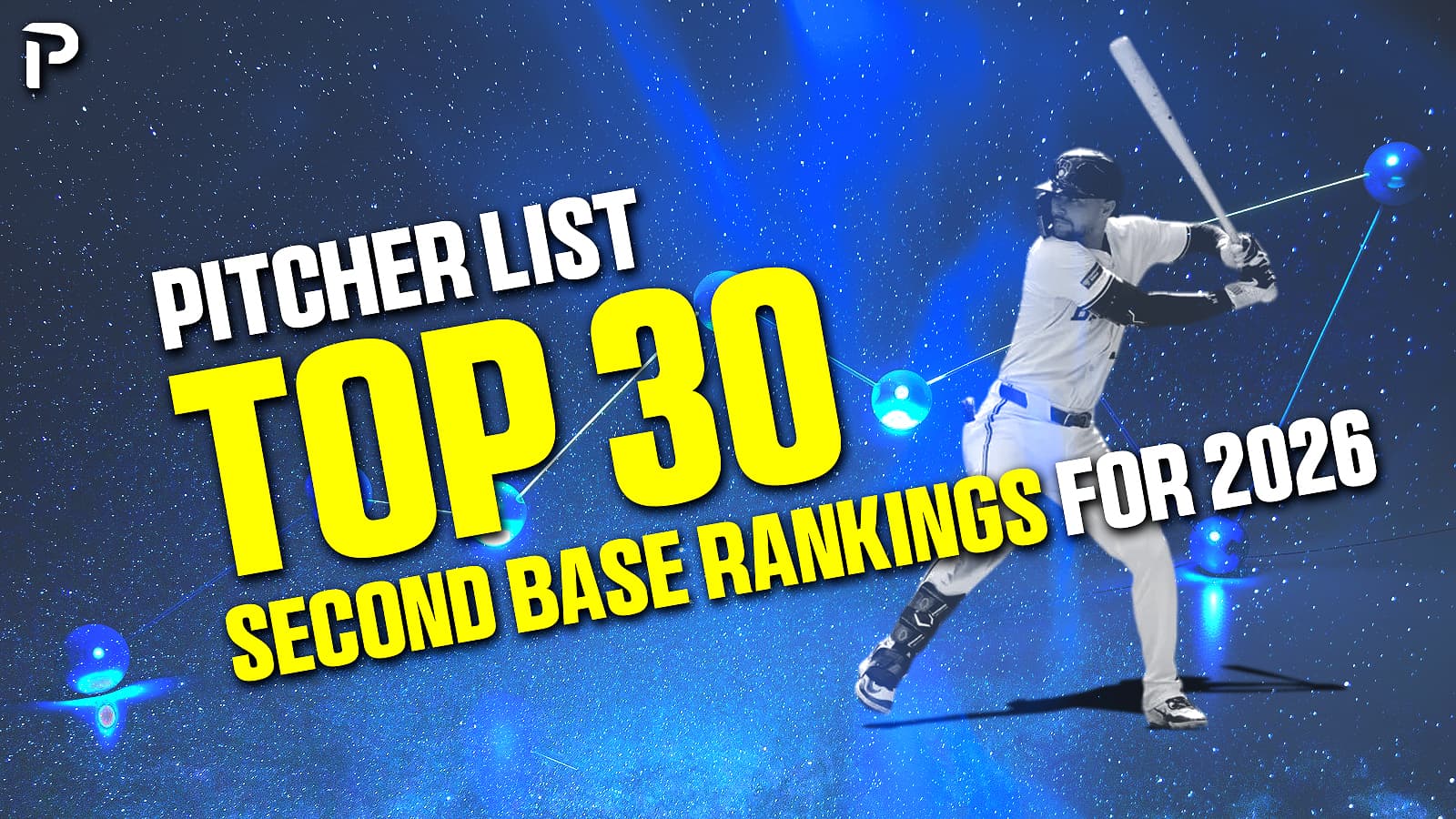
Welcome to the positional rankings! In addition to the expected positional ranks, there are two other additions:
First, a foreword by author Nate Schwartz! These give a breakdown of the position as a whole and provide an additional view on how to approach it on draft day.
Second, at the end of the article, you’ll find a table of all of the players at this position who wound up in my Top 300.
We hope that these rankings and the notes throughout give you something to think about as draft day approaches and help you feel as prepared as possible when it comes to hitters in your 2026 drafts.
- As a reminder, these rankings are geared toward a standard, daily, 12-team H2H redraft league, which is typically the most popular fantasy baseball format. They will only factor in the five standard categories: runs, RBI, home runs, batting average, and stolen bases.
- These are not best ball or draft and hold rankings. The 12-team redraft format with daily moves is the fundamental opposite of that. Pure volume plays are not valued as much here as in those no-move formats.
- The listed positions are based on five starts or 10 appearances, matching Yahoo’s eligibility rules. I use this because it’s the most inclusive standard across major platforms. If you’re in a format like ESPN or CBS, you may find certain players do not have one of the listed eligibilities. The most jarring example is Maikel Garcia, who could have anywhere from one to five eligibilities based on your site’s rules.
To keep things in the same ilk, here are a couple of notes on how I generally evaluate hitters before we dive in:
- In 12-team formats, I don’t see much value in guys who only provide stolen bases. It’s an important category, especially in Roto, but in shallower formats, there are too many other (and better) ways to get the steals you need without sacrificing production in the other categories.
- No stat is an island, and they should all be taken in proper context. For ranking purposes, the primary starting points I use are plate discipline, wRC+, quality of contact metrics (also known as Statcast batted ball data), lineup context, and the skills we can measure using tools such as our PLV Hitter Attributes (available for PL Pro members). I also use various projections (some free, some I buy) and dollar value generators.
- Positional eligibility, specifically multi-eligibility, is neat but isn’t a huge factor in many 10- and 12-team leagues anymore due to the prevalence of multi-eligible players. It’s of more value in deeper contests like the NFBC or in leagues with limited roster moves (draft and hold leagues, transaction limits/costs, extremely short benches, etc.). Still, the value is fairly situational and context-dependent.
- Similarly, I don’t penalize players for only qualifying in the utility slot. At most, it is a mild inconvenience if a DH-only player is available at a great value and you already have filled your utility spots.
- Regardless of true talent, anyone talented enough to make it to the big leagues can be brilliant or putrid for 50 to 100 at-bats. It could even last over a month with no change in potential or skill. It also could be wildly meaningful. We can’t and don’t know which will be valid until it’s over, though track record, scouting, and trends can give us hints.
- One of the most difficult things to account for in these rankings is the dynamic between low-ceiling players who have clear roles and players who could have higher ceilings but are without a clear path to playing time. I try to note this in the blurbs as much as I can. NOTE: PROJECTIONS AND AUCTION CALCULATORS WILL ALWAYS FAVOR THE FORMER OVER THE LATTER.
If you’d like input on a player or have any feedback, your best bet is to contact me on Bluesky (@scottchu.pitcherlist.com), X (@ifthechufits), or Reddit (u/ChusephEsquire)
I also host an AMA in the r/fantasybaseball subreddit every Friday (starting sometime in late March) with Nate, starting around noon ET that lasts through the rest of the day and into the weekend, so feel free to join the fun and ask questions or make comments.
For additional insight, also check out the Hacks & Jacks podcast! This is a hitter-focused pod with myself, Brett Ford, and occasional special guests. We will soon be releasing episodes breaking down these rankings.
Want more from Nate? Check out The Approach Angle podcast, his weekly articles, or jump into our Reddit AMAs during the season! You can also find him on Bluesky (@nschwartz.bsky.social), X (@_nateschwartz), or Reddit (u/NateSchwartzPL).
Once again, second base is the shallowest position across the board. The two top options, Ketel Marte and Jazz Chisholm Jr., bring skills worthy of being early picks, but they do have injury concerns. They’ve averaged under 600 plate appearances per season over the last two years (albeit close), giving you great stats for most of the season. Looking beyond the top two, only two other second basemen appear in the top 100 picks: Brice Turang and Maikel Garcia. Their projections are the rosiest of the rest, but that looks like a 20 home run ceiling, along with their plus speed and average.
After the top group, it becomes a healthy mix of players that all generally look similar: .250s average with 30 combined home runs and steals. How players get there differs slightly, but they’re all generally in the same projected bucket. There is an opportunity to take shots on skills changes: if you believe in the development of guys like Jackson Holliday or Luke Keaschall, or believe the aging curves for the older names won’t be as harsh as expected.
If you don’t end up with one of the top two names, it’s worth waiting on second base unless you desperately need stolen bases in the middle of the draft. I would target players who will either be in good lineups or in a good place in a lineup, such as Gleyber Torres. Finding hitters that won’t sink you but can also accumulate runs and RBI is a good way to ensure that second base isn’t a black hole for you.
In terms of middle-infield strategy, second base gets drowned out by the strength of shortstop. That means it won’t be the same lows that second base provides, and it gives you ample opportunity to invest in a specific need for a middle-infield position. While there are more stolen base options than power options, there are players like Jorge Polanco late enough that you don’t need to fret over options. Additionally, there’s a decent crop of prospects with 2025 ETAs that are worth taking a shot on, or that we’ll at least get more information about come spring training.
1. Jazz Chisholm Jr. (2B/3B, NYY) — Jazz’s struggles with contact make him a volatile player. Still, his dynamic skillset and eligibility at two critical positions make that easy enough to gloss over. Sure, he’ll have months where he hits .180, but in between, you’ll get a 30-30 season (or even 35-35). I’m also encouraged by a second straight season with at least 130 games (just barely) and the improved walk rate we saw this season, which helped Chisholm finish with a wRC+ above 100 in every single month in 2025. His streakiness will drive you crazy, but the juice is worth the squeeze to get all that power and speed with solid counting stats.
2. Ketel Marte (2B, ARI) — Ketel Marte missed about a month with a foot injury and hurt his hand late in the season, but none of that stopped him from hitting for a high average and smacking 28 home runs, though he wasn’t as explosive as his 36 home runs in 2024. There are plenty of questions about the state of the Diamondbacks’ offense heading into 2026 (albeit mainly in the second half of the lineup). Still, Marte should be a consistent contributor at second base who can hit 25 or more home runs and rack up counting stats in the heart of the order with a batting average north of .280.
Marte gets a big boost from my October ranks in large part because many trusted projection systems (including our own) think Marte is in for another excellent season, and while injuries have been an issue these last few seasons, being a second baseman with elite upside makes Marte a rare commodity.
3. Brice Turang (2B, MIL) — Folks drafted Turang in 2025 to hold down the stolen base category after he swiped 50 bags in 2024, but unfortunately, that number fell all the way to 24 in 2025. On the bright side, Turang had a bit of a power breakout, going from seven homers in ’24 to 18 in ’25 (including 10 in August), and became a fixture in the heart of the order, boosting his counting stats in a big way.
Turang is only 26 and may well have a new level of power in him that sticks around, but projecting more than 15 is a dangerous game, as his power is more likely to translate into more hits than it is more home runs due to his low fly-ball rates and how often he hits the ball up the middle and the opposite way. Still, 15 home runs, 90+ runs scored, 25-30 steals, and a high batting average are more than enough to make him one of the premier second basemen in fantasy.
4. Maikel Garcia (2B/3B/SS/OF/DH, KCR) — Garcia’s 16 home runs in 2025 were five more than he had in all of 2023-2024 combined, and he did it with a better batting average than ever before. Garcia doesn’t have a gawdy barrel rate thanks to his propensity to hit ground balls, but his average exit velocity of 91.3 mph shows he does have some thunder in his bat if he can get it up in the air to the pull side, which is precisely what he improved on in 2025. These changes can sometimes be fluky, but with a guy who can play several premium positions, enough raw power to make it believable, and the ability to steal over 20 bases in his back pocket, Garcia is a solid choice for managers who need speed and batting average boosts without sacrificing power entirely.
5. Jose Altuve (2B/OF, HOU) — Altuve apparently played through a painful injury on his right foot this season, though it didn’t stop him from a top-70 hitter finish with 26 home runs, 157 combined runs and RBI, and solid (if lower than we expected) ratios. Altuve will turn 36 next May and will be entering his 15th full season in the big leagues, so it’s more than fair to wonder how much tread is left on these tires. Since turning 30, Altuve has become a pull-heavy hitter who gets his home runs by targeting the shortest part of the field, so as long as he has his timing and swing, he should be able to hit 23-25 home runs with plenty of counting stats (especially if the Stros can get the offensive wheels turning more effectively than they did in 2025).
Also noteworthy is that this was his second-straight season with over 150 games played, which, for now, makes me think of him as less of an injury risk than we previously believed.
6. Nico Hoerner (2B/SS, CHC) — Hoerner’s ceiling and floor aren’t that far apart, which can be a bit boring. He’s going to hit fewer than 10 home runs, and he’s going to steal more than 25 bases while batting something close to .280. At this stage in the draft, you should have a good idea of whether Hoerner is a good fit for your roster: if you need a second baseman and/or steals and/or batting average, and have plenty of power already plugged in, then he makes a lot of sense. Alternatively, if you’re in a points league that penalizes strikeouts and gives more than one point for a stolen base, Hoerner is also a good fit. If these don’t apply, then he can be pushed down your board.
7. Ceddanne Rafaela (2B/OF, BOS) — Rafaela was the second-best second baseman in the first half as he hit 14 home runs, swiped 13 bags, and hit a robust .271 with much-improved metrics under the hood. Unfortunately, following the All-Star Break, things fell apart for Rafaela. He hit just two more home runs the rest of the way with a .218 average. It was encouraging that we didn’t see a spike in strikeout rate, as his contact ability remained strong (as it needs to be due to his aggressive nature), but his power fell off a cliff, particularly against fastballs.
Rafaela is a classic low-floor/high-ceiling sort of play, and to me, it hinges on whether he can punish fastballs. If Rafaela can bring back even average power against heaters, he’ll outperform this ranking and have a shot to be in the top 75. If he doesn’t, his floor is unfortunately very low, and he may not even be roster-worthy in 12-teamers.
8. Brandon Lowe (2B/DH, PIT) — Lowe’s injury issues and struggles against lefties persist, but despite that, he managed to hit 31 home runs with 161 combined runs and RBI with a .256 average. Landing in Pittsburgh wasn’t ideal for his home runs or counting stats, but it does make it much less likely he’ll be platooned. You’ll get one of the top power hitters and run producers at second base, who will likely also spend time on the IL and on the bench during the season due to the injury and platoon risk (he’s missed at least 50 games due to these troubles in three of the last four seasons).
9. Luke Keaschall (2B/DH, MIN) — Keaschall exploded onto the scene, swiping five bases in seven games with three doubles and an almost instant promotion to batting third before hitting the IL for the next three months. On his return, he again exploded, notching 10 hits in five games with two home runs and 10 RBI. While the speed and batting average stayed strong over the rest of the season, the power evaporated as he put up just an 85.1 mph average exit velocity and 3.4% barrel rate over his final 37 games. Power has never really been a big part of Keaschall’s game as he’s more of a hit tool and speed guy, and I think he can make some positive steps forward in 2026.
Keaschall should steal at least 20-25 bags next season and have excellent plate discipline and ratios, but whether he can hit more than 10 home runs remains up in the air. The risk associated with a player who has just 49 games in the majors (and who struggled more and more as he got more reps) has me hesitant to push Keaschall higher in these ranks.
10. Luis Arraez (1B/2B/DH, SFG) — You should know all about what Luis Arraez is and what he can do by this point: he has a highly compact swing that he uses to pepper line drives all over the field. He’s had the lowest strikeout rate among qualified hitters for four straight seasons, and his worst single-season batting average is .292 (which is what he hit in 2025).
Landing in San Francisco is rather ideal because they have a place for him to play in the infield, and they also need a full-time leadoff man. He wasn’t going to hit home runs anyway, so the park factors don’t matter.
11. Jorge Polanco (2B/3B/DH, NYM) — The injury risk is the primary concern, as he spent time on the IL in 2025 and hasn’t played at least 140 games in a season since 2021, and he’s only played close to a full season three times in his career (with one of those being the shortened 2020 season). From 2022 to 2024, he missed over 40 games each year, though when he was healthy, he did hit for power. A healthy Polanco can be a top-75ish player with power who can cover at least one tricky position (he had five starts at third base, which qualifies him for the position in Yahoo leagues and almost nowhere else), but there remains significant risk that he misses a large chunk of the season at a spot where the replacement level is far from ideal.
Also, for what it’s worth, he’ll gain first base eligibility in April, but that’s not really where you’re likely to use him.
12. Ozzie Albies (2B, ATL) — Albies was an enormous dud, based on his draft position, in the first half, finishing as the 34th-best second baseman, and it made even more devastating by the fact he had the second-most volume at the position, being out-earned by players with at least 100 fewer plate appearances, and in some cases 150+ fewer. Like his teammate Harris, though, Albies found a groove at the All-Star Break and then some, going on to be the third-best second baseman in the second half and looking almost like the unstoppable force we saw back in 2021 and 2023 (though not quite).
That said, our PLV metrics still think he has below-average pop even at his best, and his decision-making skills are bad far more often than they are good. It’s hard to get too excited about a guy whose profile suggests he’ll finish with fewer than 18 home runs and 15 steals with a middling batting average and counting stats with a floor a tier lower than that. Still, Albies was once much more than that and looked, if only for a moment, like he might be more than that again.
13. Xavier Edwards (2B/SS, MIA) — Edwards only stole bases at about half the rate he did in his electric 2024, but he did all the other things we expected, hitting very few home runs, showing solid plate discipline, and providing a strong batting average. I expect those things again in 2026, as he should steal 30-35 bases and hit fewer than five home runs while hitting .280-.290. Not everyone will require his services, but he’s a locked-in, everyday player with speed and solid ratios that can fill both middle-infield roles.
14. Gleyber Torres (2B/DH, DET) — Torres faded in the second half due to a sports hernia, but put together solid counting stats with excellent plate discipline thanks to his role hitting second for the Tigers. The Torres we saw in 2024 and 2025, who can hit 15-16 home runs and bat .255-.260, is likely the one we see again in 2026.
A return to the Tigers was a good fit for both teams, and it also benefits Torres’s fantasy value, as he should return to a spot at or near the top of the lineup and put in yeoman’s work with counting stats and a little bit of everything. He’s not an exciting player, but he is a valuable one.
15. Marcus Semien (2B, NYM) — For the first time since 2017, Semien missed more than seven games in a season. Semien has immense mileage on his tires, and now has back-to-back seasons with a batting average below .240 and a slugging percentage below .400. While Semien did show sparks of life at times in the summer, he only managed a single month with a wRC+ above 100. I’m not too excited about jumping back in on a player who, since the middle of 2024, has a single good month of baseball to his name. Still, I won’t deny that the career track record is fantastic, and that he was legitimately excellent in June of 2025.
Joining the Mets is an interesting move for Semien, though it’s not the only reason he jumped over 50 spots since my October ranks. Part of the jump is just a little more time to see how projections handle Semien’s down year, but the other is indeed his new home. Semien will likely hit near the middle of this lineup, and while that means a potentially lower ceiling on runs scored, it should provide better overall totals than he saw in Texas as he’ll hit behind Lindor, Soto, Bichette, and Polanco. The floor is still fairly low, as we saw throughout 2025, but it should be a touch higher on a more potent offense, and if Semien does, in fact, regain his prior form, he’ll be a very solid second baseman.