The Apple Studio Display XDR is a game-changer for creative professionals, finally bringing a 120Hz Mini-LED panel and Thunderbolt 5 to your desktop. It delivers the fluid performance and inky blacks that Mac users have been craving, resulting in Apple’s most capable display yet. However, at $3,299, it is a massive premium over the standard model, and the persistent limit of a single upstream port remains a frustrating hurdle for multi-Mac setups.
Upstream and downstream Thunderbolt 5 ports
Expensive compared to the standard model
Why you can trust Tom's Guide Our writers and editors spend hours analyzing and reviewing products, services, and apps to help find what's best for you. Find out more about how we test, analyze, and rate.
The Apple Studio Display XDR (starting at $3,299 / AU$5,499) is a massive upgrade over the original and is easily the best monitor the company has made yet. By merging its Pro line with its consumer-oriented Studio Display, Apple has managed to give creative professionals the best of both worlds in a familiar form factor.
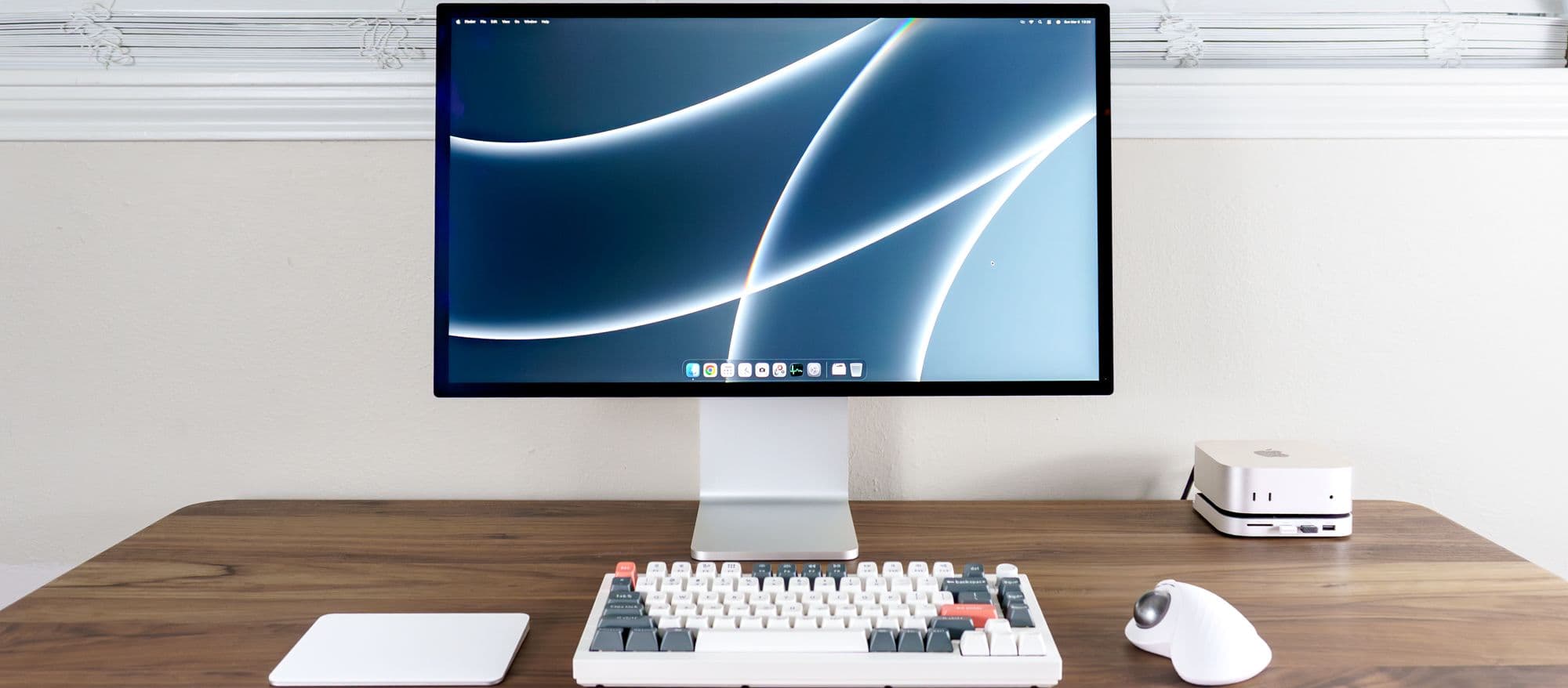
Unlike the larger Pro Display XDR at 32 inches, the new Studio Display XDR is a 27-inch, 5K monitor that looks almost identical to the standard Studio Display. However, the monitor’s new Mini-LED panel is the star of the show, delivering an impressive 2,000 nits of brightness and much deeper blacks.
However, some old frustrations remain: you can still only connect one Mac at a time, and you’re paying a $1,700 premium over the standard model for that 120Hz ProMotion panel with Mini-LED backlighting. To soften the blow, Apple finally includes the tilt and height-adjustable stand — or a VESA adapter — free of charge.
My Studio Display XDR review will help you decide if this premium monitor is the right display for your needs or if you’re better off leaving Apple’s ecosystem for a cheaper option with similar specs.
Apple Studio Display XDR: Cheat Sheet
- What is it? A 27-inch, 5K Mini-LED monitor for creative workflows and productivity.
- Who is it for? Creators and other professionals who want Apple’s best monitor yet and are willing to pay a premium for it.
- What does it cost? The Studio Display XDR costs $3,299 / AU$5,499 for the standard glass model or $3,599 / AU$5,999 for the one with Apple’s nano-texture glass. Both come with a tilt and height-adjustable stand included.
- What do we like? The stunning Mini-LED panel with deeper blacks, the smoother 120Hz refresh rate, the Thunderbolt 5 port for daisy-chaining displays or for external storage, the wider camera and Desk View support, and how Apple now includes a height-adjustable stand with the monitor.
- What don’t we like? That the Studio Display XDR still only has one input port, its higher price, and how there’s only one size option.
$3,299 / AU$5,499 (Standard glass), $3,599 / AU$5,999 (Nano-texture glass)
2 x Thunderbolt 5 (up to 120 Gb/s), 2 x USB-C (up to 10 Gb/s)
12MP Center Stage camera with Desk View, 6-speaker system with Spatial Audio, 3-mic array and 140W host charging
1-year limited warranty with 90 days of technical support
Apple Studio Display XDR: The ups
The Studio Display XDR is a massive upgrade over the standard model, featuring a 120Hz Mini-LED panel and Thunderbolt 5 support. However, it’s the way these high-end internals work together that makes the monitor truly shine.
Get instant access to breaking news, the hottest reviews, great deals and helpful tips.
XDR but in a familiar design
At 24.5 x 18.8 x 8.4 inches with a 27-inch display and an all-aluminum design, the Studio Display XDR is almost identical to the original Studio Display at first glance. This might come as a bit of a shock to Pro Display XDR users who prefer that monitor’s larger screen, but at 27 inches, the Studio Display XDR is the ideal size for most people and will easily fit on any desk.
Around back, this new monitor still has the same hard-wired power cable since it’s too thin to accommodate a detachable one. You aren’t limited to a tilt-only stand, though, and instead, you can choose between a tilt and height-adjustable one or a VESA mount adapter at checkout. Both options are included in the price and no longer cost an extra $400 like they do with the standard Studio Display.
The only other big visual difference between the two is that the Studio Display XDR is slightly thicker with a larger grill across the top of the monitor. This helps keep the A19 Pro chip and the rest of its internals cool.
The Studio Display XDR isn’t a radical departure from the original but rather another member of the new Studio Display family. Instead, it’s what's inside that sets this monitor apart.
Around back is where things begin to look a bit different. While Apple’s first Studio Display had a single Thunderbolt 3 port and three high-speed USB-C ports, the Studio Display XDR bumps the monitor’s lone upstream port to Thunderbolt 5.
Capable of transferring data at up to 120 Gb/s, this Thunderbolt 5 port delivers even more power. In fact, with 140W of passthrough charging (vs 96W on the original), the Studio Display XDR is powerful enough to fast-charge a 16-inch MacBook Pro.
While I would have preferred a second input around back, Apple gave us the next best thing by swapping one of those high-speed USB-C ports with a downstream Thunderbolt 5 one.
In addition to connecting external hard drives and other Thunderbolt-powered accessories, you can also use this downstream port to connect a second Studio Display XDR and drive both monitors with a single cable connected to your MacBook.
If you’re considering upgrading, it’s worth noting that the Studio Display XDR requires you to have macOS Tahoe 26.3.1 or later installed. Likewise, only the following Macs and iPads with Apple Silicon are compatible with this new display:
- 16-inch MacBook Pro (2021 and later)
- 14-inch MacBook Pro (2021 and later)
- 13-inch MacBook Pro (M1, 2020 and later)
- 15-inch MacBook Air (2023 and later)
- 13-inch MacBook Air (M1, 2020 and later)
- 24-inch iMac (2021 and later)iPad Pro (M4 and M5)
- iPad Air (M2, M3, and M4)
It’s also worth noting that Macs with M1, M2, or base M3 chips — as well as most iPads — are limited to a 60Hz refresh rate on this monitor. To use 120Hz ProMotion, you’ll need an M4 or M5 series chip or an M2/M3 Pro, Max, or Ultra chip.
From the instant I plugged the new Studio Display XDR into my Mac mini M4, Apple’s decision to go with a Mini-LED panel with a faster refresh rate over a standard IPS LED one made a huge difference. After turning its refresh rate up to 120Hz, my mouse cursor glided more smoothly across its screen, and scrolling up and down web pages felt and looked better, too.
You don’t have to leave the refresh rate at 120Hz, though, as the Studio Display XDR also supports an adaptive refresh rate that goes from 47 to 120Hz depending on the task at hand.
In the Displays page in the Settings menu, you also have several new color presets to pick from, including a native Adobe RGB one as well as specialized ones for HDR photography and even Medical Imaging (DICOM).
Watching videos on the Studio Display XDR is equally impressive. In the 2025 live-action adaptation of How to Train Your Dragon, Toothless with his all-black scales really stood out against the 2,304 local dimming zones. Likewise, when I watched the latest trailer for The Super Mario Galaxy Movie, the colors really popped as Mario and Princess Peach looked up at the sky from Peach’s Castle.
Now, if I had a more powerful Mac, I’m sure gaming at 120Hz on the Studio Display XDR would be awesome. Given I only had a Mac mini M4 to test this new display, though, I fired up the original Bioshock and even then, the underwater city of Rapture was a sight to behold.
The same was true when I looked at pre-edited photos in Preview and touched up a few images in GIMP.
Just like on the new MacBook Neo, the Studio Display XDR features one of Apple’s mobile chips inside. In fact, this monitor is technically faster than that new budget MacBook, as the company’s A19 Pro chip (as opposed to the A18 Pro) handles all of the image processing for its 12MP Center Stage camera.
With an A19 Pro chip under the hood, the Studio Display XDR’s built-in webcam is more capable at producing a cleaner image in low light. However, it’s also what allows you to use Apple’s Desk View feature natively, without having to mount an iPhone on top of your monitor.
At the same time, the A19 Pro serves as a dedicated audio processor. It manages the Studio Display XDR’s six-speaker array to deliver 30% deeper bass by using computational audio. In my testing, audio sounded great both while watching videos and playing games, and the built-in mics were crystal clear during our Monday morning video call.
The $3,299 price tag can certainly be a shock, but when you factor in that the Studio Display XDR essentially has the "brain" of an iPhone 17 Pro Max inside, powering its smart features, that higher price starts to make a bit more sense.