
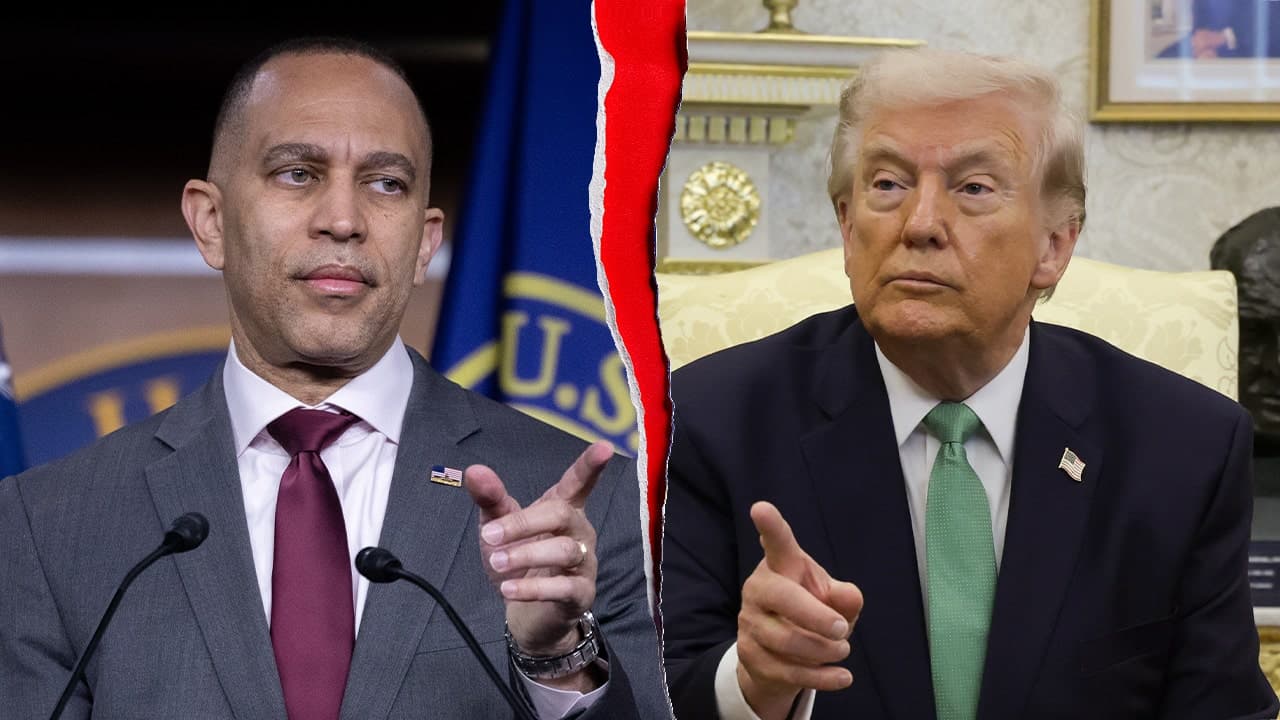
In a sharp rebuke to President Donald Trump, House Minority Leader Hakeem Jeffries, D-NY, called the former president's controversial remark on Truth Social 'reckless' and demanded he 'keep his reckless mouth shut' before endangering Americans. The statement came after Trump labeled Democrats as 'the greatest enemy' of America, a remark that ignited immediate political backlash and intensified debates over the ongoing conflict in Iran. Jeffries, a vocal critic of Trump's policies, framed the president's comments as a reflection of broader ideological divides that threaten national unity and economic stability.
The Political Tension Over the Iran War
Jeffries' Criticism of Trump's War of Choice
Jeffries described the war in Iran as a 'reckless war of choice' that has cost American taxpayers $30 billion, with gas prices soaring and the cost of living in the U.S. 'already too high.' 'The American people want us to focus on making their life better and more affordable,' he said, 'not getting involved in another endless war in the Middle East.'
The War Powers Resolution Debate
Jeffries called for a 'War Powers Resolution' to end the conflict, arguing that the current military operation in Iran is a 'reckless' decision that risks further economic strain. The resolution, he said, would 'bring this situation to a close' and prevent 'failed policies' that have already burdened American families. Meanwhile, Trump's administration has faced criticism for prioritizing military spending over domestic economic challenges, including a 12% rise in the consumer price index since 2023.
Economic Consequences of the War in the Middle East
The Cost of War on American Families
The ongoing conflict in Iran has exacerbated inflationary pressures, with gas prices climbing to record highs and fueling concerns about the cost of living. Jeffries highlighted how the war has 'added to an environment in America where life has already become too expensive,' citing the $30 billion annual cost of military operations and the $15 trillion national debt. The Federal Reserve has warned that rising prices could threaten economic stability, with mortgage rates nearing historic highs due to inflationary pressures.
The Impact on Domestic Economic Policy
Jeffries criticized Trump's administration for 'finding billions of dollars for bombs but can't find any money to actually bring down the high cost of living.' This critique aligns with broader Democratic priorities, including expanding affordable housing programs and increasing minimum wage to combat inflation. The Federal Reserve has warned that unchecked inflation could force interest rates to rise further, potentially stifling economic growth and exacerbating income inequality.
The Role of the Federal Reserve in Stabilizing the Economy
Inflation and Federal Reserve Policy
The Federal Reserve has been under pressure to balance economic growth with inflation control, with current interest rates at 5.25% and a 12% annual increase in the consumer price index. Jeffries' comments reflect a growing concern that the war in Iran is diverting resources from economic recovery efforts, as the U.S. faces a 3.1% unemployment rate and a 1.2% GDP growth rate. The Fed's recent rate hikes have been met with criticism from Democrats, who argue that the policies 'stifle small businesses and working families.'
The Broader Implications of the Political Rancor
The political conflict over the Iran war and Trump's rhetoric has deepened ideological divides, with Jeffries warning that 'the American people are not going to be in a position to support a war that is going to end in failure.' This comes as the U.S. grapples with a 10% increase in the number of people living in poverty and a 2.3% rise in the number of children in food-insecure households. The debate over the war also highlights the challenges of maintaining a 'united front' in a polarized political climate, as the House and Senate are set to vote on a $1.2 trillion budget bill that could further impact the economy.
The Broader Implications of the Political Rancor
The Future of U.S. Foreign Policy
The war in Iran has become a symbol of the U.S. 'overextension' in the Middle East, with Jeffries arguing that the administration's 'reckless' decisions 'endanger the lives of American citizens.' The conflict has also raised questions about the U.S. 'military-industrial complex' and the 'cost of war' in terms of both human and economic resources. As the U.S. faces a 1.5% annual increase in the number of military deaths in the region, the debate over the war has intensified, with Democrats calling for a 'peaceful resolution' to the crisis.
- Jeffries reprimands Trump for 'reckless mouth' after calling Democrats 'greatest enemy' in a polarizing political moment
- The war in Iran is described as a 'reckless war of choice' with $30 billion in costs and economic strain on American families
- The Federal Reserve's inflation-fighting policies are under pressure as the U.S. faces a 12% annual price increase
Frequently Asked Questions
- What is the current state of the Iran conflict?
- The U.S. is involved in a 'reckless war of choice' in Iran, with the war costing $30 billion annually and fueling rising gas prices. The conflict has been described as a 'failed policy' that is 'endangering the lives of American citizens.'
- How is the war affecting the U.S. economy?
- The war is adding to the 'cost of living' in the U.S., with gas prices at record highs and the consumer price index rising 12% annually. The Federal Reserve is under pressure to control inflation, which has been exacerbated by the war's economic impact.
- What is the role of the Federal Reserve in this context?
- The Federal Reserve is managing inflation by raising interest rates, but the war in Iran is creating 'economic strain' that could force further rate hikes, potentially stifling growth and increasing the cost of living for American families.
