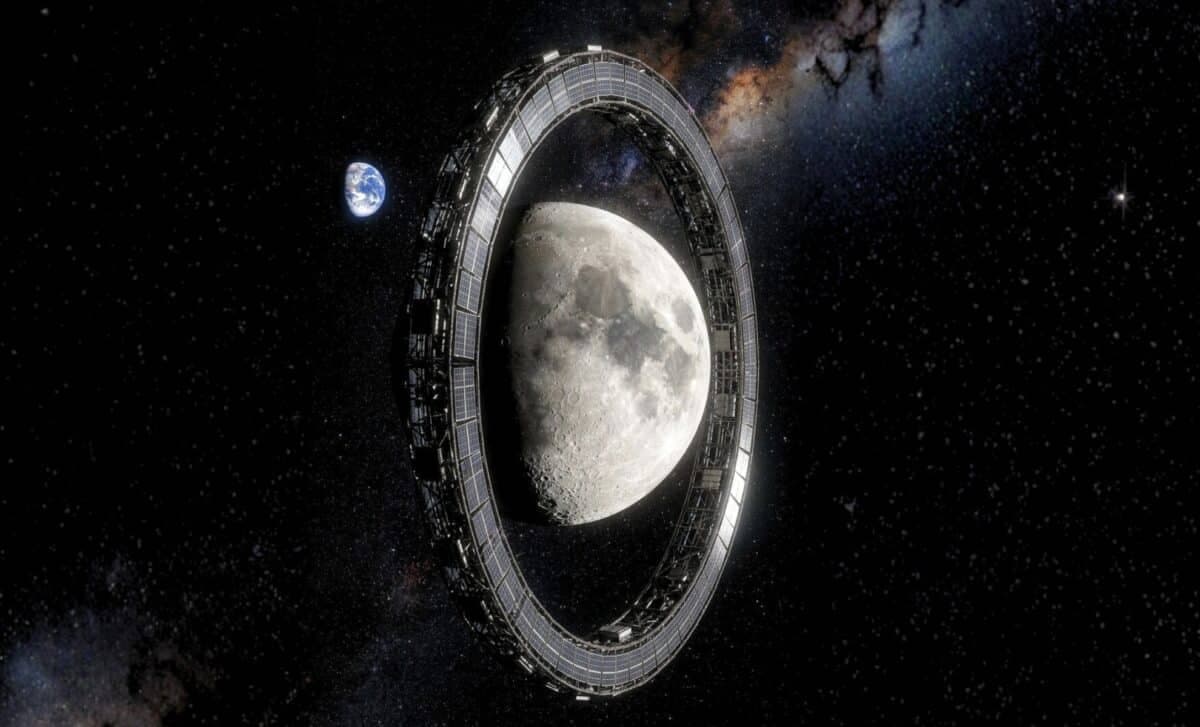
In the wake of the 2011 Fukushima Daiichi nuclear disaster, Japan’s government and public faced an existential energy crisis. With 54 nuclear reactors—responsible for 30% of the nation’s electricity—shuttered indefinitely, policymakers scrambled for alternatives. Amid this urgency, an audacious proposal emerged from Shimizu Corporation, one of Japan’s largest construction firms: a 6,800-mile belt of solar panels encircling the Moon’s equator. Dubbed the Luna Ring, this visionary project promised to harness the Sun’s rays continuously, without interference from clouds, atmosphere, or the lunar night, transmitting power wirelessly back to Earth via microwave beams and high-energy lasers. While the plan remains a conceptual dream more than a decade later, it represents one of the most ambitious clean energy initiatives ever conceived, offering a potential escape from fossil fuels—but at a cost that may prove prohibitive.
Why Japan’s Luna Ring Could Revolutionize Global Energy Forever
The core promise of the Luna Ring is simple: uninterrupted solar power. Unlike Earth-based solar farms, which suffer from intermittency due to nighttime, weather, and seasonal variations, a lunar solar array would operate 24/7. The Moon’s equator, with its consistent exposure to sunlight—no atmosphere to scatter rays, no clouds to block them—provides an ideal location for maximum energy generation. Shimizu Corporation’s calculations suggest that the energy output from such a system could dwarf terrestrial solar production by a factor of 20. Tetsuji Yoshida, president of Shimizu’s space consulting group, CSP Japan, told ABC News in 2011 that if even a fraction of the energy generated by the Luna Ring were successfully transmitted to Earth, it would eliminate the need for coal, oil, or biomass entirely. For a country like Japan, which imports nearly all its fossil fuels and has long grappled with energy security, the allure of such a self-sustaining system is undeniable.
The Physics Behind the Moon-to-Earth Power Transmission
The technical backbone of the Luna Ring hinges on three key innovations: high-efficiency solar conversion, wireless power transmission, and Earth-based reception infrastructure. On the Moon, solar cells lining the equator would capture sunlight and convert it into electricity. This power would then be funneled through buried cables to transmission facilities on the lunar near side—the hemisphere always facing Earth. There, the electricity would be converted into tightly controlled microwave beams or high-energy lasers, which would traverse the 238,855-mile void of space with minimal energy loss. On Earth, specialized antennas called rectennas—measuring up to several kilometers in diameter—would capture these beams and convert them back into usable electricity for the power grid. Shimizu’s proposal also envisions using excess energy to produce hydrogen fuel, offering a storage solution for when demand peaks or transmission is disrupted. The precision required for this system is staggering: guide beacons on Earth would need to steer the beams with pinpoint accuracy to avoid missing the rectennas entirely.
Building the Impossible: Robots, Moon Dirt, and a Construction Feat Like No Other
Constructing a 6,800-mile solar belt on the Moon presents engineering challenges that make the International Space Station look like child’s play. Shimizu’s plan relies almost entirely on robotics, with human astronauts playing a supporting role. Tele-operated robots, controlled in shifts from Earth, would handle excavation, ground leveling, and the assembly of solar panels and transmission equipment. These machines would operate 24 hours a day, seven days a week, under the guidance of engineers back on Earth. To minimize the need for Earth-sourced materials, the project would leverage lunar resources extensively. Moon soil, rich in oxides, could be processed into water, oxygen, concrete, ceramics, and even the silicon required for solar cells. Shimizu proposed mobile production plants that would crawl along the lunar equator, autonomously manufacturing solar panels from locally sourced materials before installing them in real time. The entire belt would range in width from a few kilometers to 400 kilometers at its widest point, with a transportation route running parallel to carry construction materials and bury power cables beneath the surface.
The $10+ Trillion Question: Can Japan Afford the Luna Ring?
Even for a nation as technologically advanced as Japan, the financial hurdles of the Luna Ring are staggering. Masanori Komori, an economist with the Institute of Energy Economics in Japan, dismissed the proposal as prohibitively expensive, arguing that Japan should focus on more feasible alternatives like geothermal or offshore wind power. To put the project’s scale in perspective, the Apollo Moon missions cost roughly $25 billion in 1960s dollars—equivalent to over $250 billion today. The Luna Ring, by comparison, would require an investment exceeding $10 trillion, according to independent estimates, dwarfing even the most ambitious infrastructure projects in history. Beyond cost, the technological barriers are immense. Transmitting gigawatts of power across quarter-million-mile distances with zero loss is a feat that has never been attempted. Current microwave and laser transmission systems operate at scales measured in kilowatts, not gigawatts. The guide beacon technology needed to ensure the beams hit their Earth-based targets with millimeter precision does not yet exist. Yoshida conceded in 2011 that no concrete cost estimate had been developed, stating that the focus was on proving the feasibility of the core concepts first.
Comparing the Luna Ring to Earth-Based Alternatives
While the Luna Ring offers unparalleled energy potential, its terrestrial counterparts are advancing rapidly. Japan has already invested heavily in offshore wind farms, such as the 140-megawatt project in Akita Prefecture, which became operational in 2022. Similarly, geothermal energy—abundant in Japan due to its volcanic geography—has seen renewed interest post-Fukushima. The country’s 2021 Strategic Energy Plan targets 1.7% of its energy mix from geothermal by 2030, up from 0.3% today. Even space-based solar power (SBSP) concepts closer to Earth, like those proposed by the European Space Agency’s Solaris program, aim to place solar arrays in geostationary orbit—a far less complex endeavor than building on the Moon. These alternatives, while less ambitious, are already generating power today and require a fraction of the investment.
From Fukushima to the Future: How a Nuclear Disaster Sparked a Lunar Dream
The Luna Ring’s origins trace back to 2010, when Shimizu first unveiled the concept as a futuristic energy solution. But it wasn’t until the catastrophic triple disaster of March 11, 2011—when a 9.0-magnitude earthquake triggered a tsunami that crippled the Fukushima Daiichi nuclear plant—that the proposal gained serious traction. The disaster exposed Japan’s vulnerability to fossil fuel dependence and nuclear risks, prompting a national reckoning with energy policy. Yoshida noted that the Luna Ring had been a quiet idea on Shimizu’s website for a year before the earthquake catapulted it into the spotlight. Suddenly, the public and policymakers were open to radical solutions. The Japanese government temporarily shuttered all 54 of its nuclear reactors, and energy imports surged, costing the country an estimated $30 billion annually in additional fuel expenditures. In this climate, the Luna Ring emerged as a symbol of hope—a way to break free from both nuclear risks and fossil fuel dependency.
Where the Luna Ring Stands in 2024: A Dream Half-Realized
More than a decade after its public debut, the Luna Ring remains a conceptual proposal. Shimizu Corporation has not secured government funding, received endorsements from major space agencies like JAXA or NASA, or established a development timeline. The proposal is still featured on Shimizu’s official website as part of its "Future Projects" portfolio, but there have been no substantive updates since 2011. The project’s feasibility studies, conducted in collaboration with academic institutions, concluded that the core technologies—wireless power transmission, robotic construction, and lunar resource utilization—are theoretically sound but require decades of development. Yoshida, now retired from Shimizu, remains cautiously optimistic. In a 2021 interview, he reiterated that the project’s success hinges on continued research and international collaboration. "All we’re doing is using existing resources—sunlight, solar panels, microwaves, and lasers," he said. "If we keep pushing, this could become reality."
The Broader Implications: Could Space-Based Solar Power Be the World’s Next Energy Revolution?
While the Luna Ring is Japan’s most audacious space-based solar proposal, it is not the only one. Internationally, both public and private sectors are exploring space-based solar power (SBSP) as a potential game-changer. The European Space Agency’s Solaris program, launched in 2022, aims to develop a satellite-based solar power system by the 2030s, capable of beaming energy to Earth 24/7. In the U.S., the Department of Energy and NASA have studied SBSP concepts since the 1970s, with renewed interest in recent years due to climate change pressures. China’s Chang’e program has also explored lunar resource utilization, including the potential to build solar arrays on the Moon. The appeal of SBSP is global: it could provide baseload power without the intermittency issues of terrestrial renewables, reduce land use conflicts, and eliminate greenhouse gas emissions from energy production. However, the challenges—cost, technological maturity, and geopolitical coordination—are formidable.
Key Takeaways: What You Need to Know About the Luna Ring
- The Luna Ring is a proposed 6,800-mile solar belt around the Moon’s equator, designed to generate uninterrupted clean energy via 24/7 solar exposure.
- Shimizu Corporation claims the system could produce 20 times more energy than an equivalent terrestrial solar array, eliminating the need for fossil fuels.
- Power would be transmitted wirelessly to Earth using microwaves or lasers, captured by rectennas, and integrated into the global grid or converted to hydrogen fuel.
- The project faces astronomical costs (estimated at $10+ trillion), technological hurdles, and no current funding or timeline.
- While still a concept, the Luna Ring highlights Japan’s post-Fukushima push for energy innovation and the global race for space-based solar power.
Frequently Asked Questions About Japan’s Lunar Solar Ring
Frequently Asked Questions
- How would the Luna Ring transmit power from the Moon to Earth?
- The system would convert solar energy into electricity on the Moon, then beam it to Earth as microwaves or high-energy lasers. On Earth, rectennas—specialized antennas—would capture the beams and convert them back into usable electricity for the power grid.
- Is the Luna Ring technically feasible today?
- While the core concepts (solar power, wireless transmission, robotics) are understood, scaling them to the required gigawatt levels and operating on the Moon remains unproven. Most experts agree it would take decades of development and trillions in investment.
- Why hasn’t Japan pursued the Luna Ring despite its potential?
- The project’s estimated cost exceeds $10 trillion, and there is no clear funding source. Japan has instead focused on more immediate alternatives like offshore wind and geothermal energy, which are cheaper and faster to deploy.