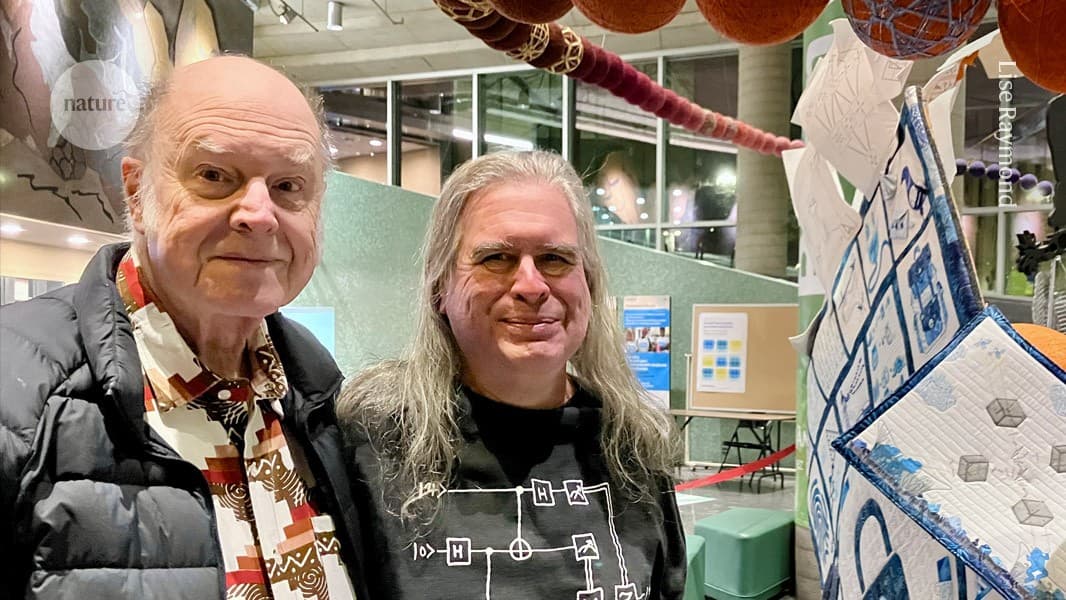
Quantum computing trailblazers Gilles Brassard and Charles Bennett have been awarded the 2023 A.M. Turing Award for their pioneering contributions to quantum information science, marking the first time the prestigious computer science prize has recognized work rooted in quantum physics. The Association for Computing Machinery (ACM) announced the $1 million award on March 18, honoring the pair’s foundational research that transformed secure communication and computing through quantum mechanics. Brassard, a computer scientist at the University of Montreal, and Bennett, a physicist at IBM Research in Yorktown Heights, New York, began collaborating in the 1970s to explore quantum phenomena that defy classical computational limits.
Why the 2023 Turing Award Marks a Quantum Leap in Technology
The A.M. Turing Award, often described as the "Nobel Prize of Computing," has historically recognized achievements in classical computer science, but the 2023 prize represents a pivotal moment in the evolution of the field. By awarding Brassard and Bennett, the ACM acknowledges that quantum information science is no longer a speculative discipline but a transformative force in technology.
The First Quantum Physics Recognition in the Turing Award’s History
Since its inception in 1966, the Turing Award has celebrated milestones in software, algorithms, and hardware design, but quantum physics remained outside its scope—until now. The decision to honor quantum pioneers underscores the growing integration of quantum mechanics into computing and communications, a shift that is reshaping industries from cybersecurity to drug discovery.
Bridging Disciplines to Unlock Quantum Potential
Brassard and Bennett’s backgrounds exemplify the interdisciplinary nature of quantum information science. Brassard, a computer scientist, and Bennett, a physicist, combined their expertise to explore how quantum mechanics could solve problems intractable for classical systems. Their collaboration began in the 1970s, a time when quantum computing was largely dismissed as theoretical fantasy.
The Groundbreaking Contributions That Redefined Computing
- Developed the first quantum encryption key distribution protocol in 1984, revolutionizing secure communications.
- Demonstrated quantum teleportation in 1993, proving quantum entanglement could transmit information instantaneously.
- Laid the foundation for modern quantum cryptography, which now underpins ultra-secure data transmission networks.
Bennett and Brassard’s most enduring legacy stems from their 1984 paper, "Quantum Cryptography: Public Key Distribution and Coin Tossing," which introduced the concept of quantum key distribution (QKD). This protocol, known as BB84 after the authors’ initials and the year of publication, uses the principles of quantum mechanics to create cryptographic keys that are theoretically unhackable. Any attempt to intercept the key alters the quantum states of the photons carrying it, immediately alerting the communicating parties to a security breach.
Their work did not stop at encryption. In 1993, Bennett led a team that experimentally demonstrated quantum teleportation, a process that leverages quantum entanglement—a phenomenon Einstein famously called "spooky action at a distance"—to transmit quantum information between two particles, regardless of the distance separating them. This breakthrough proved that quantum states could be transferred without physical movement, a concept that defies classical intuition.
From Theory to Reality: How Quantum Information Science Evolved
The journey from theoretical curiosity to practical application began with the foundational work of physicist Stephen Wiesner in the late 1960s. Wiesner, who passed away in 2021, first proposed that quantum properties—such as the polarization of photons—could be harnessed for secure communication. Though initially overlooked, Wiesner’s ideas inspired Bennett and Brassard to explore quantum cryptography further.
The Birth of Quantum Key Distribution in 1984
In their seminal 1984 paper, Bennett and Brassard outlined BB84, a protocol that uses the Heisenberg Uncertainty Principle to ensure security. Unlike classical encryption, which relies on mathematical complexity, BB84’s security is rooted in the laws of physics. Any eavesdropping attempt disturbs the quantum states of the photons, leaving detectable traces. This innovation laid the groundwork for modern quantum cryptographic systems, including those used by governments and financial institutions today.
Quantum Teleportation: A Milestone in 1993
The 1993 demonstration of quantum teleportation was a watershed moment. Bennett, alongside Brassard and a team of researchers, showed that quantum information could be transmitted between two entangled particles. This process does not involve the physical transfer of matter but rather the instantaneous transfer of quantum states, a concept that challenges our classical understanding of information transfer.
Had I been asked to choose one recognition at any point in my career, it would have been the Turing Award. This honor surpasses anything I could have imagined."
The Broader Impact: Quantum Science Beyond Computing
The implications of Bennett and Brassard’s work extend far beyond computing. Quantum information science has become a vital tool for physicists investigating fundamental questions about the universe, including the nature of black holes and the limits of quantum gravity. Jonathan Oppenheim, a theoretical physicist at University College London, notes that quantum information theory is providing new insights into the physical world, bridging the gap between abstract theory and observable phenomena.
Quantum Mechanics as a Tool for Fundamental Physics
Researchers like Oppenheim are now using quantum information principles to study black holes. By applying quantum entanglement and teleportation concepts, physicists can explore how information behaves at the event horizon, a question central to the black hole information paradox. This interdisciplinary approach highlights how quantum computing is not just a technological revolution but a scientific one as well.
The Role of Quantum Cryptography in Modern Security
Quantum cryptography, a direct descendant of Bennett and Brassard’s work, is now a critical component of global cybersecurity infrastructure. Companies like ID Quantique and Toshiba have commercialized quantum key distribution systems, offering ultra-secure communication channels for industries where data integrity is paramount. Governments, including those in China and the European Union, have invested billions in quantum communication networks to safeguard sensitive information from cyber threats.
The Quantum Hacking Threat and the Race for Unbreakable Security
Despite the promise of quantum encryption, the field is not without challenges. Quantum hacking techniques, such as photon-number-splitting attacks, have emerged as threats to quantum key distribution systems. Researchers are actively developing countermeasures, including decoy-state protocols and measurement-device-independent QKD, to mitigate these risks. The cat-and-mouse game between quantum cryptographers and hackers underscores the ongoing evolution of the field.
How Quantum Hackers Exploit Theoretical Flaws
While quantum key distribution is theoretically unhackable, practical implementations may introduce vulnerabilities. For example, hackers can exploit imperfections in single-photon detectors or side channels in the system’s hardware. Bennett has emphasized the importance of addressing these flaws to ensure the long-term viability of quantum cryptography.
The Future of Quantum-Secure Networks
The deployment of quantum-secure networks is accelerating. In 2020, China launched the world’s first quantum satellite, Micius, which demonstrated intercontinental quantum key distribution. Meanwhile, the U.S. Department of Energy has outlined a national quantum internet initiative, aiming to create a secure communication infrastructure resistant to quantum computing attacks. These efforts highlight the global race to harness quantum technology for secure communication.
The Turing Award’s Recognition of a Scientific Revolution
The ACM’s decision to award the Turing Award to quantum pioneers Brassard and Bennett reflects a broader recognition of quantum information science as a cornerstone of 21st-century technology. Stephanie Wehner, a quantum-communications researcher at Delft University of Technology, emphasizes that quantum information is more than a vehicle for classical data—it enables entirely new computational paradigms.
Why Quantum Information Defies Classical Analogues
Unlike classical bits, which can only be 0 or 1, quantum bits (qubits) can exist in superpositions of states, enabling parallel processing. This property, combined with entanglement, allows quantum computers to solve certain problems exponentially faster than classical machines. For instance, Shor’s algorithm, which can factor large numbers efficiently, threatens to break widely used encryption schemes like RSA.
The Race Toward Fault-Tolerant Quantum Computers
While quantum computers capable of outperforming classical machines (a milestone known as quantum supremacy) have been demonstrated, the road to fault-tolerant, scalable quantum computing remains long. Companies like IBM, Google, and Rigetti are investing heavily in quantum hardware, but challenges such as error correction and decoherence must be overcome before quantum computers become practical for widespread use.
Key Takeaways: The Legacy of Bennett and Brassard
- Gilles Brassard and Charles Bennett received the 2023 A.M. Turing Award for foundational work in quantum encryption and computing, marking the first quantum physics recognition in the prize’s history.
- Their 1984 BB84 protocol introduced quantum key distribution, enabling theoretically unhackable communication, while their 1993 quantum teleportation experiment proved the feasibility of entanglement-based information transfer.
- Quantum information science, once dismissed as theoretical, now underpins modern cybersecurity, drug discovery, and fundamental physics research.
- Despite progress, quantum hacking threats and hardware limitations remain hurdles for widespread adoption of quantum technologies.
Frequently Asked Questions About the 2023 Turing Award and Quantum Computing
Frequently Asked Questions
- What is the A.M. Turing Award and why is it significant?
- The A.M. Turing Award, often called the "Nobel Prize of Computing," is the most prestigious prize in computer science. Awarded by the ACM since 1966, it honors contributions of lasting importance to the field. The 2023 prize to Brassard and Bennett marks the first time quantum physics research has been recognized.
- How does quantum key distribution (QKD) make communication secure?
- QKD, pioneered by Bennett and Brassard, uses quantum mechanics to create cryptographic keys. Any attempt to intercept the key alters quantum states, alerting users to eavesdropping. Unlike classical encryption, QKD’s security is based on physical laws, not computational complexity.
- What is quantum teleportation and how does it work?
- Quantum teleportation, demonstrated by Bennett and colleagues in 1993, uses quantum entanglement to transmit quantum information between particles. It does not involve physical transfer but rather the instantaneous transfer of quantum states, enabling secure data transmission over distances.