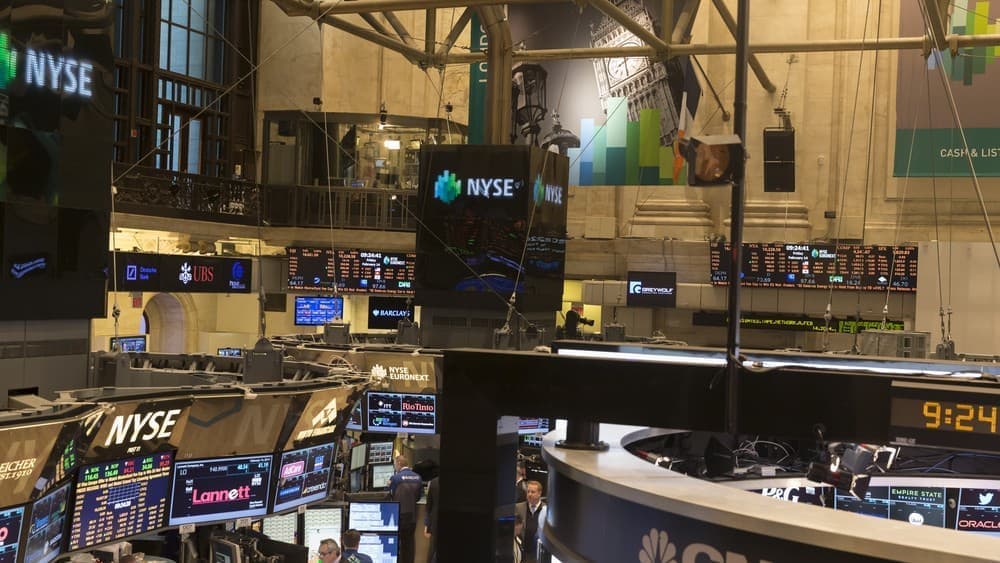
U.S. stock markets closed Tuesday with mixed results as investors navigated escalating geopolitical tensions in the Middle East and corporate earnings reports. The S&P 500 inched up 0.08% to 6,616.85, while the tech-heavy Nasdaq Composite rose 0.1% to 22,017.85. The Dow Jones Industrial Average, however, slipped 0.18% to 46,584.46, reflecting caution among traders amid the unfolding crisis. The day’s trading was dominated by two major themes: the potential resolution—or escalation—of the U.S.-Iran conflict and high-profile corporate developments, including delays in Apple’s foldable iPhone and a blockbuster bid for Universal Music Group.
Market Reaction to Trump’s Strait of Hormuz Deadline: Oil Prices Surge Ahead of 8 p.m. ET Showdown
Investors spent Tuesday bracing for President Donald Trump’s 8 p.m. ET deadline for Iran to reopen the Strait of Hormuz, a critical chokepoint for global oil shipments. The strait, through which roughly 20% of the world’s oil passes daily, has been a flashpoint in U.S.-Iran tensions, particularly after recent attacks on shipping vessels and threats to block maritime traffic. As the clock ticked toward the deadline, oil prices climbed sharply, with Brent crude rising above $95 per barrel—its highest level since late 2023. The surge in energy prices has fueled a rally in oil and gas stocks, which have gained nearly 34% in 2026 and advanced almost 8% since the conflict escalated in early October.
Energy Stocks Reach Multi-Year Highs Amid Supply Risks
The energy sector has been the standout performer in recent weeks, with companies like ExxonMobil, Chevron, and ConocoPhillips all trading near multi-year highs. Joe Terranova, chief market strategist for Virtus Investment Partners, cautioned on CNBC’s *Halftime Report* that the rally may be unsustainable if tensions de-escalate. ‘What’s in front of us is the possibility that if you get that good news, you are going to have a powerful rally,’ Terranova said. ‘What do you do with that? If you’ve had hedges in place—whether it be oil, or fertilizers, or defensive positioning—I think you pare that back at some point today.’ His remarks underscore the delicate balance investors face: positioning for continued geopolitical risk while preparing for a potential détente that could trigger a market rebound.
Analysts at Goldman Sachs echoed this sentiment in a Tuesday note, writing that while energy stocks remain attractive in the short term, ‘the sustainability of the rally hinges on geopolitical developments.’ The bank flagged that a sudden de-escalation could lead to a sharp pullback in oil prices, particularly if Iran signals a willingness to reopen the strait. For now, however, the market is pricing in elevated risk, with oil futures indicating a roughly 70% chance of prices remaining above $90 per barrel through year-end.
Apple Stock Plummets 4% as Foldable iPhone Faces ‘Setbacks’ in Engineering Tests
Shares of Apple fell nearly 4% on Tuesday, making it one of the biggest drags on the S&P 500. The decline came after Nikkei Asia reported that the company is facing ‘setbacks in the engineering test phase’ for its highly anticipated foldable iPhone, which was expected to debut alongside the iPhone 18 in September 2026. According to a person familiar with the situation, ‘Apple and the supply chain are working under a pressured timeline, and the current solutions are not enough to completely solve the engineering challenges. More time is needed.’ This marks the latest in a series of challenges for Apple’s foldable ambitions, which have faced delays due to supply chain constraints and design complexities.
The report sent ripples through the tech sector, particularly among suppliers and competitors eyeing the foldable market. Bloomberg later reported that the foldable iPhone remains on track for a September launch, but the conflicting accounts highlight the uncertainty surrounding the project. Apple, which celebrated its 50th anniversary last week, has relied on annual September iPhone launches since 2020, making any deviation from that schedule a potential risk to its brand reputation.
‘If Apple misses the September window, it could lose first-mover advantage in a market where Samsung and Huawei have already established strong footholds in foldable devices.’ — Daniel Ives, Wedbush Securities analyst
Universal Music Group Soars 13% After Pershing Square’s $64 Billion Takeover Bid
In a dramatic twist, shares of Universal Music Group (UMG) surged nearly 13% on Tuesday after hedge fund billionaire Bill Ackman’s Pershing Square Capital Management announced a cash-and-stock bid to acquire the world’s largest recorded music company for approximately 55.8 billion euros ($64.4 billion). The all-cash offer values UMG at 45.50 euros per share, a 34% premium over its closing price on Monday. Ackman, known for his activist investing style, framed the deal as a long-term play on the music industry’s growth, citing the rise of streaming, AI-driven content creation, and live events as key drivers.
The bid comes amid a wave of consolidation in the entertainment sector, with Sony Music and Warner Music Group also pursuing aggressive M&A strategies. However, the deal faces regulatory scrutiny, particularly in Europe, where antitrust authorities may challenge the merger over concerns about reduced competition in music licensing. UMG, which owns labels like Def Jam, Capitol Records, and Interscope, has been a prime target for years, with both Apple and Amazon previously exploring acquisitions.
What Pershing Square’s Bid Means for the Music Industry
Ackman’s bid represents a bold bet on the future of the music industry, which has seen its revenue grow for 10 consecutive years, reaching $32.2 billion in 2023, according to the International Federation of the Phonographic Industry (IFPI). The deal could accelerate trends like AI-generated music, virtual concerts, and exclusive artist partnerships. However, critics argue that the acquisition could further concentrate power in the hands of a few conglomerates, stifling innovation from independent artists and labels. ‘The music industry is at an inflection point,’ said Larry Miller, director of NYU’s Music Business Program. ‘Consolidation can drive efficiency, but it also risks homogenizing the creative landscape.’
Arm Holdings Falls 6% After Morgan Stanley Downgrade Cites ‘Near-Term Risks’
Shares of Arm Holdings, the British semiconductor giant, tumbled nearly 6% on Tuesday after Morgan Stanley downgraded the stock to equal-weight from overweight, citing concerns about its strategic pivot into custom chips for artificial intelligence (AI) and data centers. The bank cut Arm’s price target to $135, implying a 9% downside from Monday’s close, and warned that ‘the commercial ramp will take time.’ The downgrade reflects growing investor skepticism about whether Arm can deliver on its ambitious plans to capitalize on the AI boom amid a softening demand environment for semiconductors.
Arm’s stock has been a high-flyer in 2025, surging over 200% year-to-date as AI chip demand soared. However, Morgan Stanley’s Lee Simpson argued in a Tuesday note that while Arm’s ‘talent acquisition, strategic positioning, and early design delivery have been exemplary,’ the company’s near-term financial performance could suffer from higher R&D costs and supply chain bottlenecks, particularly around dynamic random-access memory (DRAM) shortages. ‘Investor focus is likely to revert to Arm’s in-line guide against a challenging demand backdrop,’ Simpson wrote.
S&P 500 Shows Mixed Performance: 5 Stocks Hit 52-Week Lows, While Energy and Utilities Shine
While the S&P 500 ended Tuesday in positive territory, the index’s gains masked significant divergence among sectors. Five stocks hit new 52-week lows, including Home Depot, which traded at levels not seen since December 2023, and Nike, which fell to its lowest point since October 2014. Other laggards included Boston Scientific, Insulet, and Axon Enterprise—each reflecting concerns about consumer spending, healthcare demand, and public safety budgets.
Conversely, two stocks hit all-time highs: Targa Resources, an energy company that has benefited from rising oil prices, and CMS Energy, a Michigan-based utility that has seen steady growth in regulated revenue streams. Targa’s surge to an all-time high since its 2010 IPO underscores the energy sector’s dominance in 2026, while CMS Energy’s performance highlights the resilience of utility stocks in an environment of rising interest rates.
Inflation Expectations Remain Muted Despite Soaring Energy Prices
Amid the geopolitical turmoil, the New York Federal Reserve’s March Survey of Consumer Expectations offered a rare bright spot for policymakers and investors. The survey found that one-year-ahead inflation expectations edged up to 3.4%, a 0.4 percentage point increase from February, while three-year and five-year outlooks remained relatively stable at 3.1% and 3%, respectively. The readings suggest that despite the sharp rise in gas prices—where one-year expectations jumped 5.3 percentage points to 9.4%—consumers and businesses are not yet bracing for a return to the inflationary pressures seen in 2022.
The survey’s findings are particularly notable given that gas price expectations are now at their highest since March 2022, when Russia’s invasion of Ukraine sent fuel costs skyrocketing. However, the New York Fed noted that ‘the increase in near-term inflation expectations has not translated into broader price pressures,’ with food price expectations rising only modestly to 6%. This divergence underscores the Federal Reserve’s challenge: calibrating monetary policy to address sticky services inflation while managing the fallout from energy price volatility.
Goldman Sachs Warns of Record Bearish Sentiment in Credit Markets
In a separate note, Goldman Sachs highlighted growing pessimism in credit markets, with its latest credit risk indicator (CRI) hitting a record low. The bank’s proprietary index, which tracks the likelihood of corporate defaults, fell to -22.5, a level last seen during the 2008 financial crisis. ‘Investor sentiment has deteriorated sharply, reflecting concerns about liquidity, rising interest rates, and geopolitical uncertainty,’ said Goldman analysts in a Tuesday research report.
The warning comes as corporate bond yields have climbed to multi-year highs, with investment-grade yields now hovering around 6%—a level not seen since 2001. The surge in yields has made it more expensive for companies to refinance debt, particularly in sectors like commercial real estate and leveraged loans. ‘We are in uncharted territory,’ said Diane Swonk, chief economist at KPMG. ‘The combination of higher-for-longer rates and geopolitical risks is creating a perfect storm for credit markets.’
Key Takeaways: What Investors Should Watch in the Coming Days
- The Strait of Hormuz deadline at 8 p.m. ET Tuesday could trigger sharp moves in oil prices and energy stocks, depending on whether tensions escalate or de-escalate.
- Apple’s 4% drop underscores the risks of its foldable iPhone project, which may face further delays despite Bloomberg’s conflicting report on its timeline.
- Universal Music Group’s 13% surge follows Bill Ackman’s $64 billion bid, highlighting the music industry’s consolidation trend and regulatory hurdles ahead.
- Arm Holdings’ 6% decline reflects investor caution about its AI chip pivot, with Morgan Stanley warning of ‘near-term risks’ in a softening semiconductor market.
- Inflation expectations remain subdued despite energy price spikes, but credit markets are flashing warning signs with record bearish sentiment.
What’s Next for the Market? Analysts Weigh In
As the Tuesday trading session closed, analysts offered mixed outlooks for the remainder of the week. With the Strait of Hormuz deadline looming, many are positioning for volatility in oil and energy stocks. ‘The market is in a state of high alert,’ said Ed Yardeni, president of Yardeni Research. ‘Any sign of a diplomatic breakthrough could send oil prices crashing and stocks soaring, while a misstep could trigger a risk-off move.’
Meanwhile, corporate earnings season is heating up, with major tech companies like Microsoft, Alphabet, and Meta set to report later this month. ‘The market’s resilience will depend on whether these companies can justify their lofty valuations in a higher-rate environment,’ said Liz Ann Sonders, chief investment strategist at Charles Schwab. ‘We’re seeing a bifurcation between growth and value stocks, with energy and utilities holding up better than tech and consumer discretionary.’
Frequently Asked Questions: What’s Driving the Market Today?
Frequently Asked Questions
- Why are oil prices rising ahead of Trump’s Strait of Hormuz deadline?
- Oil prices are climbing due to fears that Iran may disrupt shipping through the Strait of Hormuz, a critical oil chokepoint. The strait handles about 20% of global oil supply, and any blockade could send prices soaring. Traders are pricing in geopolitical risk premiums as the 8 p.m. ET deadline approaches.
- Will Apple’s foldable iPhone be delayed?
- Reports suggest Apple is facing ‘setbacks in the engineering test phase’ for its foldable iPhone, which was expected in September 2026. While Bloomberg later reported the phone remains on track, the conflicting accounts raise concerns about potential delays and supply chain challenges.
- What does Bill Ackman’s bid for Universal Music Group mean for the music industry?
- Ackman’s $64 billion bid for UMG signals growing consolidation in the music industry, driven by streaming growth and AI opportunities. However, the deal faces regulatory scrutiny over antitrust concerns, particularly in Europe, where authorities may challenge the merger.