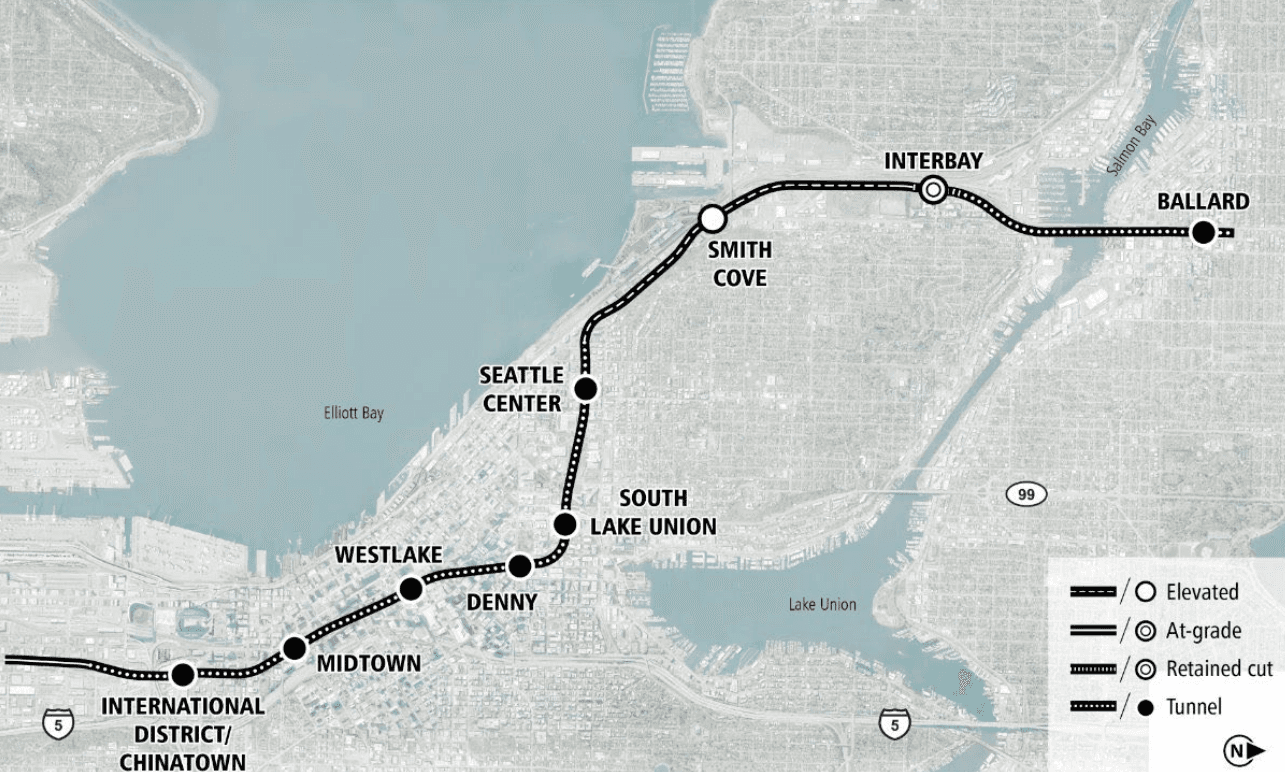
Sound Transit’s board convened in Tacoma Wednesday to confront a daunting financial reckoning: how to bridge a $34.5 billion funding shortfall through 2046 without abandoning the ambitious promises made to voters in 2016. In a marathon retreat, agency leaders unveiled three cost-cutting scenarios, and each one carried the same sobering reality—none would deliver light rail to Ballard’s 15th Avenue and Market Street station, the signature project that secured widespread support a decade ago. Instead, the proposals would defer Ballard Link to a future phase, potentially terminating the line at Seattle Center or Smith Cove, while also sidelining other major projects like the West Seattle Link Extension and the South Kirkland-to-Issaquah light rail line.
- Sound Transit faces a $34.5B funding gap through 2046, forcing major project delays.
- All three cost-cutting scenarios defer Ballard light rail, breaking a 2016 voter promise.
- Seattle Councilmember Dan Strauss and other leaders push for a Ballard route despite financial constraints.
- Deferred projects would still advance to 30% design, preserving future flexibility.
- A final plan is expected by May, though the timeline may slip amid ongoing negotiations.
Sound Transit’s $34.5 Billion Shortfall: Why the Math Doesn’t Add Up
The $34.5 billion shortfall represents more than just a budget imbalance—it’s a structural crisis for Sound Transit’s long-term vision. The agency’s financial projections, based on assumptions about tax revenue, ridership growth, and federal funding, have been upended by inflation, supply chain disruptions, and slower-than-expected post-pandemic ridership recovery. Unlike past shortfalls, which were often addressed through temporary delays or scope adjustments, this gap is persistent and requires fundamental rethinking of the ST3 program approved by voters in 2016. According to Sound Transit CEO Dow Constantine, the three scenarios presented this week were never intended as final solutions but as ‘illustrative starting points’ to guide the board’s deliberations. ‘The approaches are meant to provide meaningful contrasts for the board’s deliberations as you weigh how to update the Sound Transit 3 system plan,’ Constantine told reporters ahead of the retreat.
Deferring Ballard: The Cost of a Promise Unfulfilled
Ballard Link has emerged as the most contentious casualty of Sound Transit’s budget crisis. Even with aggressive cost-cutting measures, estimates peg the 4.3-mile extension from Westlake to Ballard at over $17 billion—more than double the cost of the Everett Link or Tacoma Dome extensions. The project’s price tag is driven by dense urban construction challenges, including a 1.6-mile tunnel beneath Seattle Center, which alone could cost billions. Ridership projections tell a different story: Ballard Link is expected to attract 90,000 to 147,000 daily riders by 2046, making it the highest-traffic line in the entire ST3 program. Its absence would not only limit connectivity in Ballard but also reduce transfer opportunities for riders coming from West Seattle, South Lake Union, and other dense neighborhoods.
“Getting to Ballard does require really doing a lot less of the rest of the program that, in staff’s opinion, made it not seem plausible to bring forward.” — Alex Krieg, Sound Transit Deputy Executive Director for Enterprise Planning
Which Projects Are on the Chopping Block—and Why
The three scenarios presented to the board prioritize different tradeoffs, but all share a common thread: deferring projects that are either expensive, politically contentious, or not yet in active planning. Option 1 would keep active projects like Everett Link and Tacoma Dome on track while deferring Ballard Link to Seattle Center, consolidating two South Lake Union stations into one, and deferring infill stations along the 1 Line in Seattle and Tukwila. Option 2 would go further, deferring the entire West Seattle Link—despite receiving federal approval—while still advancing the South Kirkland-to-Issaquah line. Ballard Link would terminate at Smith Cove under this scenario. Option 3, a more extreme planning exercise, would phase every project, stopping Everett Link at Southwest Everett Industrial Center and Tacoma Dome at Fife, while funding deferred projects like Graham Street Station and Boeing Access Road infill via cost savings from paused expansions.
Seattle’s Political Backlash: Why Leaders Are Pushing Back Against Delays
The deferral of Ballard Link has sparked fierce opposition from Seattle’s political leadership, particularly from Councilmember Dan Strauss, whose district includes Ballard. Strauss, a vocal advocate for transit equity and affordability, has argued that Sound Transit’s current approach breaks a decade-old promise to voters who approved ST3 with overwhelming support—including precincts in Ballard where nearly 90% voted in favor. Strauss also criticized Sound Transit’s ridership projections as outdated, noting that the agency has rezoned Ballard three times since 2016, potentially increasing future demand. ‘I say that it is unacceptable that we do not have a plan to get to Ballard,’ Strauss said at the retreat. ‘When I look at Ballard, by the time that we complete our enterprise work in May, we will have rezoned Ballard three times since ST3 was passed. So the ridership projections that we’re discussing today are outdated by a decade.’
“Some of those precincts adopted ST3 with nearly 90% of the vote.” — Dan Strauss, Seattle City Councilmember
The Broader Implications: How Sound Transit’s Choices Could Shape Seattle’s Future
Sound Transit’s financial struggles are not unique in the transit world, but they arrive at a pivotal moment for Seattle’s growth and equity. The agency has long positioned itself as a catalyst for affordable housing, economic development, and climate action, with light rail extensions designed to connect low-income communities and job centers. Delaying Ballard Link could undermine these goals by limiting access to high-opportunity areas for residents in North Seattle and Ballard, where rents have surged alongside limited transit options. Meanwhile, King County Councilmember Claudia Balducci, one of the board’s longest-serving members, has warned of a dangerous cycle of broken promises. ‘We keep cycling back to this place of crisis,’ Balducci said. ‘And we have to figure out why, so that we don’t keep doing that. So that ourselves or our successors are not sitting here 10 years from now doing this again.’
The Role of Inflation and Federal Funding in Sound Transit’s Crisis
Sound Transit’s funding model relies heavily on sales tax revenue, which plummeted during the pandemic and has only partially recovered. Inflation has driven up construction costs across the board, with West Seattle Link’s price tag dropping from nearly $8 billion to $5 billion in just 18 months due to revised engineering and cost-saving measures—a rare bright spot in an otherwise grim financial picture. However, federal funding, which has historically covered up to 50% of major transit projects, remains uncertain amid shifting national priorities and partisan debates over infrastructure spending. The agency is also grappling with the legacy of past decisions, including the 2021 delay of multiple light rail projects due to a $7 billion shortfall triggered by the pandemic’s economic fallout.
What’s Next for Sound Transit: A Timeline of Key Decisions
The Sound Transit board is racing to finalize a revised ST3 plan by May, though agency insiders acknowledge the timeline may slip as board members demand more data on ridership, demographics, and cost projections. The next major milestone is a board meeting on March 18, where staff will present additional cost-saving measures and seek direction on which projects to prioritize. Beyond May, the agency faces a series of external pressures, including potential legal challenges from communities affected by deferred projects and political pressure from state legislators to find alternative funding sources. Sound Transit has also committed to advancing deferred projects to at least a 30% design stage, preserving the option to revisit them if financial conditions improve. ‘This exercise is really about what can we afford based on the circumstances we know now, not: what can we ever deliver, period,’ said Alex Krieg of Sound Transit.
Could Ballard Light Rail Still Happen? Exploring the ‘Plausible and Affordable’ Path
Despite the bleak financial outlook, some transit advocates and political leaders argue that Sound Transit has not exhausted all options for delivering Ballard Link. Sound Transit staff has acknowledged that an option to reach Ballard could be feasible if the agency scales back other parts of the ST3 program more aggressively. However, Krieg noted that such a scenario would require ‘doing a lot less of the rest of the program,’ including delaying projects with strong political support in Snohomish and Pierce Counties. The challenge lies in balancing Ballard’s high ridership potential with the need to maintain regional connectivity and political viability. ‘We still have time to try to solve for delivering the full project,’ Krieg said, hinting that future cost-saving innovations or external funding could yet make Ballard a reality.
Frequently Asked Questions
Frequently Asked Questions
- Why is Sound Transit delaying Ballard light rail?
- Sound Transit faces a $34.5 billion funding shortfall through 2046. All three cost-cutting scenarios presented to the board defer Ballard Link due to its high cost ($17B+) and the need to prioritize other projects with lower price tags and stronger political support.
- What projects are at risk of being delayed?
- Projects on the chopping block include Ballard Link (terminating at Seattle Center or Smith Cove), West Seattle Link Extension, the South Kirkland-to-Issaquah light rail line, Tacoma’s T Line streetcar extension, and infill stations along the 1 Line in Seattle and Tukwila.
- Could Ballard light rail still happen in the future?
- Yes, but it would require Sound Transit to scale back other parts of the ST3 program more aggressively or secure additional funding. Deferred projects would still advance to 30% design, preserving the option to revisit them if financial conditions improve.