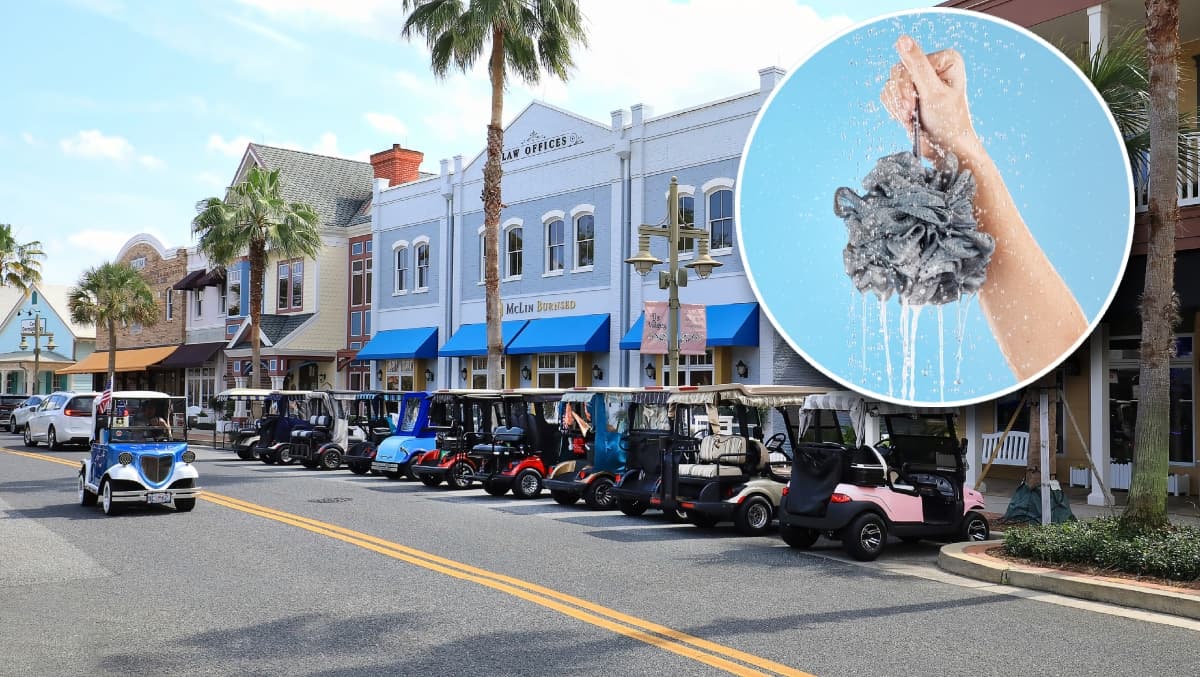
In a quiet retirement community in central Florida, an unlikely trend has taken hold, captivating local residents and baffling outsiders alike. Golf carts and cars in The Villages, a sprawling 55-and-older community known for its golf courses, social clubs, and active lifestyle, are now adorned with loofahs—yes, the same exfoliating shower sponges found in most American bathrooms. What began as a quirky local mystery has since ballooned into a viral sensation, thanks to a local news segment that aired earlier this month. The story, which features hilariously candid interviews with residents, has become a cultural touchstone, sparking debates, memes, and no shortage of head-scratching from viewers across the country.
How a Shower Sponge Became a Retiree Status Symbol in The Villages
The Villages, Florida, is a 49-square-mile retirement haven that bills itself as the "Healthiest Place to Live in America." With over 135,000 residents, it’s a self-contained world of golf courses, pools, and social clubs designed exclusively for adults aged 55 and older. The community is a microcosm of American retiree life, where leisure, socializing, and, yes, quirky trends, dominate the conversation. The loofah trend, while seemingly absurd, is a perfect example of how niche behaviors can emerge and spread in tight-knit communities where every detail—from bumper stickers to golf cart decals—becomes a form of self-expression.
The Origins of the Loofah Trend: A Mystery Wrapped in Exfoliation
No one knows exactly when or why loofahs first appeared on golf carts and cars in The Villages, but local residents and news reporters have offered a variety of explanations. Some claim the loofahs are used as a practical way to identify vehicles in crowded parking lots, especially since many residents drive similar models of Buicks, Chevys, and Hondas. Others suggest the trend is a playful nod to the community’s active social scene, where retirees often prioritize comfort and convenience over traditional aesthetics. A third theory, perhaps the most widely circulated, posits that the loofahs are a subtle signal among residents about their personal preferences—a sort of retiree shorthand for shared interests, though the specifics of what those interests might be remain delightfully vague.
The Local News Segment That Turned a Quirky Trend Into a Cultural Moment
The loofah phenomenon gained national attention after a segment aired on a local news station, WFTV 9 in Orlando, which serves The Villages and surrounding areas. The segment, part of the station’s regular local news coverage, featured interviews with three residents, each offering a wildly different take on the trend. The first interviewee, a woman who spoke limited English, explained that the loofahs were simply a way to distinguish her car from others—a claim that many viewers found hard to believe given the sheer variety of visual cues available, from license plates to bumper stickers. The second interviewee, an 82-year-old man wearing an Orioles hat, played dumb, asking, "What’s a loofah? I’m 82 years old. Is it like a hula hoop?" His baffled reaction became an instant meme, resonating with audiences who couldn’t fathom how someone could mistake a loofah for anything but an exfoliating tool. The third interviewee, a friend of the Orioles-hat man, took a more straightforward approach. "Yeah, we like to party; what of it?" he said with a grin, leaving little doubt about the trend’s underlying motives.
Why This Bizarre Trend Resonates: A Window Into Retiree Culture
The loofah trend may seem like a frivolous oddity, but it offers a fascinating glimpse into the social dynamics of retirement communities like The Villages. For many residents, life revolves around social clubs, group activities, and shared experiences. In such a tightly knit environment, even the smallest details—like a loofah on a golf cart—can become a form of communication. Some sociologists suggest that these trends emerge as a way for residents to assert individuality within a homogeneous setting or to signal belonging to a particular subgroup. Others argue that the trend is simply a playful rebellion against the conventional expectations of aging, a way for retirees to inject humor and whimsy into their daily lives.
The Broader Impact: From Local News to National Conversations
What started as a lighthearted local news story quickly transcended its origins, becoming a cultural talking point across social media platforms and online forums. Memes featuring the loofah interviews spread rapidly, with users remixing the footage into satirical videos and parody news segments. The trend even inspired debates about the role of local journalism in amplifying quirky community stories, with some praising the segment for its authenticity and others questioning whether it trivializes serious reporting. Regardless of perspective, the loofah phenomenon has undeniably left its mark, proving that even the most mundane objects can become symbols of broader cultural shifts.
The Psychology Behind the Trend: Why Loofahs?
To outsiders, the choice of a loofah as a decorative item might seem random, but psychologists and cultural analysts suggest that the trend taps into several psychological and social principles. First, the loofah’s texture and appearance make it highly visible, ensuring it stands out against the backdrop of golf carts and cars. Second, its association with personal hygiene and comfort aligns with the priorities of retirees, who often prioritize convenience and ease in their daily routines. Finally, the loofah’s dual nature—as both a functional tool and a potential symbol of shared interests—makes it a versatile medium for self-expression. In a community where individuality is celebrated but conformity is often expected, the loofah trend offers a tongue-in-cheek way to assert identity.
Key Takeaways: What You Need to Know About the Loofah Trend
- The loofah trend originated in The Villages, Florida, a massive retirement community known for its golf courses and active social scene.
- Residents offer varying explanations for the trend, ranging from practical identification to playful signaling of shared interests.
- A local news segment featuring hilarious interviews with residents went viral, turning the trend into a national conversation.
- The phenomenon reflects broader themes of individuality, community dynamics, and the role of humor in retiree culture.
- The loofah’s visibility, versatility, and association with comfort make it a uniquely effective symbol for this kind of expression.
Could This Trend Spread Beyond The Villages?
While the loofah trend is currently confined to The Villages, its viral nature raises questions about whether similar quirks could emerge in other retirement communities or even broader cultural contexts. Retirement communities in states like Arizona, Nevada, and California are already known for their eccentricities, from themed neighborhoods to elaborate social rituals. If the loofah trend gains traction elsewhere, it could become a symbol of the playful, rebellious side of aging in America—a counterpoint to the more traditional narratives of retirement as a time of decline. For now, however, the trend remains a uniquely Villages phenomenon, a testament to the community’s ability to turn the mundane into the memorable.
The Role of Local Journalism in Amplifying Quirky Stories
The loofah segment’s success highlights the enduring appeal of local journalism, particularly in communities where hyper-local stories can resonate far beyond their immediate audience. In an era of algorithm-driven news and nationalized media, stories like this serve as a reminder of the value of authentic, community-focused reporting. For journalists, the loofah trend is a case study in how to balance humor and seriousness, using a lighthearted topic to engage audiences while subtly exploring broader themes like aging, social dynamics, and the power of symbols. It’s also a reminder that not every story needs to be breaking news or investigative exposé to capture the public’s imagination.
Frequently Asked Questions About the Loofah Trend in The Villages
Frequently Asked Questions
- Why are there loofahs on golf carts and cars in The Villages, Florida?
- The exact reason remains unclear, but theories include using loofahs as a way to identify vehicles, a playful signal among residents, or simply a quirky trend that caught on within the tight-knit community. Some residents suggest it’s a nod to the community’s active social scene.
- Did the local news segment really feature an 82-year-old man asking, 'What’s a loofah?'
- Yes, the interview with the man in the Orioles hat became one of the most memorable moments of the segment. His baffled reaction to the question went viral, sparking memes and widespread amusement.
- Could the loofah trend spread to other retirement communities?
- While it’s possible, the trend appears to be uniquely tied to The Villages’ culture and social dynamics. Other retirement communities may have their own quirks, but the loofah phenomenon seems to reflect the specific identity of this central Florida retirement haven.