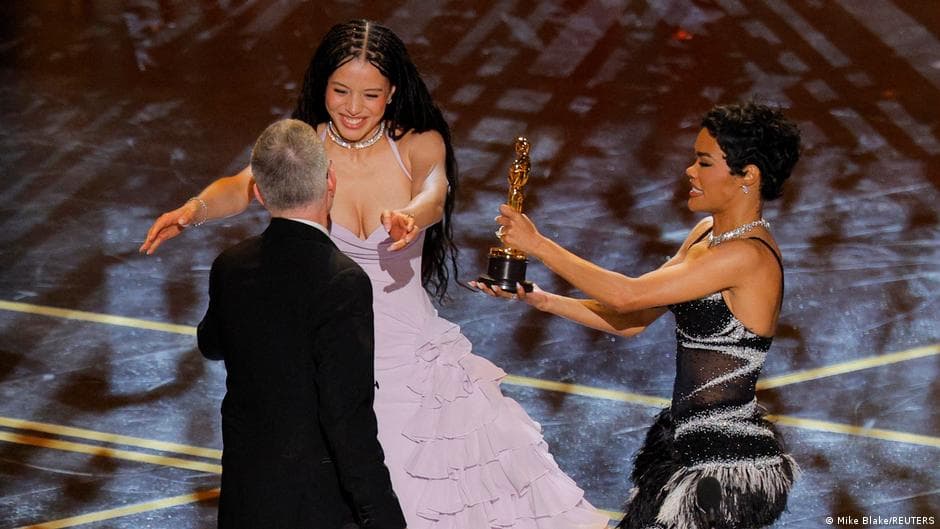
Hollywood’s most glittering night crowned Paul Thomas Anderson’s sweeping epic *One Battle After Another* as Best Picture at the 2026 Academy Awards, capping a ceremony that celebrated artistic ambition, generational storytelling, and a historic first for K-pop. The film, a multi-generational saga of political resistance set against an unnamed American landscape, dominated the night with six Oscars, including Best Director and Best Adapted Screenplay—marking Anderson’s long-overdue triumph after 11 prior nominations. Elsewhere, Michael B. Jordan claimed his first Oscar for *Sinners*, Jessie Buckley delivered a poignant acceptance speech for *Hamnet*, and the Korean K-pop track *Golden* from *K-Pop Demon Hunters* etched its name into history as the first non-English-language song to win Best Original Song, while also securing a sequel on Netflix.
The Big Winners: Best Picture and Anderson’s Redemption Arc
For over two decades, Paul Thomas Anderson has stood as a titan of American cinema, crafting masterpieces like *Boogie Nights*, *There Will Be Blood*, and *Phantom Thread*—films celebrated for their technical precision, emotional depth, and unflinching social commentary. Yet despite 11 prior nominations, including multiple nods for Best Director, Anderson had never claimed the golden statuette—until Sunday night. *One Battle After Another*, his sprawling, emotionally raw family drama, finally earned him the Oscar, a milestone that capped a career defined by both critical adoration and awards-season frustration. Speaking from the stage at the Dolby Theatre, Anderson reflected on the journey with characteristic humility, acknowledging the doubt that lingers even after such validation.
“You make a guy work hard for one of these,” Anderson quipped, his voice tinged with the weight of decades in the industry. “There will always be some doubt in your heart that you deserve it. But there is no question the pleasure of having it for myself.”
The film itself—a multi-generational saga centered on a family navigating political upheaval—has been praised for its grand visuals, layered performances, and its unflinching exploration of legacy and responsibility. Anderson dedicated his screenplay win to a deeply personal note: a message to his children, framed as both apology and encouragement. “I wrote this movie for my kids to say sorry for the housekeeping mess that we left in this world,” he said, “we’re handing off to them. But also with the encouragement that they will be the generation that hopefully brings us some common sense and decency.”
Why *One Battle After Another* Resonated Beyond the Screen
Anderson’s victory wasn’t just a personal milestone; it reflected a broader shift in Academy recognition toward ambitious, narrative-driven films that blend historical resonance with contemporary urgency. *One Battle After Another*, set against the backdrop of political turmoil reminiscent of mid-20th-century America, taps into themes of resistance, family obligation, and intergenerational trauma—topics that have gained renewed relevance in an era marked by global upheaval. Critics have lauded the film for its refusal to simplify its characters or its moral dilemmas, instead offering a portrait of flawed, human beings caught in the currents of history. The film’s six Oscar wins—including Best Casting, a first in Academy history—underscore its technical and artistic breadth, positioning it not just as a winner of 2026, but as a potential classic.
Michael B. Jordan and Jessie Buckley Claim Acting Gold
The acting categories delivered two of the night’s most emotionally charged moments. Michael B. Jordan, long considered one of Hollywood’s most charismatic leading men, secured his first Oscar for his dual role in *Sinners*, a drama set in Mississippi during the Great Depression. Jordan plays Elijah “Smoke” and Elias “Stack” Moore, estranged war veterans who attempt to use stolen money to open a juke joint—a narrative steeped in Black resilience, cultural preservation, and the scars of war. His acceptance speech was a masterclass in gratitude and lineage, placing his achievement in the context of generations of Black performers who paved the way.
“I stand here because of the people that came before me— Sidney Poitier, Denzel Washington, Halle Berry, Jamie Foxx, Forest Whitaker, Will Smith,” Jordan said, his voice steady with emotion. “And to be up amongst those giants, amongst those greats, amongst my ancestors, amongst my guys, thank you everybody in this room and everybody at home supporting me over my career.”
Jordan’s win was widely anticipated, but his speech elevated it from expected triumph to a moment of tribute. *Sinners*, directed by Antoine Fuqua, has been praised for its atmospheric direction and Jordan’s transformative performances, particularly in a role that required him to embody both physical and emotional duality. The film’s themes of brotherhood, redemption, and the weight of history resonated deeply with audiences and voters alike.
Jessie Buckley’s Triumph: A Poetic Ode to Legacy
Across the Dolby Theatre, Jessie Buckley delivered one of the night’s most moving speeches upon accepting the Oscar for Best Actress for her portrayal of Agnes in *Hamnet*. Based on Maggie O’Farrell’s acclaimed novel, the film reimagines the life of William Shakespeare’s son, Hamnet, who died in childhood, and the profound grief that shaped his father’s art. Buckley’s performance was a revelation—capturing both maternal love and sorrow with haunting precision. Her speech was equally powerful, weaving together family, cultural identity, and artistic defiance.
“My family, my Irish family—they’re all here. Ireland bought them flights,” Buckley said, her eyes welling with tears. “Mom, dad, thank you for teaching me to dream and to never be defined by expectation but to carve your own passion. We all come from a lineage of women who continue to create against all odds. Thank you for recognizing me in this role.”
Buckley, a rising star known for her versatility in projects like *War & Peace* and *I’m Thinking of Ending Things*, has long been tipped for award success. Her win solidified her status as one of the most compelling actors of her generation. In a playful aside before the ceremony, she joked that Shakespeare himself would approve of the Oscars—though she wryly noted, “I suspect he’d be more interested in the afterparty.”
K-Pop Enters the Mainstream: 'Golden' Makes History
No moment at the 2026 Oscars captured the zeitgeist quite like the win for Best Original Song by *Golden*, the infectious K-pop anthem from the animated film *K-Pop Demon Hunters*. The track—composed by Mark Sonnenblick, Joong Gyu Kwak, Yu Han Lee, Hee Dong Nam, Jeong Hoon Seo, and Teddy Park—became an overnight sensation, dominating streaming platforms and social media feeds. Its win marked a cultural milestone: the first time a non-English-language song won in the category, and the first K-pop track to ever receive an Oscar. The song’s infectious melody and high-energy production made it an instant earworm, but its victory also signaled a tectonic shift in global pop culture, where K-pop has evolved from niche genre to mainstream juggernaut.
From Netflix Hit to Oscar Winner: A Franchise is Born
*K-Pop Demon Hunters* was already the most-watched film in Netflix history before the Oscars, its viral success fueled by TikTok trends, fan art, and a soundtrack that transcended language barriers. The film’s blend of demon-slaying action, vibrant animation, and K-pop choreography created a uniquely modern cinematic experience. Following the Oscar win, Netflix confirmed a sequel is in active development, with co-director Maggie Kang expressing her ambition to build a larger universe. “I feel immense pride as a Korean filmmaker that the audience wants more from this Korean story and our Korean characters,” Kang said. “There’s so much more to this world we have built and I’m excited to show you. This is only the beginning.”
The film is also nominated for Best Animated Feature and Best Original Song, and *Golden* has already made history beyond the Oscars. Earlier this year, it won the Grammy for Best Song Written for Visual Media—the first K-pop track to claim that trophy, further cementing its place in music history. The song’s producer, Teddy Park, a legend in K-pop known for his work with BIGBANG, was visibly moved as he accepted the Oscar, though the orchestral rules limited his microphone time to a single sentence.
International Spotlight: 'Sentimental Value' and 'Mr. Nobody Against Putin'
The Academy also honored international cinema with two powerful wins. From Norway, *Sentimental Value* took home Best International Feature Film, a quietly devastating drama directed by Kristoffer Borgli. The film follows stage actress Nora (Renate Reinsve), who returns to her estranged father’s home in a crumbling seaside town, uncovering long-buried family secrets. Reinsve, already an Oscar nominee for her role in *The Worst Person in the World*, delivered a nuanced performance that critics called a masterclass in emotional restraint. The film’s four acting nominations—including nods for Best Actress and Best Supporting Actor—highlighted its ensemble strength and its exploration of memory, loss, and reconciliation.
The night also brought a sobering moment of political cinema to the forefront with *Mr. Nobody Against Putin*, a documentary that exposed the systematic propaganda and indoctrination of Russian schoolchildren in the wake of the invasion of Ukraine. The film, directed by Geeta Gandbhir and produced by Alisa Payne, Nikon Kwantu, and Sam Bisbee, follows Pavel Talankin, an exiled activist who was a child in Russia during the Soviet era. Speaking in Ukrainian from the stage, Talankin delivered a plea that echoed across the theater: “Stop all of these wars now.” The film’s win underscored the Academy’s continued engagement with global conflicts and its role as a platform for voices silenced by authoritarian regimes.
The Biggest Snubs and Surprises of the Night
While the 2026 Oscars celebrated excellence across categories, the ceremony was not without controversy. Timothée Chalamet, widely considered a frontrunner for Best Actor for his role in *Marty Supreme*, was passed over in favor of Michael B. Jordan—a decision that sparked debate among critics and audiences alike. Chalamet, known for his collaborations with director Luca Guadagnino and his Oscar-nominated roles in *Call Me by Your Name* and *Dune*, has yet to win an Academy Award despite multiple nominations. His omission renewed discussions about the Academy’s evolving tastes and the role of genre films in awards recognition.
Other notable snubs included *The Last Waltz*, a Martin Scorsese documentary about The Band, which failed to secure a nomination despite strong critical reception. Meanwhile, the Best Cinematography award went to Autumn Durald Arkapaw for *Sinners*, a visually stunning achievement that highlighted the film’s use of chiaroscuro lighting and sweeping landscapes—a testament to the growing recognition of cinematographers in crafting immersive visual experiences.
What the 2026 Oscars Say About the Future of Cinema
The 2026 Academy Awards represented more than just a night of trophies—they reflected a rapidly changing industry. The dominance of *One Battle After Another* and *K-Pop Demon Hunters* signaled a shift toward ambitious, culturally diverse storytelling that blends high art with mass appeal. The recognition of international cinema, from Norway’s *Sentimental Value* to the Ukrainian-backed *Mr. Nobody Against Putin*, underscored the Academy’s growing commitment to global perspectives. Meanwhile, the historic win for *Golden* marked a turning point for non-English-language music in Hollywood, challenging long-held assumptions about what constitutes “American” culture.
Key Takeaways from the 2026 Oscars
- Paul Thomas Anderson’s *One Battle After Another* won Best Picture, marking his first Oscar win after 11 nominations, and cementing its place as a modern epic.
- Michael B. Jordan won his first Oscar for *Sinners*, delivering a heartfelt tribute to Black cinematic pioneers in his acceptance speech.
- Jessie Buckley claimed Best Actress for *Hamnet*, with a speech that celebrated Irish heritage and artistic defiance.
- *Golden*, the K-pop anthem from *K-Pop Demon Hunters*, made history as the first non-English-language song to win Best Original Song and the first K-pop track to ever receive an Oscar.
- The night highlighted international cinema (*Sentimental Value*, *Mr. Nobody Against Putin*) and continued the push for greater cultural diversity in Hollywood.
What’s Next: Sequels, Soundtracks, and Legacy
With a sequel to *K-Pop Demon Hunters* officially greenlit and Anderson’s Oscar win likely to spur renewed interest in his back catalog, the cultural ripple effects of the 2026 Oscars are only beginning. The win for *Golden* has already boosted the song’s streaming numbers by over 800%, and its Grammy victory earlier this year set the stage for K-pop to become a permanent fixture in awards conversations. Meanwhile, *One Battle After Another* is expected to benefit from the “Oscar bump,” potentially driving theatrical re-releases and streaming interest in the coming months. As for Anderson, his next project—a rumored adaptation of Thomas Pynchon’s *Against the Day*—could become one of the most anticipated releases of the decade, following his Oscar redemption arc.
Frequently Asked Questions
Frequently Asked Questions
- Who won Best Picture at the 2026 Oscars?
- Paul Thomas Anderson’s *One Battle After Another* won Best Picture at the 2026 Academy Awards, marking Anderson’s first Oscar win after 11 nominations.
- Did a K-pop song win an Oscar in 2026?
- Yes, the song *Golden* from the film *K-Pop Demon Hunters* won Best Original Song, making it the first non-English-language track and first K-pop song to ever win the award.
- Will there be a sequel to *K-Pop Demon Hunters*?
- Yes, Netflix has officially greenlit a sequel to *K-Pop Demon Hunters*, with co-director Maggie Kang expressing ambitions to expand the franchise beyond the original film.