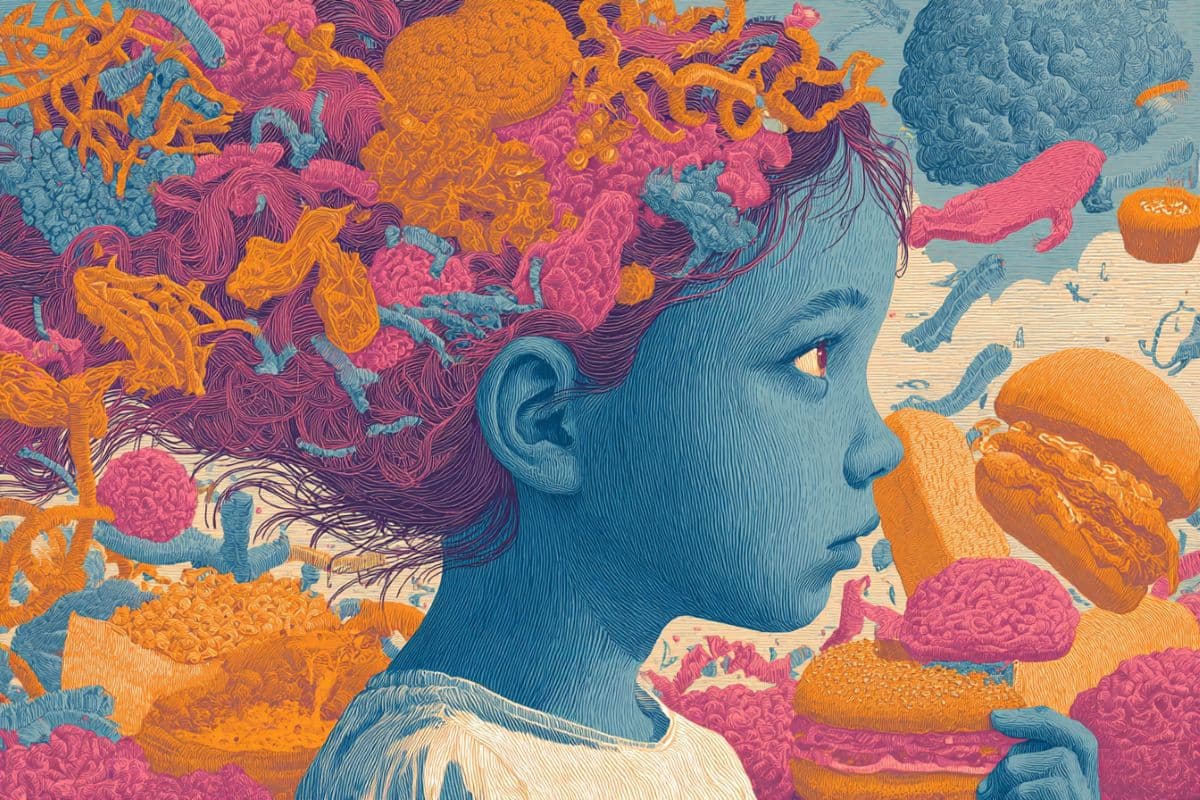
Summary: Unhealthy eating during childhood may leave a permanent imprint on the brains appetite control center, even if body weight is later normalized. New research demonstrates that a high-fat, high-sugar diet in early life causes lasting disruptions in the hypothalamus. These changes result in unhealthy feeding patterns that persist into adulthood.
However, the study also offers a beacon of hope: specific gut bacteria interventions, such as the probiotic Bifidobacterium longum or prebiotic fibers, were found to restore healthy brain-gut signaling and mitigate the long-term effects of an early poor diet.
- The Hypothalamic Imprint: Early exposure to junk food disrupts the brain pathways involved in appetite control and energy balance, leading to persistent unhealthy eating habits.
- Hidden Effects: These brain changes can remain even after an unhealthy diet is stopped and weight returns to a healthy range, creating a hidden risk for future obesity.
- Microbiome as a Shield: Administering the probiotic strain Bifidobacterium longum APC1472 helped prevent and restore the feeding behavior changes induced by early-life junk food.
- Prebiotic Power: Fibers like FOS and GOS (found in onions, garlic, and bananas) drove broader shifts in the gut microbiome that supported healthier brain-gut communication.
- Early Intervention: The findings emphasize that dietary habits from birth are critical for lifelong brain health, but also highlight the gut microbiome as a therapeutic target for reversing early damage.
Eating unhealthy foods early in life leave lasting brain and feeding changes but gut bacteria can help restore healthy eating, new UCCresearch study finds today.
A high-fat, high-sugar diet during the early life period can cause long-lasting changes in how the brain regulates eating, even when the unhealthy diet is stopped and body weight is normalised, the researchers at APC Microbiome, a leading research institute, at UCC discovered.
Children today are growing up in food environments saturated with high-fat, high-sugar options that are readily accessible and heavily promoted. From birthday parties and school celebrations to sporting events and even as rewards for good behaviour, these foods have become a routine part of childhood experiences.
This new research highlights the long-term impact of this early exposure, demonstrating that frequent consumption of energy-dense, nutrient-poor foods in childhood can shape preferences and establish unhealthy eating patterns that persist well into adulthood.
Published today in Nature Communications, the study also demonstrates that microbiota-targeted interventions, including a specific strain of beneficial gut bacteria (Bifidobacterium longum APC1472) or prebiotic fibres (fructo-oligosaccharides (FOS) and galacto-oligosaccharides (GOS), naturally present in foods such as onions, garlic, leeks, asparagus and bananas, and widely available in fortified foods and prebiotic supplements), could help prevent these effects when administered throughout life.
The researchers found that exposure to a high-fat, high-sugar diet during early life in a preclinical mouse model led to persistent alterations in feeding behaviour in adulthood. These behavioural changes were linked to lasting disruptions in the adult hypothalamus, a key brain region involved in appetite control and energy balance.
What we eat early in life matters
“Our findings show that what we eat early in life really matters.” said Dr Cristina Cuesta-Martí, first author of the study. “Early dietary exposure may leave hidden, long-term effects on feeding behaviour that are not immediately visible through weight alone.”
The study showed that unhealthy diets early in life disrupted brain pathways involved in feeding behaviour, with effects lasting into adulthood, suggesting an increased risk of obesity later in life.
Importantly, targeting the gut microbiota helped counteract these long-term diet-related effects. The putative probiotic strain Bifidobacterium longum APC1472 produced marked improvements in feeding behaviour while inducing only minor changes in overall microbiome composition, suggesting a targeted mode of action. In comparison, the prebiotic combination (FOS+GOS) drove broader shifts in the gut microbiome.
Targeting the gut microbiota can mitigate the long-term effects
Dr Harriet Schellekens, lead investigator of the study, added: “Crucially, our findings show that targeting the gut microbiota can mitigate the long-term effects of an unhealthy early-life diet on later feeding behaviour. Supporting the gut microbiota from birth helps maintain healthier food-related behaviours into later life.”
Professor John F. Cryan, Vice President for Research & Innovation at UCC and collaborator on the study, said: “Studies like this exemplify how fundamental research can lead to potential innovative solutions for major societal challenges. By revealing how early-life diet shapes brain pathways involved in the regulation of feeding, this work opens new opportunities for microbiota-based interventions.”
Funding: The UCC led study was in partnership with collaborators at the University of Seville (Spain), University of Gothenburg (Sweden) and Teagasc Food Research Centre (Fermoy, Ireland), and funded by Research Ireland, a Government of Ireland Postgraduate Scholarship and a research award from the Biostime Institute for Nutrition & Care.
A: Yes. The research shows that high-fat, high-sugar foods during childhood can rewire your hypothalamus—the part of the brain that tells you when youre hungry or full. This can make you more prone to overeating later in life, regardless of your current weight.
A: Not necessarily. The study found that targeting the gut microbiome with specific probiotics or fiber can help reset these brain pathways, suggesting that gut health might be the key to overcoming early-life dietary habits.
A: Prebiotic fibers like FOS and GOS are naturally found in everyday foods like leeks, asparagus, garlic, onions, and bananas. These fibers feed the good bacteria that help maintain healthy brain-gut signaling.
- This article was edited by a Neuroscience News editor.
- Journal paper reviewed in full.
- Additional context added by our staff.
About this neurodevelopment and diet research news
Author: Eoin HahessySource: UCCContact: Eoin Hahessy UCCImage: The image is credited to Neuroscience News
Original Research: Open access.Bifidobacterium longum and prebiotic interventions restore early-life high-fat/high- sugar diet-induced alterations in feeding behavior in adult mice by Cristina Cuesta-Marti, Eduardo Ponce-España, Friederike Uhlig, Iris Stoltenborg, Luiza A. Wasiewska, Lamiah Kareem, Dara Hedayatpour, Loreto Olavarría-Ramírez, Cristina Rosell-Cardona, Thomaz. F. S. Bastiaanssen, Gabriel. S. S. Tofani, Benjamin Valderrama, Klara Vlckova, Suzanne L. Dickson, Aonghus Lavelle, Catherine Stanton, R. Paul Ross, John F. Cryan, Timothy G. Dinan, Gerard Clarke, Siobhain M. O’Mahony & Harriët Schellekens. Nature CommunicationsDOI:10.1038/s41467-026-68968-2
Bifidobacterium longum and prebiotic interventions restore early-life high-fat/high- sugar diet-induced alterations in feeding behavior in adult miceAbstract