Some of us didn’t choose to become doctors for a reason. Because not everyone enjoys staring at organs in jars, or flipping through coroners’ reports.
Medicine, after all, deals with the real human body. And the real human body isn’t always pretty. Some injuries, conditions, and treatments can look like they come straight out of a horror movie — except they’re very real.
However, if you belong to the group that is drawn toward medical images for some reason, then dare to scroll till the end.
One Instagram page, called Creepy Medical, has nearly 170,000 followers who show up for exactly this kind of content.
We’ve rounded up some of the most unsettling pics from their account. And perhaps, we don’t need to repeat it, but we will — the pics below may be disturbing to some viewers.
The curiosity to look at medical procedures or conditions isn’t new.
Long before the internet existed, crowds gathered to watch public surgeries in the anatomical amphitheaters of the Renaissance. Here, public dissections took place several times a year to see what many believed were the “secrets of nature revealed by God.”
For an entrance fee, people could watch doctors conducting an autopsy on the body of an executed criminal. Surgery was pure theatre, literally.
As Julie V Hansen describes, “In the anatomical theater, which was lit by scented candles to augment the dim light drawn from windows and sometimes featured music played by a flutist…they took on a festive and theatrical atmosphere.”
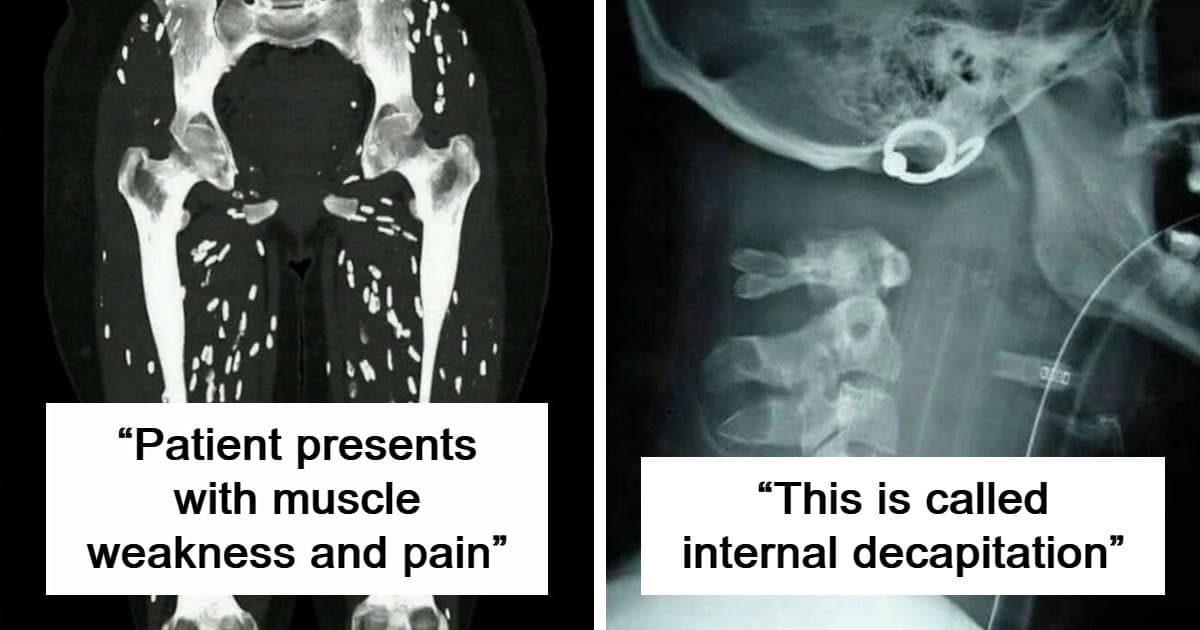
Fibrodysplasia ossificans progressiva is a disorder in which muscle tissue and connective tissue such as tendons and ligaments are gradually replaced by bone (ossified), forming bone outside the skeleton (extra-skeletal or heterotopic bone) that limits movement.
44-year-old man came to the emergency department wearing a baseball cap and complaining of severe headaches that had progressively worsened over the preceding 11 weeks. when the patient removed his cap to it was revealed that an assortment of metallic objects are embedded in his scalp. .Plain radiographs showed 11 nails penetrating into his brain. His detailed history presented a diagnosis of PARAN0ID SCHlZ0PHRENlA, and the patient confirmed that he had hammered a nail into his head each week for the past 11 weeks in order to rid him of evil. .The nails were removed with the patient under general anesthesia, and he made an uncomplicated recovery with no neurological deficits.
Usually Reynaud's phenomenon it's kinda blue/white/red and it's not focus on a specific finger (in general)
Around the 18th century, the operating theater at Jefferson Medical College in Philadelphia was famously nicknamed “the pit,” a reference to the space where orchestra musicians typically sit during performances.
Surgery turned certain doctors into public attractions. Scottish surgeon Robert Liston was history-of-operating-theaters/1" rel="noopener noreferrer" target="_blank">nicknamed “the fastest knife in the West End,” and it was rumored that he operated with a blade gripped between his teeth.
However, by the 20th century, operating theatres with audiences had all but disappeared.
Once anesthesia started being used, doctors no longer had to rush through operations as fast as possible, and the dramatic atmosphere faded. Doctors also began to realize that big crowds were bringing germs with them which was not so ideal for the patients.
The 27-year-old woman with a history of schizoaffective disorder presented from an inpatient psychiatric facility with an acute onset of nausea, vomiting, abdominal pain and early satiety.
On examination, vital signs were stable. Abdomen was distended and diffusely tender to palpation but without peritoneal signs. CT scan showed multiple, well-circumscribed lesions of varying density within the gastric body but no evidence of perforation or obstruction.
In upper endoscopy, upon entering the stomach, there were numerous crayons layered in the gastric fundus and gastric body, as shown above. An overtube was placed into the stomach under endoscopic guidance, and a total of 81 full-size and intact crayons, crayon wrappers and a pen were removed with a snare.
The patient did well after the procedure and was discharged back to inpatient psychiatric facility.
Today, the setting is different, but the curiosity is still there.
People visit museums to see preserved specimens or detailed wax models showing diseases and injuries.
They scroll through online archives of historical medical photos, follow pages dedicated to unusual cases, or watch doctors explain procedures online.
A recent survey found that 58.5% of US adults used the internet to look for health or medical information.
In another survey of medical students, 39.2% said they watch cadaver dissection videos, while 85% said they use YouTube to study human anatomy.
Extensive head swelling due to an allergic reation to hair dye!
A university student says she thought she might die after she had a severe allergic reaction to a hair dye that caused her head to swell enormously. She bought a hair color dye in a supermarket so she could change the color from blonde to brunette. She got concerned a few hours after she applied the dye to her scalp, when it started to itch. Not thinking too much about it, she went to the pharmacist to get some cream to deal with the irritation—but the worst was yet to come.
Two days later, she looked in the mirror and was shocked by what she saw. Her head had swollen beyond recognition.
She was rushed to the hospital where doctors found she had an allergic reaction to paraphenylenediamine (PPD,) a compound found in 90 percent of hair dyes and known to carry allergic risks. After treatment the swelling eventually went down and her face went back to normal.
It’s easy to understand why medical students end up watching anatomy videos or surgical clips online. But that still makes us wonder why people with zero medical background scroll through unusual medical photos, especially when they are not suffering from any illnesses.
Part of it is simple curiosity. The human body can do some pretty strange things, and people want to know what’s possible.
Sometimes, it’s also about awareness — seeing a rare condition online might help someone recognize it later in real life.
Take something like a green hairy tongue. It sounds made up, but it’s a real condition often linked to things like antibiotic use or smoking.
Then there’s anonychia, a rare condition where someone is born without fingernails. It doesn’t affect many people, but when it does, it can change both appearance and everyday function.
Stories and images like these are exactly why people keep scrolling.
Some are fascinating, some are a little gross… but they all show just how strange and unpredictable the human body can be.
Can you imagine having no fingernails? Anonychia, also known as congenital anonychia or congenital nail absence, is a rare condition characterized by the absence of nails at birth or a severe reduction in nail size. While it affects a small percentage of the population, its impact on physical appearance and function can be significant.
Causes:Anonychia can be inherited as a genetic trait or occur sporadically. It may result from mutations in various genes involved in nail development during embryogenesis. Additionally, certain environmental factors or underlying medical conditions, such as ectodermal dysplasias, may contribute to its development.
Symptoms:The primary symptom of anonychia is the absence of one or more nails on the fingers or toes. In some cases, the nails may be present but severely underdeveloped, thin, or misshapen. Other associated features may include abnormalities in the skin, hair, and teeth, depending on the underlying cause.
Management:Treatment for anonychia focuses on addressing cosmetic concerns and optimizing nail function, if possible. While there is no cure for the condition, individuals may explore various options such as prosthetic nails, nail wraps, or cosmetic tattooing to improve the appearance of affected nails. Additionally, regular care of the remaining nails and surrounding skin can help prevent complications such as infections or ingrown nails.