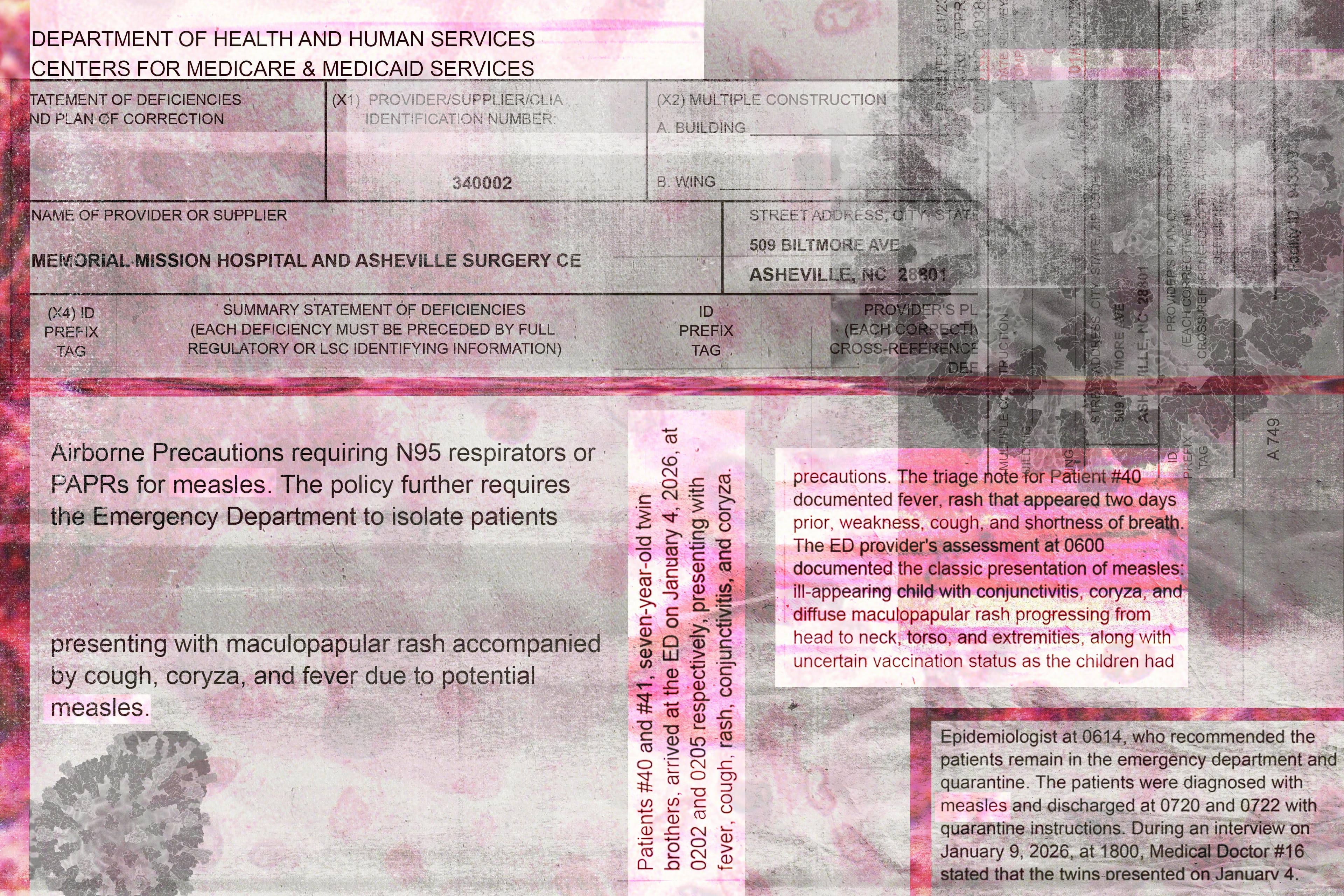
ASHEVILLE, N.C. — At around 2 a.m., 7-year-old twin brothers arrived at Mission Hospital in Asheville. Both had a fever, a cough, a rash, pink eye, and cold symptoms.
This story also ran on USA Today. It can be republished for free.
The boys sat in one waiting room and then another. Two hours and 20 minutes passed before the two were isolated, according to Centers for Medicare & Medicaid Services records obtained by KFF Health News. Then two more hours ticked by.
As the sun rose, an emergency room doctor called the state epidemiologist and described the symptoms. The public health official told him to keep the kids in the hospital and quarantine them. Shortly after that call, the patients were diagnosed.
Hospital staff gave the father instructions on how to quarantine the family and sent them home.
The virus exposed at least 26 other people in the hospital that January day, federal investigators determined. Health inspectors for CMS investigated the measles infections and other failures in care and concluded that the twins’ symptoms should have triggered an isolation procedure for which Mission Hospital staffers had trained seven months earlier. CMS designated Mission in “Immediate Jeopardy” for the exposures and other unrelated issues, one of the most severe sanctions a hospital can face, threatening to pull federal funding unless it remedied the problems.
A spokesperson for Mission said its staff was trained to manage airborne sickness and is following federal rules.
As U.S. hospitals face an increasing risk of encountering measles, and pressure to immediately spot it, health care workers face an unusual barrier: Many don’t know what it looks like.
“There’s a word, ‘morbilliform’ — it means measles-like, and there are lots of viruses that can cause a rash that looks like a measles rash in children,” said Theresa Flynn, a pediatrician in Raleigh and the president of the North Carolina Pediatric Society. In 30 years in health care, she’s never seen a measles case, she said.
North Carolina has reported more than 20 cases since mid-December, and more than 3,000 people nationwide have been infected since the beginning of 2025.
Children in areas with low immunization rates have been especially susceptible to outbreaks, triggering public health campaigns to promote the measles vaccine. CMS Administrator Mehmet Oz encouraged vaccination in a CNN interview on Feb. 8.
With two doses of the measles, mumps, and rubella vaccine, a person has a 3% chance of getting the virus after exposure. If exposed, an unvaccinated person has a 90% chance of being infected, according to the CDC. It can take a week or two before someone infected with measles shows symptoms.
But for the past year, the Trump administration has sown doubt about vaccine effectiveness. Health and Human Services Secretary Robert F. Kennedy Jr. was a longtime anti-vaccine activist before taking office, and under his leadership the Centers for Disease Control and Prevention has reduced the number of shots recommended to children.
After measles erupted in West Texas last year, Kennedy publicly recommended unconventional and unproven treatments for the virus, including steroids, antibiotics, and cod liver oil.
Infectious disease experts and doctors said federal policies have left health care workers to lean on their own experience or guidance from their state public health systems to fight a disease that many are preparing to see for the first time and that initially may behave like the common cold.
“As measles becomes more common, all of us are leveling up in our ability to recognize and immediately respond to suspected measles,” Flynn said.
Officially, the U.S. has maintained “measles elimination status” since 2000, meaning the U.S. has avoided significant spread of the virus. After outbreaks in Texas, Arizona, Utah, and now South Carolina, the nation is on track to lose that designation before the year is out. Its own adopted regulations tie elimination status to a lack of a continuous viral spread persisting for 12 months.
One county in South Carolina, an hour’s drive from Asheville, has had more than 900 cases in the current outbreak — more than Texas reported in all of 2025.
Symptoms of measles, a virus that attacks the lungs and airways, can include fever, cough, a blotchy rash, and red, watery eyes. Researchers consider measles among the most contagious diseases, and the virus may remain active for up to two hours after an infected person leaves a room.
It can be lethal, with 1 to 3 deaths per 1,000 cases in children.
In 2025, two children in Texas and one adult in New Mexico died of measles.
Along with tracking data, the CDC provides detailed summaries on its website for diagnosing measles. State public health agencies and some counties have developed dashboards tracing the disease as it surfaces in such places as hospitals, schools, grocery stores, and airports. Large hospital systems developed staff training protocols last year and shared them with area clinics.
Look for the three C’s, that guidance said: cough, coryza (cold symptoms), and conjunctivitis (pink eye). According to CMS inspection records, HCA Healthcare, which owns Mission Hospital, trained Mission staff on the three C’s early last year. On top of failing to isolate the twin patients right away, Mission staff didn’t have a designated area for patients with respiratory symptoms, federal inspectors found.
The CDC advises health workers to immediately place patients with measles or suspicious symptoms in a special isolation room, where airflow is controlled inward. The Mission patients were separated from other patients only by plastic partitions, according to the CMS records.
Mission spokesperson Nancy Lindell said the hospital was equipped and staffed to manage airborne illnesses like measles.