- Jeffrey Epstein WAS a dad: The pedophile's shocking confession and the photo of the blonde he called the 'perfect woman'
- Moment HStikkytokky is told off by his mum on Louis Theroux's Manosphere as she scolds 'that's not how I brought you up'
- Trump declares war with Iran WON as Tehran fires intense missile barrage and vows to fight on
- What REALLY goes on inside a David Lloyd gym: Rumours of 'amorous' liaisons in quiet corners, members who use it like a hook-up joint and rival cliques that would make the Real Housewives blush (if your partner's a member, look away now!)
- 'She has quite an ego but Hannah is a million times better': Amber Davies's new West End feud with rising star threatening to replace her... as insiders reveal mortifying on-stage gaffe and backstage tension: OLIVIA KEMP
- Dubai high-rise catches fire after direct-hit from Iran drone as rescue operation unfolds off Iraq after 'deadly attack' oil tankers - updates
- Iran plotting drone attack on California as retaliation for the war, terrifying FBI alert reveals
- I've suffered with piles for 10 years. I tried ointment and two surgeries but nothing helped... until I found this simple remedy. This is how it changed my life - and the surprising daily habit that was making my agony worse
- How Sasha Attwood is stepping out of boyfriend Jack Grealish's shadow with a VERY lucrative new venture... as insiders tell MOLLY CLAYTON about the couple's big plans for the future
- Mandelson's '£75,000 bung for betraying Britain': Starmer's ministers 'happily' handed peer huge payoff... and the PM DID know he stayed friends with Epstein
- Lorna Luxe returns to social media after her 'brilliant' husband John's 'beautiful' funeral following his death from cancer
- Nothing I tried could shift my 'meno-middle'... Then a miracle method banished it in just four weeks - without jabs or a single visit to the gym
- Apple quietly kills 15 devices in sweeping product purge... is yours on the list?
- I thought everyone did this in bed. But when I told my friends my go-to sex move... they said I was vile: DEAR JANE
- Home Office REFUSES to reveal how many failed asylum seeker families have accepted £40,000 in taxpayers' money to leave Britain
- The exact age Gen Z consider you 'old', revealed - so, are you past it?
- Moment 'white British' boy, 15, is arrested by armed police after teenage girl pupil is stabbed in school
- Schoolgirl, 12, is feared to have taken her own life after being relentlessly bullied on Snapchat
- Jeff Brazier left 'blindsided as sons Bobby and Freddy continue reality TV show without him' amid family tension
- The glamorous stars who can't resist a cigarette... after Kylie Jenner sparked outrage by smoking on Vanity Fair cover
- Ellie Goulding reveals newborn baby daughter's sweet name in formal birth announcement
- Carole's Cheltenham cheer! Kate's mother proves she's truly in the Royal inner circle as she hugs Princess Anne on Ladies Day out with Queen Camilla
- Moment Louis Theroux humiliates HStikkytokky by calling out his double standards in Netflix's Manosphere documentary - before influencer explodes 'you're talking s**t, mate!'
- The ultimate guide to beating mortgage hikes: Our experts reveal exactly what's happening and how you can still grab a cheap deal
By XANTHA LEATHAM, EXECUTIVE SCIENCE EDITOR
Published: 10:58 GMT, 11 March 2026 | Updated: 16:04 GMT, 11 March 2026
An incredible new map could help explain why anger feels similar to fear, and why being in love makes you feel warmhearted.
Researchers have used AI to analyse brain imaging data, revealing how we process different emotions.
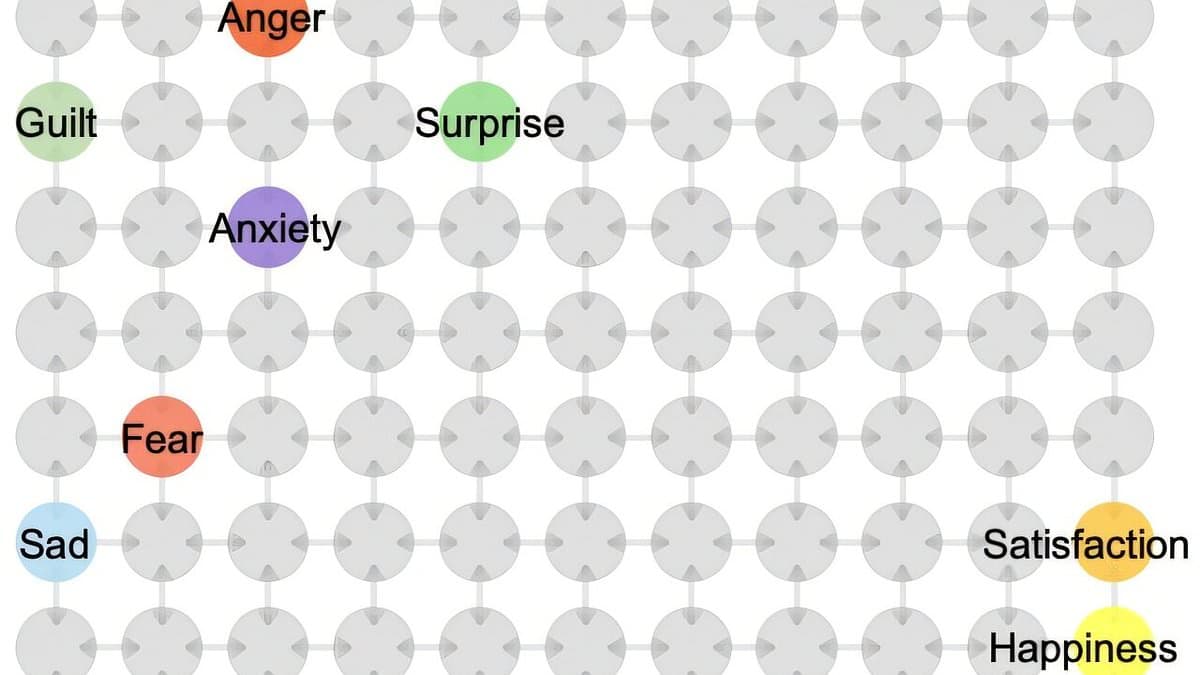
They created an artificial 'mental map', with pleasantness along one axis and bodily reactions along the other, and charted how the brain responded while watching clips from films.
The results revealed clear groupings in the way that our brains represent emotion – with guilt, anger and disgust in one corner and happiness, satisfaction and pride in the other.
The findings could help explain why fear, anxiety and anger all elicit the same bodily response – rapid breathing and a beating heart – and all carry a similar level of unpleasantness.
Meanwhile love, pride and warmheartedness are all mapped closely together, showing how these emotions are also comparable.
'People's emotional experiences are subjective,' first author Yumeng Ma, from Emory University in the US, said.
'We're using technology to understand the mechanisms underlying emotions in an objective, scientific way.'
The results revealed clear groupings in the way that our brains represent emotion – with guilt, anger and disgust in one corner and happiness, satisfaction and pride in the other
For their study, the team asked 30 participants to watch short, emotionally evocative film clips while rating their emotions.
These ratings were compared to brain MRI scans taken while they were viewing the movies.
The team discovered links between self-reported emotional experiences and MRI patterns in the brain.
Analysis revealed brains 'embed' emotions in a map-like way.
'For example, occurrences of anger and fear are often closer together compared to those of happiness and excitement,' Ms Ma said.
The researchers hope to build on their findings by studying how this mental map may differ among those with mental health issues.
'Research has shown that individuals with depression and anxiety represent emotions in a more compressed, less differentiated way,' Philip Kragel, senior author, said.
'And that people who represent emotion with more granularity and differentiation tend to have better health outcomes.'
The 'mental map' involved charting how pleasant or unpleasant an emotion was, along with how it prompted bodily reactions
The researchers used their 'brain map' to analyse how participants felt while watching film clips
They also want to explore how this mental map for emotions develops over time.
Anger, Disgust, Guilt, Anxiety, Surprise, Fear, Sadness
Satisfaction, Happiness, Pride, Warmheartedness, Love, Regard