- News Local News National True Crime World Health Podcasts Weather Archives
- Sports Local Sports Hockey London Knights NHL PWHL Soccer Football CFL NFL Baseball Basketball London Lightning NBA Curling Golf Tennis MMA Auto Racing
- Business Local Business Featured Businesses Mining Technology FP Markets
- Arts Local Arts Theatre Movies Television TV Listings Music Books Celebrity
- Life Horoscopes Fashion & Beauty Diet & Fitness Sexual Health Homes Decorating Gardening Food Recipes Parenting Relationships Royals Travel Travel Ontario Travel Canada Travel USA Travel International Cruises Travel Essentials Savings New York Times Crossword Contests National Contests Advice Horoscopes Weather
- Travel Travel Ontario Travel Canada Travel USA Travel International Cruises Travel Essentials
- Driving Vehicle Research Reviews News Gear Guide
- Obituaries Place an Obituary Place an In Memoriam
- Advertising Advertising With Us Advertising Solutions Postmedia Ad Manager Sponsorship Requests
- Classifieds Place an Ad Business Card Directory Celebrations Pet Posts & Adoptions Real Estate Working Business Ads This Week's Flyers
Portable MRI gives surgeon ‘instant feedback’ during brain tumour surgery
LHSC team first in the world to use device during pituitary tumour surgery.
You can save this article by registering for free here. Or sign-in if you have an account.
The use of a portable MRI during a complex pituitary tumour procedure is being hailed as a “game-changer” by the London Health Sciences Centre neurosurgeon who led the operation.
- Exclusive articles from Ryan Pyette, Dale Carruthers, Jane Sims, Norman De Bono and others. Plus, the Noon News Roundup newsletter on weekdays and the LFP Weekender newsletter on weekends.
- London Free Press ePaper, an electronic replica of the print edition to view on any device, share and comment on.
- Daily puzzles, including the New York Times Crossword.
Create an account or sign in to continue with your reading experience.
- Access articles from across Canada with one account.
- Share your thoughts and join the conversation in the comments.
- Get email updates from your favourite authors.
- Access articles from across Canada with one account
- Share your thoughts and join the conversation in the comments
- Get email updates from your favourite authors
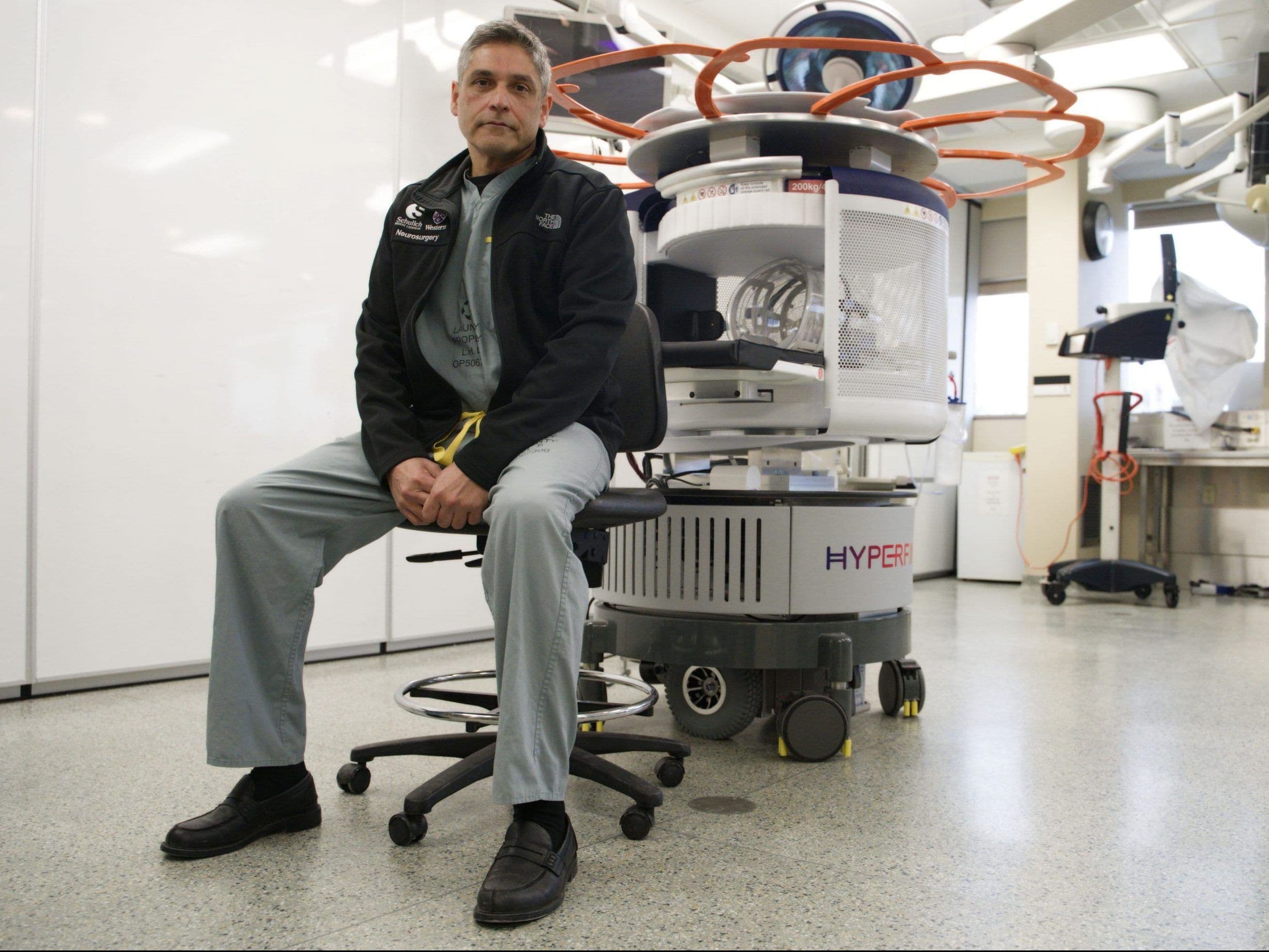
A Hyperfine Swoop portable brain MRI was used during a procedure to remove a patient’s pituitary tumour at University Hospital in October, enabling the surgical team to see the intricate area of the brain in real time, said LHSC neurosurgeon Neil Duggal.
The pituitary gland is a pea-sized gland attached to the brain that produces and releases hormones controlling many bodily functions, including growth, metabolism, blood pressure and reproduction.
For buyers, sellers, renters and dreamers — London's complex, fascinating real estate market is brought into focus and into context with this newsletter.
A welcome email is on its way. If you don't see it, please check your junk folder.
The next issue of Homes in London will soon be in your inbox.
We encountered an issue signing you up. Please try again
“We were able to use this (MRI) for a pituitary tumour to know if we had completely removed the tumour,” Duggal said.
Loss of peripheral vision, hemorrhages and hydrocephalus, which can lead to headaches, vomiting, seizures, and mobility and cognitive issues, are among symptoms of pituitary tumours, he said.
The surgery to remove the tumour was performed endoscopically through the nose and is complex because the carotid arteries – which supply blood to the brain – and optic nerves that transmit information from the eyes to the brain lie close to the tumour, Duggal said.
A slip-up could be “disastrous,” he said. Injury to the carotid arteries “could lead to a catastrophic hemorrhage, stroke or death,” while damage to the optic nerves could cause tunnel vision or blindness.
The value of the portable MRI is that, rather than moving a patient elsewhere in the hospital for imaging, which can take hours in some cases, the MRI is brought to the patient’s bedside, Duggal said.
With the device in the operating room, the surgical team can receive “immediate feedback,” he said, adding that leftover tumour residue could lead to regrowth and potentially require another operation.
Duggal said the portable MRI enabled the team to spot tumour residue during the operation.
“Getting that immediate feedback . . . allowed us to go right back in to that one spot where we saw residual tumour and to tackle it and remove it,” Duggal said. “I think that’s invaluable.”
The procedure was successful for Dave Evans, the patient who underwent what LHSC says was the first pituitary tumour surgery in the world to use the Hyperfine Swoop portable MRI.
A father of three who has been married for more than 40 years, Evans said he began feeling lethargic and experiencing low-grade headaches, initially attributing the symptoms to long COVID after contracting the virus during the pandemic.
Likening the progression of the condition to a failing television, the 65-year-old said: “If you had a TV set and the quality diminished one per cent per month, it’s not that detectable, but after a while, it really is diminished.”
An “incidental finding” during a CT scan at Brightshores Health System’s Owen Sound hospital in March 2025 revealed Evans had lymphoma – cancer of the lymphatic system – which is now dormant. But his symptoms did not align with that diagnosis.
Doctors later discovered a non-cancerous pituitary tumour was responsible for his symptoms, which also included deteriorating peripheral vision and severe headaches when driving for long periods.
“A lot of brain surgery is quite intimidating, but I did have every confidence in my care team,” Evans said.
He underwent surgery on Oct. 29 and noticed an improvement in his vision “almost immediately.“
“I was euphoric at that point, because I knew I was on the road to recovery,” Evans said.
“To have my health back and be able to enjoy life with my wife and my children is great.”
Since Evans’ procedure, Duggal said the portable MRI has been used in six similar pituitary tumour surgeries. He is confident the device will expand to other operations.
“I’m sure my colleagues who do other areas of neurosurgery will come up with inventive ways to utilize this technology to help improve outcomes for our community,” Duggal said.
This website uses cookies to personalize your content (including ads), and allows us to analyze our traffic. Read more about cookies here. By continuing to use our site, you agree to our Terms of Use and Privacy Policy.