- Peter J. Makovicky ORCID: orcid.org/0000-0001-9307-99821,2,3,
- Jonathan S. Mitchell ORCID: orcid.org/0000-0002-8666-58254,
- Jorge G. Meso5,
- Federico A. Gianechini6,
- Ignacio Cerda ORCID: orcid.org/0000-0001-6279-03925,7 &
- Sebastian Apesteguía ORCID: orcid.org/0000-0002-0414-05248
Nature (2026)Cite this article
- 505 Altmetric
- Metrics details
- Palaeontology
- Phylogenetics
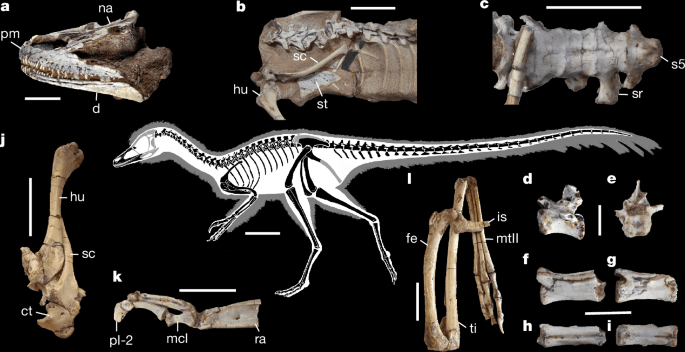
Alvarezsauroids are an enigmatic clade of predominantly small-bodied theropod dinosaurs that are known mainly from the Jurassic to Cretaceous periods of Asia and South America1,2,3. Late Cretaceous alvarezsauroids possess specialized forelimbs adapted for digging4,5, minute supernumerary teeth and heightened sensory capacities6, and are interpreted as myrmecophagous. They are hypothesized to exhibit evolutionary miniaturization coupled to their dietary specialization2. Fragmentary South American taxa are traditionally arrayed as a paraphyletic grade with respect to the Late Cretaceous Asian subclade Parvicursorinae2,3, invoking dispersal to explain their disjunct distributions. Here we describe a skeleton of the alvarezsauroid Alnashetri cerropoliciensis7 representing to our knowledge the most complete and smallest South American taxon to date. We also recognize two alvarezsauroids among historic taxa from the Northern Hemisphere. Phylogenetic analysis recovers Alnashetri among basal non-alvarezsaurids, rendering South American taxa polyphyletic. Combined with the new taxa recognized here, our biogeographical analyses infer a Pangaean ancestral distribution for Alvarezsauroidea, with vicariance dominating the early history of the clade. The early branching position of Alnashetri among larger-bodied relatives revises best-fit models of body size evolution in alvarezsauroids—we find no support for evolutionary miniaturization but, rather, find support for repeated evolution within a narrow body size range.
This is a preview of subscription content, access via your institution
Access Nature and 54 other Nature Portfolio journals
Get Nature+, our best-value online-access subscription
Receive 51 print issues and online access
- Purchase on SpringerLink
- Instant access to the full article PDF.
Prices may be subject to local taxes which are calculated during checkout
- Learn about institutional subscriptions
- Read our FAQs
- Contact customer support