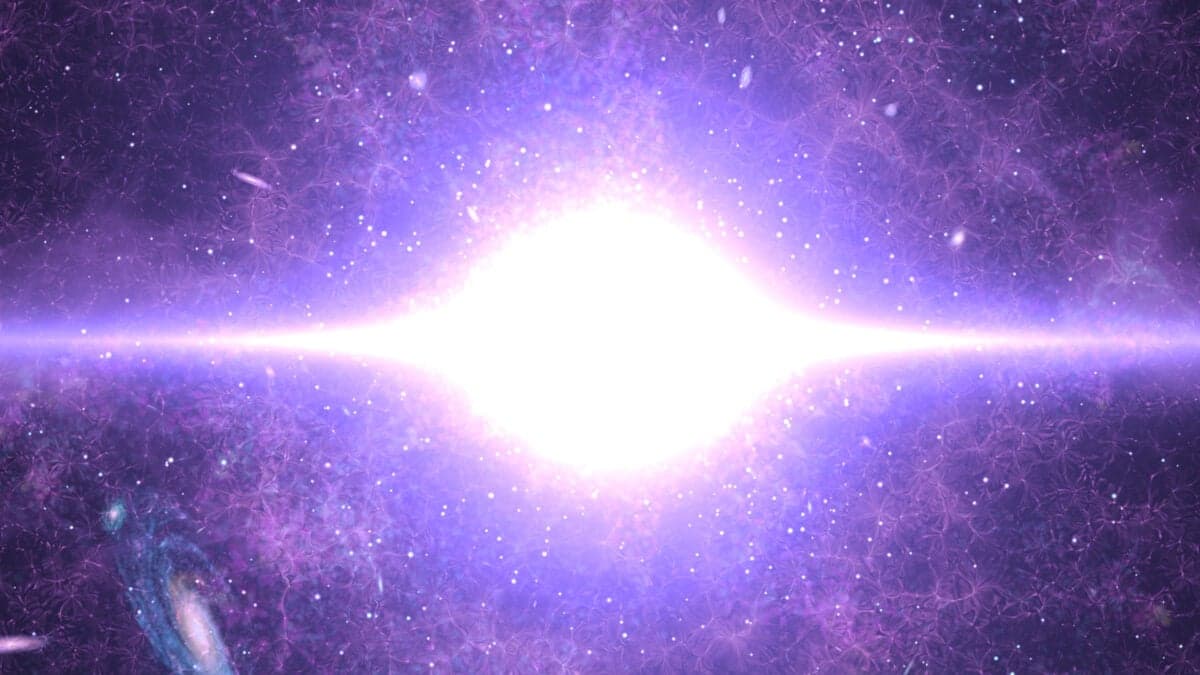
One of the most profound mysteries in modern physics—how to reconcile quantum mechanics with Einstein’s general relativity—may have taken a significant step toward resolution, and the answer could rewrite the very beginning of our universe. In a groundbreaking study published in Physical Review Letters, researchers at the University of Waterloo and the Perimeter Institute for Theoretical Physics in Canada have proposed a radical new theory suggesting the Big Bang did not require an external inflaton particle to trigger its explosive expansion. Instead, they argue, the rapid growth of the early universe emerges naturally from the principles of quantum gravity, specifically through a revised formulation of Einstein’s theory known as quadratic gravity.
Why the Big Bang Theory Needs a Quantum Makeover
The standard cosmological model, widely accepted since the late 20th century, describes the universe beginning in a hot, dense state nearly 13.8 billion years ago. This moment, known as the Big Bang, set in motion the expansion that eventually led to the formation of galaxies, stars, and planets. However, the most popular explanation for the universe’s initial rapid growth—cosmic inflation—relies on an unobserved hypothetical particle called the inflaton. Inflation posits that a burst of exponential expansion occurred in the first fraction of a second after the Big Bang, smoothing out irregularities and setting the stage for the large-scale structure we see today.
The Inflationary Paradox: Where the Standard Model Falls Short
Despite its success in explaining many observed features of the universe, the inflationary scenario has faced growing scrutiny in recent years. The theory struggles to account for conditions before the Planck epoch—the earliest known period in the universe’s history, when temperatures and densities were so extreme that general relativity alone cannot describe them. Moreover, inflation requires fine-tuning of initial conditions, which some physicists argue undermines its elegance. As Ruolin Liu, lead author of the new study and a postdoctoral researcher at the Perimeter Institute, explained, 'The inflationary model breaks down as we extrapolate backward toward higher energies, corresponding to earlier times in the universe’s history. It doesn’t naturally emerge from more fundamental principles—it’s an add-on.'
Quadratic Gravity: Einstein’s Theory at Higher Power
To address these limitations, the Waterloo-Perimeter team turned to quadratic gravity, a modified version of Einstein’s general relativity that incorporates higher-order terms into the equations governing spacetime. While general relativity describes gravity as the curvature of spacetime caused by mass and energy, quadratic gravity adds nonlinear corrections that become significant at extremely high energies—precisely the conditions present during the Big Bang. 'Think of Einstein raised to the second power,' said Jerome Quintin, co-author and theoretical cosmologist at the University of Waterloo. 'Quadratic gravity takes the formal mathematics of quantum field theory and bridges it to real-world cosmological observations. This allows us to test ideas that were previously confined to abstract theory.'
How Quantum Effects Spontaneously Created the Universe
The team’s breakthrough came when they applied the mathematical framework of quadratic gravity to the earliest moments of the universe. Their calculations revealed something remarkable: the quadratic terms in the equations naturally generated a period of accelerated cosmic expansion—essentially, a self-starting Big Bang—without requiring any additional particles or fields. This expansion emerged organically from the quantum corrections to gravity, transitioning seamlessly into the familiar dynamics described by general relativity as the universe cooled and expanded.
From Quantum Fluctuations to Cosmic Structure
The study’s findings suggest that quantum fluctuations in the fabric of spacetime itself may have been sufficient to drive the initial expansion. Unlike inflation, which relies on an external inflaton field, this mechanism is intrinsic to gravity’s quantum nature. 'Our model shows that the Big Bang doesn’t need a separate trigger,' said Liu. 'The expansion is a direct consequence of the quantum corrections to gravity. It’s a more parsimonious explanation—fewer assumptions, fewer variables, and it aligns with observations without contrivance.'
A Theory That Finally Makes Predictions—and Can Be Tested
One of the most compelling aspects of the new theory is its testability—a rare feat in quantum gravity research, which often deals in abstract, unobservable predictions. The quadratic gravity model makes a specific and measurable claim: it predicts a minimum level of gravitational waves generated during the universe’s earliest expansion. These primordial gravitational waves, ripples in spacetime itself, would carry imprints of the quantum processes that drove the Big Bang.
Quantum gravity is often conveyed as something purely theoretical, something that can never be tested. But our work shows that quantum gravity can absolutely be studied and bridged to concrete cosmological scenarios, which come with specific predictions that we can test now and in the future as well.
Niayesh Afshordi, senior author of the study and a physicist at the Perimeter Institute, emphasized this point. 'This isn’t just another beautiful equation on a chalkboard,' he said. 'We’re talking about a framework that makes falsifiable predictions. If next-generation gravitational wave detectors don’t see these signals, the theory can be ruled out.'
The Next Generation of Cosmic Probes: A Golden Age of Discovery
The timing of this theoretical breakthrough could not be more fortuitous. Cosmology is entering a golden era of observational capacity, with several ambitious projects on the horizon designed to probe the earliest moments of the universe. The Laser Interferometer Space Antenna (LISA), a joint mission between NASA and the European Space Agency, is slated to launch as early as 2035. This space-based gravitational wave observatory will be sensitive enough to detect the faint signatures of primordial gravitational waves predicted by the quadratic gravity model.
Key Upcoming Missions to Watch
- LISA (2035): A space-based gravitational wave detector capable of capturing signals from the dawn of time, potentially confirming or refuting the new theory.
- Nancy Grace Roman Space Telescope: NASA’s next-generation observatory, originally delayed by budget concerns, is now back on track and expected to launch in the late 2020s. Its wide-field infrared surveys could reveal subtle imprints of early universe physics.
- Vera C. Rubin Observatory: Currently under construction in Chile, this ground-based telescope will conduct the Legacy Survey of Space and Time (LSST), capturing hundreds of thousands of observations per night and providing unprecedented data on cosmic structure and expansion.
Reconciling Quantum Mechanics and General Relativity: A Century-Old Quest
The tension between quantum mechanics and general relativity has persisted since the early 20th century. Quantum mechanics governs the behavior of particles at microscopic scales, while general relativity describes the macroscopic structure of spacetime and gravity. Yet the two theories are fundamentally incompatible, particularly in extreme environments like black holes or the Big Bang. For decades, physicists have sought a unified theory—quantum gravity—that could bridge this divide. String theory, loop quantum gravity, and other approaches have been proposed, but none have provided a complete or testable framework.
Quadratic Gravity Joins the Conversation
Quadratic gravity represents a relatively recent entry into the quantum gravity landscape. Unlike string theory, which posits that fundamental particles are one-dimensional strings vibrating in higher dimensions, quadratic gravity stays within the framework of Einstein’s geometric view of gravity while adding quantum corrections. This makes it more conservative—and potentially more testable—than some competing theories. 'We’re not reinventing the wheel,' said Quintin. 'We’re taking a well-established theory and pushing it to its limits, asking what happens when you include these higher-order terms. The answer, it turns out, could be the key to understanding the universe’s birth.'
Implications for Cosmology: A Simpler, More Elegant Universe
If validated, the quadratic gravity model could revolutionize our understanding of the universe’s origins. By eliminating the need for an inflaton particle and instead deriving cosmic expansion from quantum gravity, the theory offers a more parsimonious explanation for the Big Bang. This aligns with a growing philosophical preference in physics for 'natural' theories—those that require fewer arbitrary assumptions. Moreover, the model’s predictions align with recent observations from the Planck satellite and other cosmological surveys, which have detected subtle anomalies in the cosmic microwave background that are difficult to explain under standard inflation.
The Road Ahead: From Theory to Empirical Proof
As with any groundbreaking scientific proposal, the quadratic gravity model will face intense scrutiny from the physics community. Independent researchers will need to reproduce the calculations, explore alternative interpretations, and assess whether the predicted gravitational wave signatures are unique to this theory or could be mimicked by other processes. Afshordi acknowledged the challenges ahead. 'Science moves forward by testing bold ideas,' he said. 'This is a testable prediction, and that’s what makes it exciting. But we won’t know for sure until we look.'
Key Takeaways: What This Means for the Future of Physics
- The Big Bang may not require an inflaton particle: A new theory from the University of Waterloo and Perimeter Institute suggests cosmic expansion emerged naturally from quantum gravity corrections.
- Quadratic gravity offers a testable alternative: Unlike many quantum gravity models, this framework predicts specific gravitational wave signatures detectable by next-generation observatories like LISA.
- The theory aligns with recent cosmological observations: Its predictions match anomalies in the cosmic microwave background that standard inflation struggles to explain.
- A golden age of cosmology is coming: Upcoming missions such as LISA, the Nancy Grace Roman Telescope, and the Vera C. Rubin Observatory will provide the data needed to validate or refute this radical new idea.
- Physics may be on the verge of a paradigm shift: If confirmed, the quadratic gravity model could rewrite our understanding of the universe’s birth and the fundamental nature of spacetime.
Frequently Asked Questions About the New Big Bang Theory
Frequently Asked Questions
- What is quadratic gravity, and how is it different from Einstein’s general relativity?
- Quadratic gravity is a modified version of Einstein’s general relativity that includes higher-order terms in the equations governing spacetime. While general relativity describes gravity as the curvature of spacetime caused by mass and energy, quadratic gravity adds nonlinear corrections that become significant at extremely high energies, such as those present during the Big Bang.
- How does this theory explain the Big Bang without an inflaton particle?
- The new model suggests that the rapid expansion of the early universe emerges naturally from quantum corrections to gravity. In other words, the Big Bang is a direct consequence of the quantum nature of spacetime, eliminating the need for a hypothetical inflaton particle to trigger cosmic inflation.
- What kind of evidence would confirm this theory?
- The most compelling evidence would come from detecting primordial gravitational waves—ripples in spacetime generated during the universe’s earliest moments. Next-generation detectors like LISA are designed to capture these signals, which would provide direct observational support for the quadratic gravity model.