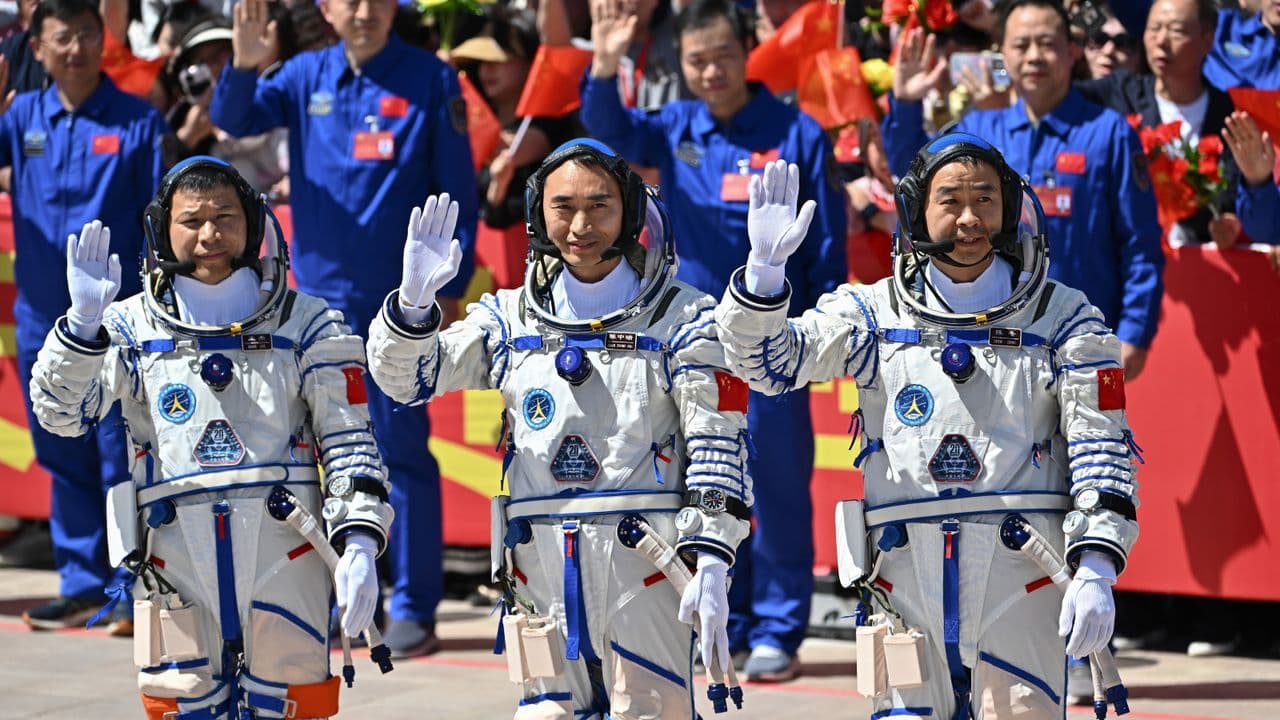
Taikonauts from the fated Shenzhou-20 mission have described what happened when they discovered cracks on their spacecraft as they prepared to depart China's Tiangong space station last year.
When you purchase through links on our site, we may earn an affiliate commission. Here’s how it works.
Unlock instant access to exclusive member features.
By submitting your information you agree to the Terms & Conditions and Privacy Policy and are aged 16 or over. You are now subscribed
Once a week Life's Little Mysteries Feed your curiosity with an exclusive mystery every week, solved with science and delivered direct to your inbox before it's seen anywhere else.
Get full access to premium articles, exclusive features and a growing list of member rewards.
Chinese astronauts have described what happened when they were nearly stranded in space last year after a suspected piece of space junk struck their return capsule.
Chen Dong, Chen Zhongrui and Wang Jie, the crew of the ill-fated Shenzhou-20 mission, were preparing to leave China's Tiangong space station and return to Earth on Nov. 5, 2025. During a routine check, the astronauts spotted something unusual, beginning what has since been described as China's first spaceflight emergency.
Commander Chen Dong was carrying out final checks on the return capsule when he noticed a triangular mark in the spacecraft's viewpoint window, according to a detailed interview with the crew by Chinese state media, reported by Live Science's sister site Space.com.
- NASA astronauts back on Earth after unprecedented medical emergency on ISS
- Russia accidentally destroys its only working launch pad as astronauts lift off to ISS
- Bungled Boeing Starliner mission was the highest order of mishap that put stranded astronauts at risk, report says
Watch On "My first thought was whether a small leaf had somehow stuck to the outside of the window," Chen said in the interview, aired by China Central Television (CCTV). "But then I quickly realized that couldn't happen because we were in space. How could there possibly be a fallen leaf there?"
Chen determined that the leaf-shaped mark was the result of cracks to the window, some of which he said "had penetrated through." His crew then worked with the Shenzhou-21 relief crew and ground teams on Earth to check and confirm the condition of the window. The taikonauts (Chinese astronauts) have previously described taking a methodical approach to what could have been a perilous event.
"When we learned of the situation, we had discussions and reached a common understanding," astronaut Chen Zhongrui told CCTV in a press briefing on Jan.17. "At the same time, the ground teams communicated with us promptly, and we soon calmed down."
The taikonauts arrived at the Tiangong (Mandarin for "heavenly palace") space station on April 24, 2025. Their original departure date of Nov. 5 was pushed back after the crack was discovered, but they were able to travel home 9 days later in the Shenzhou-21 spacecraft that had delivered their relief crew.
Get the world’s most fascinating discoveries delivered straight to your inbox.
—NASA set to roll Artemis rocket back for urgent repairs after yet another delay
—'There will be leadership accountability': Bungled Boeing Starliner mission put stranded NASA crew at risk, report says
—Supercomputers simulated the orbits of 1 million satellites between Earth and the moon — and less than 10% survived
The three taikonauts safely touched down in northern China's Inner Mongolia Autonomous Region on Nov. 14. The crew spent 204 days in orbit, which was a record for a taikonaut crew, though far from the record for longest time humans have spent in space (437 days).
The quantity of space junk in Earth's orbit is increasing. This junk, which includes things like rocket boosters and other discarded space travel objects, has the potential to collide with uncrewed and crewed spacecraft and thus puts astronauts at risk. Various methods have been proposed to deal with the growing space debris problem — including the development of sci-fi-inspired tractor beams and junk-capturing spacecraft. But so far, no potential solutions are ready to be deployed at scale.
Patrick Pester is the trending news writer at Live Science. His work has appeared on other science websites, such as BBC Science Focus and Scientific American. Patrick retrained as a journalist after spending his early career working in zoos and wildlife conservation. He was awarded the Master's Excellence Scholarship to study at Cardiff University where he completed a master's degree in international journalism. He also has a second master's degree in biodiversity, evolution and conservation in action from Middlesex University London. When he isn't writing news, Patrick investigates the sale of human remains.","collapsible":{"enabled":true,"maxHeight":250,"readMoreText":"Read more","readLessText":"Read less"}}), "https://slice.vanilla.futurecdn.net/13-4-17/js/authorBio.js"); } else { console.error('%c FTE ','background: #9306F9; color: #ffffff','no lazy slice hydration function available'); } Patrick PesterSocial Links NavigationTrending News WriterPatrick Pester is the trending news writer at Live Science. His work has appeared on other science websites, such as BBC Science Focus and Scientific American. Patrick retrained as a journalist after spending his early career working in zoos and wildlife conservation. He was awarded the Master's Excellence Scholarship to study at Cardiff University where he completed a master's degree in international journalism. He also has a second master's degree in biodiversity, evolution and conservation in action from Middlesex University London. When he isn't writing news, Patrick investigates the sale of human remains.
You must confirm your public display name before commenting
Please logout and then login again, you will then be prompted to enter your display name.
- 1We now know why shoes squeak, and it involves miniature lightning bolts
- 2'Rare and enigmatic' structures found at the Milky Way's center in largest-ever map of its kind
- 3COVID-19 vaccination during pregnancy may cut risk of preeclampsia
- 4Follow the BBC's Kingdom and all your favorite natural history documentaries on your travels with this great deal on a top-rated VPN
- 5Can you crack our science word of the day puzzle?