My first round of busts came way back in January. Now that we're in the thick of Draft Prep season, it's time for an update.
Below, you'll find some new additions followed by my original list, which has been refreshed with the latest information. To put it simply, these players have clear warning signs that make them not so worth drafting at their going rate. Some even show the potential for outright collapse.
- Sleepers 2.0: Scott | Chris | Frank
- Breakouts 2.0: Scott | Chris | Frank
- Busts 2.0: Scott | Chris | Frank
I'm not so confident in my prognostication skills that I'd avoid any of these players outright, but at cost, I'd prefer to go another direction.
Note that ADP comes from FantasyPros, which averages data from multiple platforms. ESPN was excluded because its data is the most out of step (possibly due to different scoring rules).
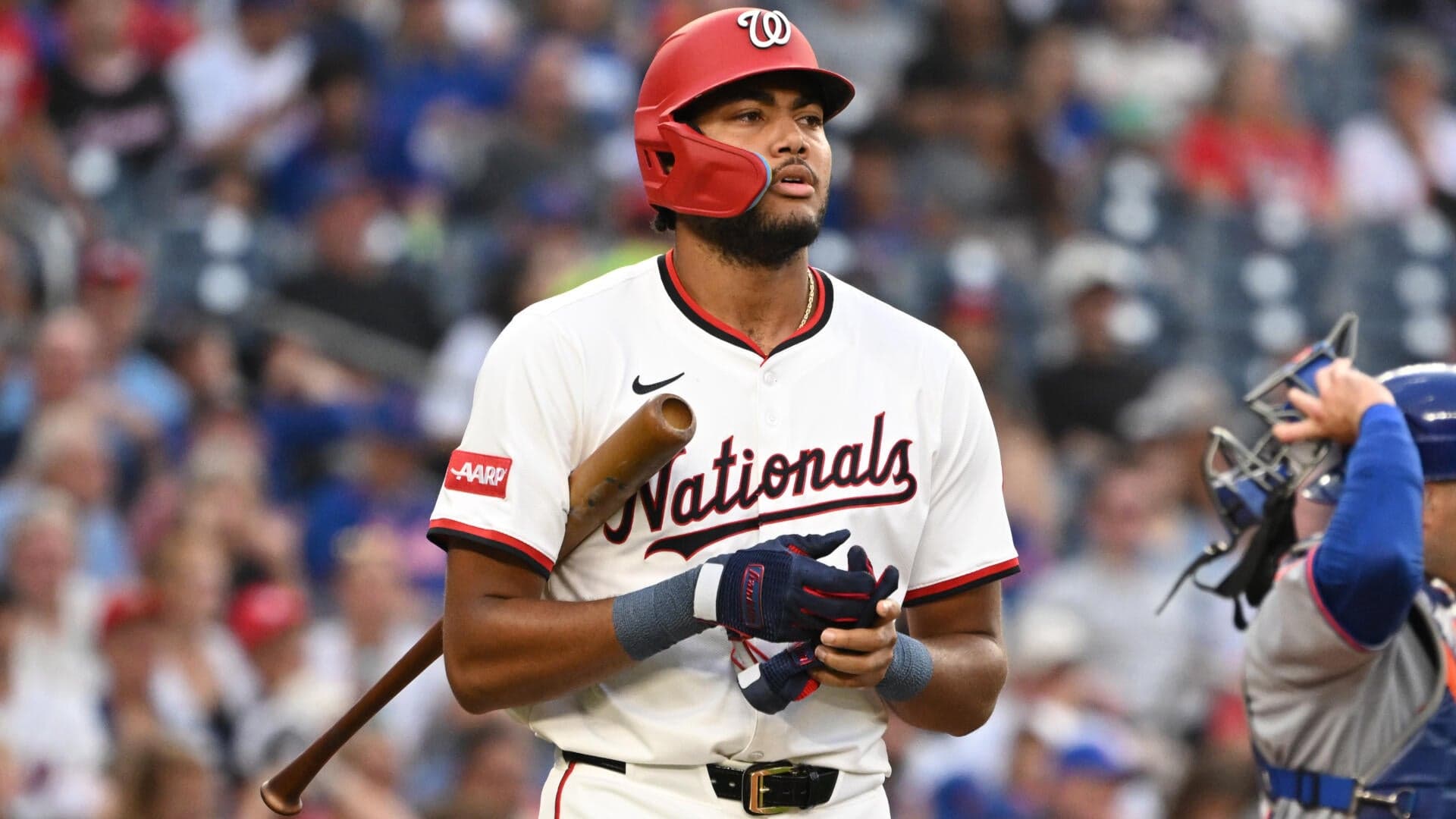
WAS Washington • #29 • Age: 23
Wood's and Pete Crow-Armstrong's fates seem inextricably tied. Both were recent top prospects who seemed on the path to becoming Fantasy first-rounders early last year, in spite of their flaws, but both collapsed down the stretch, raising serious doubts about their 2026 outlook. So why am I disentangling them here? Well, I gave Crow-Armstrong a hard enough time last year and can't even take credit for the bust call because his first half was so good. Besides, his collapse seemed like it was tied to a preexisting flaw, the poor plate discipline that made me skeptical of him in the first place.
Wood's collapse, by contrast, was the result of something entirely new. He wasn't just struggling to pull the ball in the air, which had always been the case. No, the problem was that his strikeout rate ballooned, going from 27.6 percent in the first half to 39.0 percent in the second half. Nobody, no matter how good their contact quality (and Woods' is among the best) could survive with a strikeout rate so high, and sure enough, Wood hit .223 with a .690 OPS during that time.
Explanations for this downturn have ranged from his launch angle becoming too steep to him simply tiring out in the second half. But the launch angle excuse is thinly sourced, and the "he was tired" claim is just plain weak. It could still prove to be valid, but it's not convincing enough for me to want to sink a third-round pick in him. I may still do it in the name of upside, but the downside risk is higher than I'd prefer for that kind of draft capital. My preference would be for someone else to take the plunge on Wood, allowing me to direct my attention to one of the stud first baseman who go in that range instead.
DET Detroit • #31 • Age: 25
The 2025 season marked Greene's second straight with must-start production, so you may not have given even a second thought to its legitimacy. But he came about that must-start production in a different way -- one that seems less sustainable to me. In short, it was all home runs. His launch angle became steeper, his approach became more aggressive, and he just let 'er rip, hitting a dozen more home runs than the year before.
The tradeoff was a reduced average exit velocity, from 84th percentile to 48th percentile, and much more swing and miss, his 30.7 percent strikeout rate ranking fifth among qualifying batters. He went from being a fairly well-rounded hitter -- one who struck out a little too much but could contribute in different ways -- to one whose outlook is entirely tied to the long ball. He may not be enough of a pure power hitter to measure up in that regard. The cracks were already beginning to show toward the end of last season. Really, "toward the end" is a generous way of putting it. Over his final 73 games, or nearly half the season, he hit .212 with a .691 OPS.
My fear is that if he gives back just a little something in the way of home runs, the batting average collapses. His hitting profile now seems as volatile as Brenton Doyle's, only without the soft landing of Coors Field. It's possible Greene tweaks his swing and approach to recapture the form he showed in 2024, but the bottom line is that the price doesn't factor in enough of the downside risk. There's no way to justify taking him over Cody Bellinger and Randy Arozarena, as AP shows.
ATL Atlanta • #99 • Age: 27
I was trying to reserve judgment on Strider, hoping that an offseason spent regaining his fastball shape or developing a new pitch to go with still-killer slider would help him regain the dominance he apparently forfeited with an internal bracing procedure in 2024. His comments suggested that he knew what the issue was and simply needed the time to address it, and his history as a self-made pitcher earned him credibility on that front. But then came his first start of the spring Saturday, an actual data point instead of happy talk, and let's just say there was nothing happy about it.
OK, one little thing: His fastball shape was sort of, kind of back. The pitch had 18 inches of induced vertical break, which was more than an inch more than last year and about where it was at his most dominant. Unfortunately, it was also down another 2.5 mph. I've been contending that regaining his fastball shape was more important than regaining his fastball velocity, an idea that Strider himself has echoed, but I wasn't counting on another drop in velocity. I'm not sure any shape could save him at 93 mph. His fastball registered just one whiff Saturday.
I may be jumping the gun by including him here. The official line, according to Mark Bowman of MLB.com, is that Strider is "pacing himself" and that "there's no reason to overly concern yourself with any pitcher's velocity during the first few weeks of spring training," but that, frankly, seems like too convenient of an excuse for a pitcher who was already on shaky ground.
I reserve the right to change my mind if Strider's velocity ticks up over the rest of spring training. For as disappointing as he was last year, he still had an incredible 48 percent whiff rate on his slider, and his overall 13.9 percent swinging-strike rate would have ranked seventh among qualifiers. But his fastball was too susceptible to loud contact at its going velocity, which itself may be out of reach. I initially ranked Strider similarly to the consensus, which was about 30th at starting pitcher, but now I think he'd have to drop outside of the top 45 for the reward to be worth the risk to me.
KC Kansas City • #53 • Age: 33
Estevez is such an obvious regression candidate that part of me wants to take a contrarian stance just because saves are saves and don't always come in the prettiest packages. But he hasn't actually slipped enough in drafts to make that approach a rewarding one. In fact, he's being drafted ahead of not just Emilio Pagan and Daniel Palencia, who have the kind of swing-and-miss stuff better suited for the role, but also Raisel Iglesias, who is one of the most accomplished closers in the game today.
Sure, you could raise concerns about those three relievers. Pagan is a homer-prone pitcher who managed to navigate his first year in homer-friendly Great American Ball Park well enough but doesn't have the sort of track record to suggest he always will. Palencia came out of nowhere to be the Cubs closer last year and certainly wouldn't be the first pop-up reliever to give it all back the following year. Iglesias struggled for the first couple months of 2025 and now has Robert Suarez waiting in the wings should he fall into a similar rut.
But none of those concerns is more glaring than the 8.2 percent swinging-strike rate and 7.4 K/9 that Estevez put together in 2025, all while losing about a mile per hour off his fastball and two off his slider. Those are the kinds of numbers that you'd see from back-end rotation filler like Nick Martinez or Kyle Hendricks, not a pitcher tasked with freezing the offense in its tracks during the most critical inning of every game he enters.
If that's not bad enough, his fastball is down another 6-7 mph through two appearances this spring. You read that correctly. Anne Rogers of MLB.com notes that he endured something similar last spring and went on to have the season he had, leading the majors in saves with a stellar ERA and WHIP, which may be why his stock hasn't tanked yet. But the spring velocity dip, enormous though it may be, is far from his biggest concern.
LAD L.A. Dodgers • #44 • Age: 25
If you take Pages' numbers last year at face value, he's a perfectly reasonable choice to be your third outfielder in Fantasy, which is about the range where he's going in drafts. But I'm here to tell you that you shouldn't take his numbers at face value. I'll make the case in three ways.
- A traditional statistical analysis. Pages's success last year was front-loaded. He slashed only .251/.295/.418 from July 1 on, a span of 75 games.
- An advanced statistical analysis. Pages was an overachiever by the Statcast readings, which pegged himf or a .258 batting average and .428 slugging percentage as compared to his actual .272 and .461 marks. His average exit velocity placed in only the 28th percentile and his max in only the 40th percentile, which aren't readings befitting of a power hitter. He also had significant enough chase issues that his walk rate ended up being the seventh-lowest among qualifiers. You can see why the data didn't love him.
- A usage concern. Pages was so bad in the postseason, going 4 for 51, that the Dodgers ended up benching him for the final two games of the World Series, with everything on the line. They may not have a great alternative in center field at the moment, which buys him some time, but that will change once Tommy Edman is back from ankle surgery in May. Plus, they're the Dodgers. They have the resources to go fetch whatever they need.
Of course, it's distinctly possible that, at 24, Pages uses his postseason failure as a learning experience and grows into something more in 2026, but I don't see a loud of enough tool set for me to bet on it. For the price, I'd rather play it safe with an Ian Happ or Jurickson Profar type.
CHW Chi. White Sox • #5 • Age: 26
In a way, the league has already made the case against Murakami for me. How does a 25-year-old with prodigious exit velocities, two MVPs and a Triple Crown already under his belt, and the single-season record for most home runs ever by a Japanese-born player (set during a dead ball era for the league, no less) only get two years and $34 million from the lowly White Sox? The most logical answer is that better contracts weren't available, and the better teams all passed.
The reason why is that for all of Murakami's power, he has major contact issues, the sort that may actually contend for the worst in MLB history. His zone-contact rate last year was only 72.6 percent. No qualifying major league hitter had a mark that low last year, and if we reduce "qualifying" to just 300 plate appearances, only one does: Gabriel Arias, author of a .220 batting average. Others in the bottom 12 include Christopher Morel (.219), Matt Wallner (.202), Michael Toglia (.190), Michael Taylor (.200), Oneil Cruz (.200), Ryan McMahon (.214) and Colton Cowser (.196). There were successes in there as well -- like Rafael Devers, Nick Kurtz and Ronald Acuna -- but clearly, missing hittable pitches is the kind of flaw that can sink an otherwise talented hitter.
And remember, Murakami's 72.6 percent mark came against pitchers in Japan. The pitchers are a little bit better here, at least on the whole, and the main way they excel over their Japanese counterparts is in pure velocity. According to FanGraphs, Murakami's contact rate on fastballs 93 mph and over is just 63 percent since 2022. Pitchers who throw only 93 mph here are lucky to have a job.
I'd love to see Murakami put on a power display in the majors, but I don't see how he makes enough contact to factor in a meaningful way. Clearly, a bunch of teams with far better methods of analysis than I have feel the same way. You may argue that you're not giving up much by gambling on him at Pick 181, but among the players going later are Daulton Varsho, who saw a big exit velocity jump last year and had a 162-game pace of 46 home runs, and Jac Caglianone, who hits the ball about as hard as Murakami and has been lighting up spring training.
SD San Diego • #3 • Age: 22
If you're questioning the sense of declaring a player a bust a year after he already busted, I would say, well, we clearly didn't learn the lesson the first time. Merrill is still being drafted like a stud outfielder -- ahead of the likes of Cody Bellinger, Ben Rice and Geraldo Perdomo -- when he was easily one of the most disappointing Fantasy assets last year. His 16 home runs in 115 games (a 23-homer pace over 162 games) shouldn't inspire much confidence on its face and, even worse, was only made possible by a seven-homer September. He also stole precisely one base, one, which means we can't count on him being even a viable contributor to that category.
The prevailing sentiment right now seems to be "oh, well, he suffered a concussion early on, so clearly that impeded him all year, preventing him from stealing bases and undermining his power potential until that final hot stretch." Maybe! It wouldn't be the first time a concussion had far-ranging effects. But without a track record to back it up, it's kind of just optimism. Merrill was a prospect in high standing when he arrived in 2024, but his production in the minors to that point was lacking. His 2024 rookie season is his only high-performing season on record.
Going back to my earliest days of Fantasy Baseball analysis, one of the clearest warning signs for a young hitter was a lack of patience. Major league pitchers are simply too good not to take advantage of that, and Merrill's walk rate for his career is only 5.8 percent. So that undermines his hit tool, which is purportedly his best, and then his power tool, which is more middle-of-the-pack (70th percentile average exit velocity in 2024 and 46th percentile in 2025), is undermined both by a ballpark that's long been known to suppress left-handed power and a pull-air rate that ranks firmly in the lower half of the league.
I don't think Merrill will lose his job or end up back in the minors or anything, but I do think, particularly if he doesn't turn out to be the base-stealer we once thought he would, he might end up ranking closer to the Brandon Nimmo side of the ledger than the Jackson Chourio side. I'm obviously giving him more credit than that by ranking him 23rd among outfielders.
SD San Diego • #27 • Age: 33
Pivetta a bust? Didn't I just have him as a sleeper a year ago? And didn't it play out exactly as I suggested then, with his move to a pitcher's park finally allowing his sparkling peripherals to shine through?
Well, yes and no. He did have a fantastic season, his ERA dropping more than a run as he placed sixth in NL Cy Young voting. But what the accolades hid is that his sparkling peripherals lost much of their luster. He had consistently delivered on, and at times even exceeded, 10 K/9, but h dropped to 9.4 K/9 last year, including 8.5 in the second half. His swinging-strike rate, meanwhile, dropped nearly a full point from 2024, landing at 10.5 percent, which is about as middling as it gets.