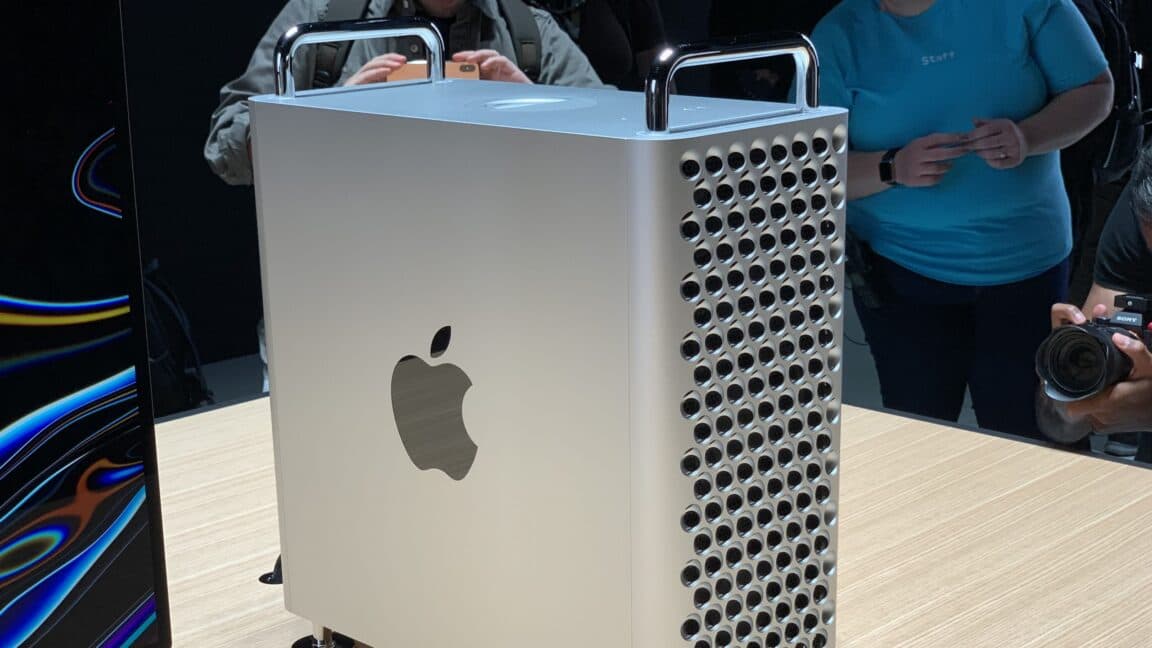
- Apple has officially ended production of its Mac Pro desktop line, marking the conclusion of over a decade of high-performance workstation development
- The final model, powered by the M2 Ultra chip and launched in mid-2023, will be the last Mac Pro ever produced according to Apple
- The discontinuation reflects Apple's strategic shift toward unified Apple Silicon architecture that eliminates need for traditional expandable workstations
Apple has officially pulled the plug on its flagship Mac Pro desktop line, bringing an end to more than a decade of high-performance workstation production. The company confirmed to 9to5Mac that the M2 Ultra-powered Mac Pro, released in mid-2023, represents the final iteration of its premium desktop computer. In a definitive statement about its future strategy, Apple indicated that no replacement model is currently planned, effectively ending the Mac Pro's 16-year run as the company's most powerful personal computer.
End of an Era: Apple's Flagship Workstation Meets Its Conclusion
The Mac Pro's discontinuation marks the end of an era for Apple's professional computing segment. Originally conceived as a powerful, expandable workstation for creative professionals, the Mac Pro's journey began in 2006 when Apple transitioned from its Power Mac line to Intel processors. For nearly two decades, the tower served as Apple's flagship desktop offering, commanding premium prices and catering to demanding users in video editing, 3D rendering, music production, and scientific computing.
However, signs of the Mac Pro's declining relevance became increasingly apparent throughout the past decade. Industry analysts noted that sales figures remained consistently low compared to mainstream Mac models, and the product line struggled to maintain competitive performance against custom-built PC workstations running comparable Intel processors. The shift to Apple Silicon has further accelerated this trend, as the new chip architecture fundamentally challenges the traditional workstation model that the Mac Pro represented.
Historical Context: From Power Mac Towers to Silicon Integration
Steve Jobs' Original Vision and Early Development
When Steve Jobs returned to lead Apple in 1997, one of his immediate priorities was simplifying the company's sprawling Mac product lineup. At that time, consumers faced confusion among dozens of models including Quadras, Performas, and various Power Macintosh variants. Jobs streamlined this complexity into a focused four-quadrant strategy: consumer laptop, consumer desktop, professional laptop, and professional desktop. The latter category evolved into what would become the Mac Pro, initially as the Power Mac tower before transitioning to Intel processors in the mid-2000s.
The Controversial 'Trash Can' Design and Lessons Learned
Apple's approach to professional desktop computing took a dramatic turn in 2013 with the introduction of the cylindrical 'trash can' Mac Pro. Marketed as a revolutionary design innovation, the compact unit represented one-eighth the volume of its predecessor while attempting to pack equivalent performance into a dramatically smaller form factor. However, this ambitious redesign ultimately constrained Apple's ability to iterate and update the product line effectively.
"I think we designed ourselves into a bit of a thermal corner, if you will," said Apple's Craig Federighi in 2017, addressing concerns about the limitations of the cylindrical design. "We designed a system… with the kind of GPUs that at the time we thought we needed, and that we thought we could well serve with a two GPU architecture… But workloads didn't materialize to fit that as broadly as we hoped."
The thermal and upgradeability issues inherent in the 2013 design forced Apple to acknowledge design missteps publicly—a rare occurrence for the typically secretive company. This admission paved the way for the return to a traditional tower design in 2019, but by then, the landscape of professional computing had already begun shifting toward cloud-based workflows and mobile collaboration tools that reduced demand for traditional workstation towers.
Apple Silicon Revolution Transforms Professional Computing Needs
Unified Memory Architecture Eliminates Traditional Upgrade Paths
The transition to Apple Silicon represents perhaps the most fundamental challenge to the Mac Pro's core value proposition. Traditional workstation towers thrived on their expandability—users could incrementally upgrade RAM, install faster graphics cards, add specialized processing units, or expand storage capacity through standard PCIe slots. However, Apple's M-series chips utilize unified memory architecture that integrates RAM directly into the processor package, making memory upgrades impossible once the device leaves the factory.
This architectural shift extends beyond mere memory considerations. Apple Silicon's integrated graphics processing eliminates compatibility with external graphics cards from industry leaders like AMD and NVIDIA—the very components that traditionally allowed workstation owners to extend their systems' useful life through targeted hardware upgrades. Additionally, the chips include dedicated video encoding hardware that previously required separate Afterburner accelerator cards, further reducing the need for internal expansion capabilities.
Thunderbolt Performance Reduces Need for Internal Expansion
Modern Thunderbolt connectivity provides external bandwidth that rivals or exceeds many internal expansion solutions from previous generations. High-speed Thunderbolt ports enable connection of external storage arrays, GPU accelerators, and specialty I/O devices at speeds that often match or exceed what internal PCIe slots provided in older systems. This evolution in peripheral connectivity has fundamentally altered how creative professionals approach their hardware needs, favoring modular, externally connected solutions over monolithic tower systems.
Market Realities and Strategic Positioning in Post-Mac Pro Era
Pricing Challenges and Limited Market Appeal
Throughout its existence, the Mac Pro commanded premium pricing that limited its market appeal. The late-2000s Mac Pro tower launched with base configurations ranging from $2,200 to $2,500, while peak configurations of the 2012 model reached $6,199. The 2019 redesign continued this pricing tradition, with entry-level systems starting at $6,000 and escalating rapidly with higher-performance components. These price points placed the Mac Pro firmly outside the budget of all but the most dedicated professional users, constraining potential sales volumes.
Timing and Transition Complications
By the time Apple delivered the redesigned tower Mac Pro in late 2019, the company was already preparing to unveil its first Apple Silicon Macs. This timing created an awkward overlap between Intel-based and ARM-based architectures, leaving the Mac Pro caught between technological generations. Apple executive Phil Schiller acknowledged in 2017 that the redesigned system was intended to support "regular improvements," yet the rapid advancement of Apple Silicon made such iterative updates economically questionable.
The company's decision to discontinue the Mac Pro reflects a calculated assessment that remaining customer segments can be adequately served by alternative products. Current professional users are directed toward the Mac Studio, available with M4 Max or M3 Ultra processors, and the more compact Mac mini featuring M4 Pro capabilities. These alternatives provide substantial processing power while embracing Apple's vision of simplified, integrated hardware ecosystems.
Successor Products and Future Professional Computing Strategy
While the Mac Pro officially exits Apple's product lineup, its legacy continues through evolved offerings that better align with contemporary computing paradigms. The Mac Studio occupies a similar performance tier, delivering workstation-class capabilities within a more compact, thermally managed enclosure. Unlike the Mac Pro's emphasis on user-accessible internals and component replaceability, the Studio embraces sealed designs that optimize thermal efficiency and acoustic performance.
This strategic pivot reflects Apple's broader commitment to vertical integration and system optimization. Rather than relying on discrete component upgrades to extend product lifecycles, Apple focuses on delivering complete platform refreshes that maximize performance per watt while minimizing user complexity. For professional users requiring maximum performance, the transition involves adapting workflows to accommodate these architectural changes rather than continuing to invest in traditional workstation upgrade cycles.
Frequently Asked Questions
- What will replace the discontinued Mac Pro for professional users?
- Apple recommends the Mac Studio as the primary alternative for professional workflows, with M4 Max and M3 Ultra configurations providing comparable performance. The more compact Mac mini with M4 Pro also serves many professional applications. Both products embrace Apple Silicon architecture that emphasizes integrated performance over traditional expandability.
- Why did Apple decide to discontinue the Mac Pro line?
- The discontinuation reflects Apple's strategic shift toward unified Apple Silicon architecture that makes traditional workstation features obsolete. Unified memory, integrated graphics, and high-speed Thunderbolt connectivity eliminate the need for internal expansion slots and component upgrades that defined the Mac Pro's purpose. Sales volumes also remained relatively small compared to mainstream Mac products.
- Was the Mac Pro profitable for Apple despite its high price?
- While specific financial details remain proprietary, the Mac Pro likely operated as a prestige product rather than major profit driver. Premium pricing positioned it as Apple's flagship desktop, supporting brand perception in professional markets. However, limited sales volumes and complex manufacturing requirements suggest it may not have achieved profitability levels of mainstream Mac products despite its high retail prices.