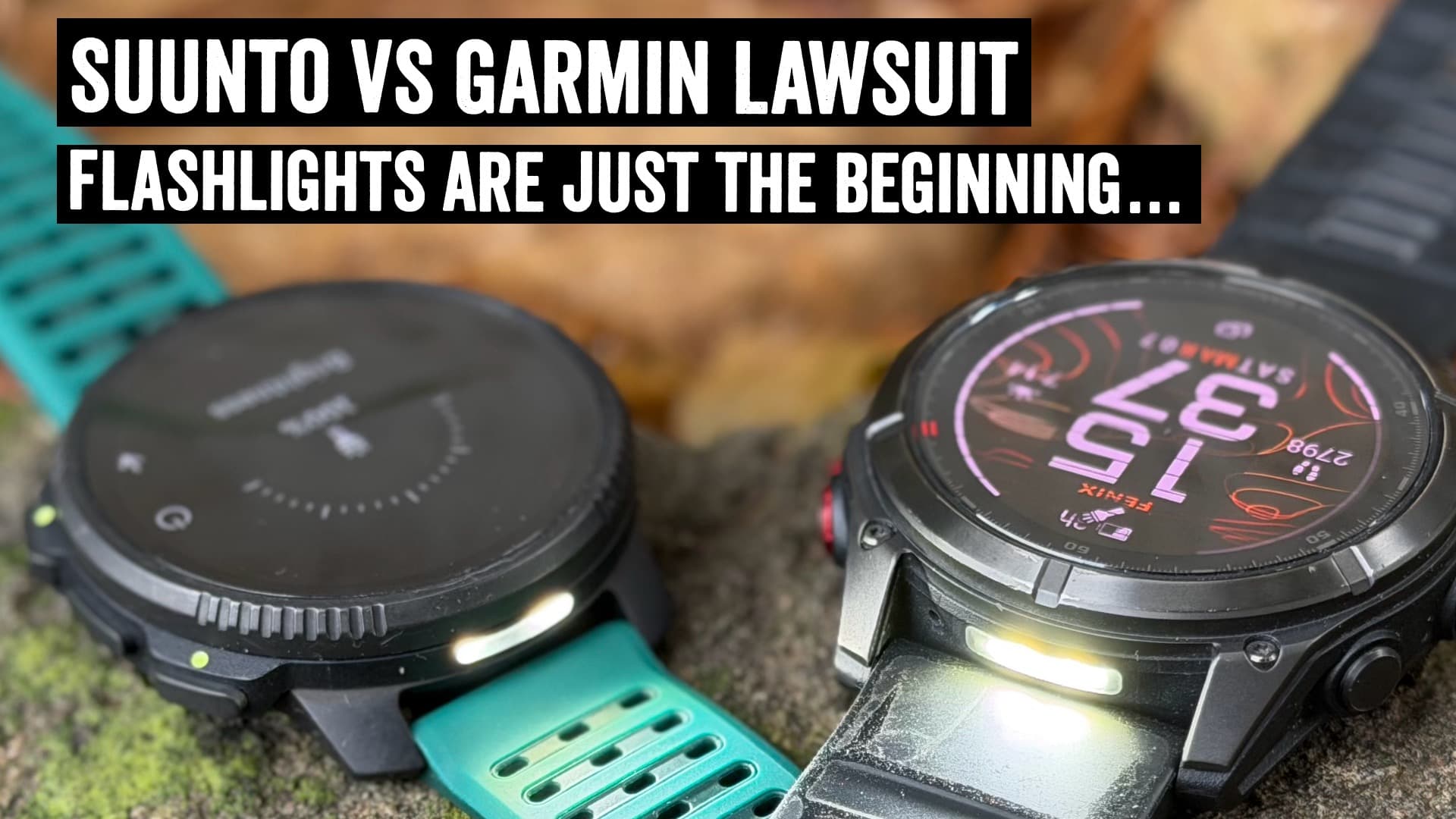
Before Strava, there was Suunto. Both in terms of which company started business, but also, more notably, which company sued Garmin first. While Strava suing Garmin back in October got all the headlines, the reality is that Suunto actually sued Garmin nearly two weeks prior, though mostly unnoticed.
Specifically, in September, Suunto and their parent company, Dongguan Liesheng, sued Garmin over 5 different patent infringement allegations, and did so in a court district in Texas known specifically for being fast-moving and generally favoring the company filing the case. This was quite different than the Strava lawsuit in almost every way. The Suunto lawsuit was much more akin to typical patent-troll filing behavior. That was odd for a number of reasons, the most notable being that Suunto and Garmin generally got along just fine, including Suunto licensing numerous things from Garmin during a nearly two-decade-long span. A timeframe that, by all accounts, ended amicably as the two companies (and their ownerships) drifted in different directions.
While Suunto initiated the first salvo back in September, Garmin seemed set on delivering the final 218-page WWF-style salvo back in late December, in a counter-claim of five other patents. As you’ll see, some of the patents in question are incredibly complex, dealing with internal antenna structures. It’s one of the reasons I hadn’t really covered it previously; I prefer to talk about lawsuits I can dive into from a technical standpoint. But Garmin’s response is just too juicy to ignore at this point, the level of sass is something I haven’t seen from Olathe in..well…ever. But also notably, an understanding that this isn’t really the Suunto they know and love driving this, but rather their new parent company’s lawyers.
First up, Suunto’s initial suit, filed back in September, centers on five specific patents. As one might expect of any company in this space for decades, Suunto has many patents. In fact, they even have a super nifty website listing all of them (I’d love to see Suunto actually link to the patents for each one, but hey…it’s still a fun list). In any case, the patents are as follows:
Patent 1: 7,489,241: This patent focuses on golf shot tracking, using an accelerometer (detecting the hit of the club against the ball) Patent 2: 8,021,306: This patent is around determining respiration rate via an optical HR sensor. Patent 3: 11,018,432: This is about slot mode antennas and antenna design in wearable devices. Slot mode antennas are basically antennas designed to become integrated as part of another object, such as the bezel/etc…and are usually flexible in some capacity. Patent 4: 7,271,774: This is also about placing antennas in a wrist-worn device. Patent 5: 10,734,731: This is further about antenna design in a wrist-worn device
Patent 2: 8,021,306: This patent is around determining respiration rate via an optical HR sensor.
Patent 3: 11,018,432: This is about slot mode antennas and antenna design in wearable devices. Slot mode antennas are basically antennas designed to become integrated as part of another object, such as the bezel/etc…and are usually flexible in some capacity.
Patent 4: 7,271,774: This is also about placing antennas in a wrist-worn device.
Patent 5: 10,734,731: This is further about antenna design in a wrist-worn device
As you can see, three out of the five are about antenna design, with one about physiological metrics, and then the last one about golf shot tracking. These are somewhat all over the map, but that’s OK, variety is the spice of life.
In Suunto’s 56-page filing, things are honestly pretty vanilla. While we often see grandiose lawyer fun in filings, including extravagant claims about a company’s importance in the universe, Suunto’s is pretty mellow. The vast majority of the filing is simply listing off the 9,328 different Garmin watch models that encompass these features, as required by the courts to establish which models are allegedly infringing.
At the end of which, it asks the court to order Garmin to stop infringing on said patents, and to get some money in gift cards as a result. It’s not as vocal as Strava’s, which had an assortment of rhetoric and wants. Again, super-duper vanilla.
As I said above, looking at these five patents myself, with 3 out of 5 of them requiring intimate internal knowledge of wire placement, those aren’t ones I could decide one way or another. And the other two, golf-club and respiration rate, are frankly more of a he-said-she-said type thing. So I don’t know who is right or wrong per se, but instead, I can tell you what actually matters here: Size.
Before we go too far though, I do want to point out one thing – which is that this entire post is less about Suunto and their products (or how I view their products), and more about a legal circus. As I’ll get into later on, I think Suunto is making some of the best products they’ve ever made, and some of the most competitive products they’ve ever made. I would *strongly* separate out Suunto’s product/engineering development teams from Dongguan Liesheng’s legal teams. Got it? Good.
After Suunto’s filing, things were mostly quiet, as they usually are. The court’s case notes basically are just various legal teams trading confirmations of assignment things, but nothing of note for a few months. That’s normal. Instead, we have to fast forward to a few days after Christmas, on December 29th, when Garmin delivers an astonishing 218-page smack-down.
I can only imagine Garmin’s lawyers went to the company Christmas party some weekend in December, got a bit tipsy, and then proceeded to sit down at 2AM and write their best Suunto smack-down jokes they could. It’s brutal. Just to set the stage for what’s to come, here’s one line from deep in the filing:
“Like everything else, Suunto predictably looked to copy Garmin’s GPS technology as it fell behind in the marketplace.”
Which is a good time to point out that if you’re reading this post in a few years, Garmin’s response may seem a bit strong. But you have to put things in context. This comes at a timeframe where they just got done feeling broadsided by Strava’s lawsuit festival, and then Suunto’s starting in on the action too. From Garmin’s perspective, this starts to look a little bit like the beginning of a trend. Keeping in mind that Garmin themselves haven’t sued any company over patent bits in well over a decade. Their general stance here has been to ignore starting patent battles, but equally, they rarely lose the ones against them (almost never).
Garmin’s document is essentially divided up into about a dozen different ‘defenses’. Some of this stuff is just procedural, but some of it is very real technical talk. However, the very first defense is that Suunto literally sued the wrong company. I’m not kidding. Garmin, of course, has a bunch of corporate entities, and basically, Suunto’s lawyers picked the wrong one.
This won’t likely have any meaningful impact on the case, but it’s a bit of a way to embarrass Suunto’s legal team. Though admittedly, Garmin has almost as many shell companies as they have Instinct models.
So now the document basically goes in a few different directions:
1) They mount defenses against the five patents Suunto says Garmin is infringing 2) They initiate a countersuit against Suunto for five different patents
But more interesting than all that, Garmin starts to separate out Suunto from Dongguan Liesheng. The way they do this is pretty notable, because it’s Garmin saying, “Look, you want this to be about Suunto, but we’re actually going to sue you about every other Dongguan Liesheng device you have in the US”.
However, they give a brief nod on page 2 to the lower-level employees at Suunto first, seemingly saying, “this isn’t about you, we know”:
“Suunto and Garmin cooperated and competed constructively for years. Suunto was a long-time purchaser of Garmin’s wireless and wellness technology. But since Dongguan Liesheng bought Suunto, moved production and design to China, laid off many of Suunto’s employees, and filed this baseless lawsuit, that cooperation has ended.”
And indeed that’s true. Suunto had long licensed technology from Firstbeat, which Garmin acquired years earlier. But also, even before that, Suunto was a big part of ANT+ too (which Garmin owned). Long-time engineers at these two companies know each other on a first-name basis. Heck, upwards of 15 years ago I sat down having nightly beers with them all at the same table.
From there, the games begin. For example, in relation to Dongguan Liesheng’s products, instead of talking about mostly offending Suunto products (which they do later), they include screenshots of offending Dongguan Liesheng products. These are, of course, still mixed in with Suunto ones, but the emphasis here is on pointing out the breach of things.
As we start to get into some of the patents, things get spicy quickly. They point out that Suunto’s ‘306 patent (the one about respiration rate via HR) is actually something Suunto licensed from Garmin starting back in 2003. They then call out a provision (pre-AIA 35 U.S.C. § 102(f)), which basically states you can’t patent something you learned from someone else. And given that Suunto’s ‘306 patent literally references Garmin’s own patent as prior art, Garmin is doing a bit of a double-take here:
Now, to be clear, you can (and should) absolutely list prior art in your patent application. That in and of itself isn’t an issue (and is part of almost every filing). But Garmin’s defense here is so short and blunt that they seem almost baffled at why they’d have to defend it. Again, I’m not going to try to figure out which side is right here. Because while Garmin lays out a pretty straightforward case, patent battles are rarely straightforward. Still, it seems like Dongguan Liesheng’s lawyers just aren’t familiar with the decades-long intertwined history that Suunto/Garmin/FirstBeat actually have.
After that, Garmin tries to pull an argument that even if Suunto were to succeed on the ‘241 & ‘306 patent, it’d be limited to infringements after 2022, due to assignment of rights from the American sports acquisition. I’m not a lawyer, but this claim seems pretty shaky to me.
In fact, there are a few things that are a bit weird, or simply incorrect. For example, Garmin does a bunch of weird date and company fails here, that almost seems like AI mistakes:
“Suunto is a Finnish brand that sells fitness watches. Suunto launched it’s first GPS product in 2003, some 12 years after Garmin launched it’s first GPS product and also after Garmin’s first fitness watch”.
In reality, Suunto launched its first GPS-integrated watch product in 2003/2004 (Suunto X9), and Garmin launched their first in 2003 (Forerunner 201), but that’s actually all ignoring the fact that Garmin got their dates/companies/etc all mixed up here.
Same goes for this section talking about Connect IQ (during a general grandstanding moment). This is incorrect, because Suunto actually beat Garmin to an App Store, with the Suunto App Zone in 2012 (versus Garmin’s 2014). Suunto later did a different App Store in 2022, but Suunto definitely beat Garmin here on timelines, no matter how you slice it.
And that ignores the comments about Garmin pay and Suunto contactless payments, because the Suunto watch they are referring to here is the Suunto 7, which is really a WearOS watch…and thus, if we want to get really picky here, WearOS actually had contactless payments before Garmin did, in February 2017 versus Garmin’s November 2017. Just sayin’…
So, on to the patents. When it comes to the golf patent, things are relatively straightforward there. First, Garmin says:
“Suunto’s ’774 and ’241 Patents both describe obsolete functionality not used in any Garmin products. It is difficult to have meaningful patents for Suunto as it is consistently behind its competitors, such as Garmin.”
But, nonetheless, they carry on and explain why the ‘241 golf patent wouldn’t apply here anyway:
“Garmin Ltd. denies at least that any of the ’241 Patent Garmin Accused Products “determine[e] a GPS position of the user when the strike event is detected” or “record[] at least the GPS position of the user within a wearable wristop computer after the determination of the GPS position of the user is completed,” as required by the ’241 Patent. GPS functionality in the ’241 Patent Garmin Accused Products operates independently of shot detection.”
Basically, Garmin is saying that the patent itself requires the usage of GPS to trigger a shot event, and then Garmin says that it’s not leveraging GPS for anything to do with the shot. At this point, we have no way to independently validate that code (that’ll come later), but frankly, it kinda makes sense. There’s no reason to use a GPS coordinate when detecting an accelerometer/gyroscope event like a golf swing.