Americans' confidence that their elections will be run fairly has dropped to its lowest point in years, according to a new PBS News/NPR/Marist poll.
Ahead of a consequential midterm contest in November, two-thirds of Americans say they are confident their state or local government will run a fair and accurate election, a drop of 10 percentage points from the month before the 2024 presidential election. The percentage who expressed confidence is at the lowest it's been since Marist first asked this question in 2020.
The drop has been driven largely by Democrats and independents, whose confidence has dropped 16 and 11 percentage points respectively. Republicans, however, are 3 percentage points more confident in how elections will be run this November, within the poll's margin of error.
Two-thirds of Americans say they are confident their state or local government will run a fair and accurate election, according to the latest PBS News/NPR/Marist poll — a drop of 10 percentage points from the month before the 2024 presidential election. Graphic by Steff Staples/PBS News
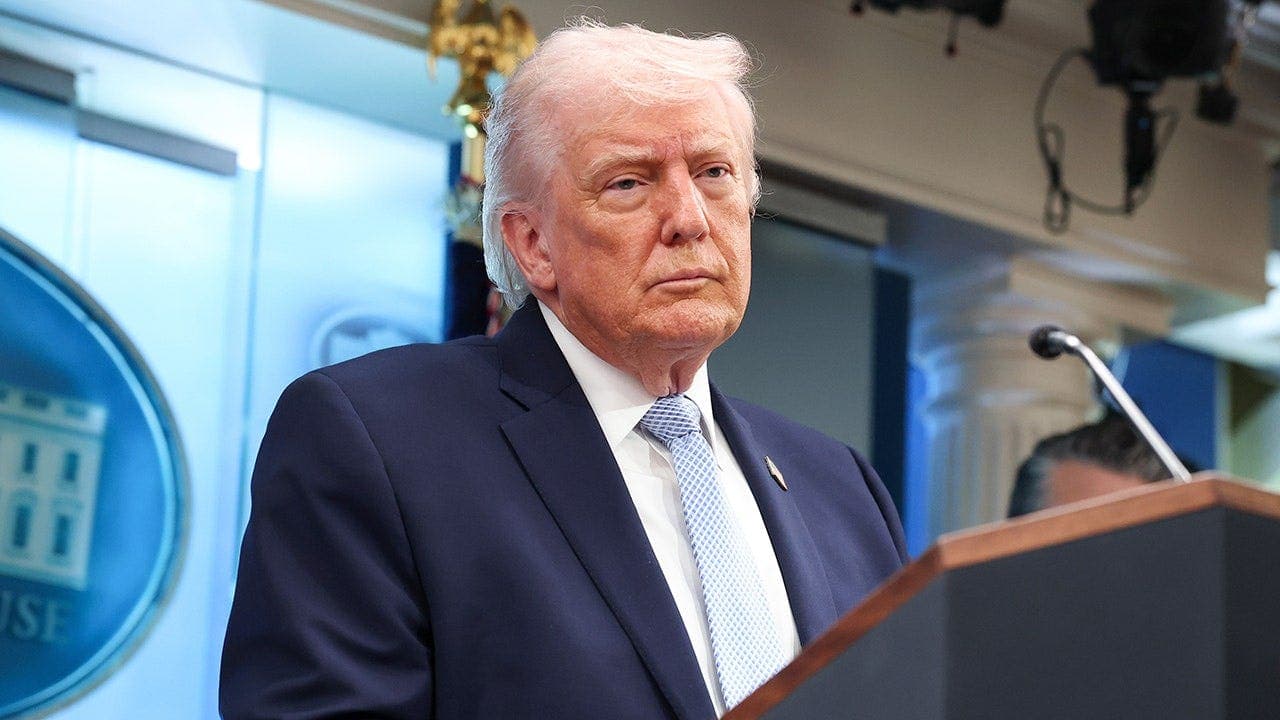
The growing concern comes as President Donald Trump threatens to hold up all legislation until Congress passes a sweeping overall of federal voting rules, despite many states already holding primaries and actively preparing for the general election.
Speaking to House Republicans on Monday, Trump called the SAVE America Act, which already passed the House along party lines last month, his singular legislative priority right now. Among the bill's components, the most controversial and complicated to implement is a requirement that Americans present proof of citizenship to register to vote in federal elections. The president claims it will prevent non-citizens from committing voter fraud – a very rare occurrence, according to experts – and that the legislation has overwhelming support from voters.
"It'll guarantee the midterms," Trump said. "If you don't get it, big trouble."
One third of Americans say voter fraud is the single biggest threat to keeping elections safe and accurate, according to the new poll. But the public's anxieties about voting are more complicated and more divided than the president would suggest.
Another 26% cite misleading information as the biggest threat, while 24% say voter suppression. Foreign interference was named by just 8 percent, despite a recent renewed assertion from Trump, as part of his shifting justification for strikes on Iran, that Tehran tried to meddle in recent presidential elections.
WATCH: Primaries in key states begin to shape the midterm matchups
Broken down by party, Republicans were most likely – at 57% – to say voter fraud is the biggest threat. Among Democrats, 41% point to voter suppression; about a third of independents are most worried about misleading information.
Overall, voter fraud and voter suppression concerns have risen 9 points and 8 points respectively since January 2020, suggesting ongoing messaging from Republican and Democratic officials have increased those fears among their base voters.
"It's the politicians driving the cart," said Lee Miringoff, director of the Marist Institute for Public Opinion. "It's not being determined by court cases. It's not been determined by evidence. It's being shaped by a sense that the other guy's up to no good."
While Trump has said the SAVE America Act is an "88% issue with ALL VOTERS," this latest survey finds Americans are more conflicted about the competing issues of voter access and preventing ineligible votes from being cast.
Nearly 6 in 10 respondents say it is more important to make sure everyone who wants to vote can do so; 41% say their bigger concern is making sure no one votes who is not eligible. The divide has remained relatively stable since 2021. Independents are 7 percentage points more likely in this poll to prioritize voter access.
President Donald Trump and Rep. Steve Scalise, R-La., on March 9 at Trump National Doral Miami in Miami. The public's anxieties about voting are more complicated and more divided than the president would suggest. Photo by Kevin Lamarque/ Reuters
According to this latest poll, 58% of Americans are concerned that people will show up to the polls in November only to be told they are not eligible, a striking 16 percentage point jump from January 2020. Democrats are driving that concern: nearly three-quarters are worried. Among Republicans and Independents, 47% share that view.
The poll also reveals a sharp disparity between younger and older voters. Three-quarters of Americans under 30 years old are concerned about voters being told they are not eligible; while just 43% of Americans 60 years old and above share the concern.
It is already illegal for noncitizens to vote in federal elections. Rick Hasen, director of the Safeguarding Democracy Project at UCLA School of Law, said documented cases of noncitizen voter fraud are extremely rare.
According to the latest PBS News/NPR/Marist poll, 58% of Americans are concerned that people will show up to the polls in November only to be told they are not eligible, a striking 16 percentage point jump from January 2020. Graphic by Dan Cooney/ PBS News
"In 2016, when Donald Trump claimed there were three million noncitizens who voted, it turned out there were 30 possible cases that were documented in the entire country. That's a miniscule amount," Hasen said. "We just do not see large hordes of noncitizens voting in the way that Donald Trump routinely describes it."
David Becker, the executive director of the nonpartisan Center for Election Innovation & Research, said the administration's own record undermines its case that voters should be concerned about ineligible voters participating in elections.
"This administration has gone out hunting for fraud with all of the tools of the federal government over the last year and they have found virtually none," he said. "Their own Department of Homeland Security has found only a shockingly small number of noncitizens that are on the voter list. And yet, that disinformation is clearly infecting the American public to make them doubt their own elections."
Erosion of election confidence could worsen
Miringoff described the 10-point drop in confidence since October 2024 as a "be on guard" kind of decline.
"I can only expect that the numbers may even get worse as we get closer to the midterms," he said. "This may be just a stopping-off point to an erosion in even the state and local confidence people have."
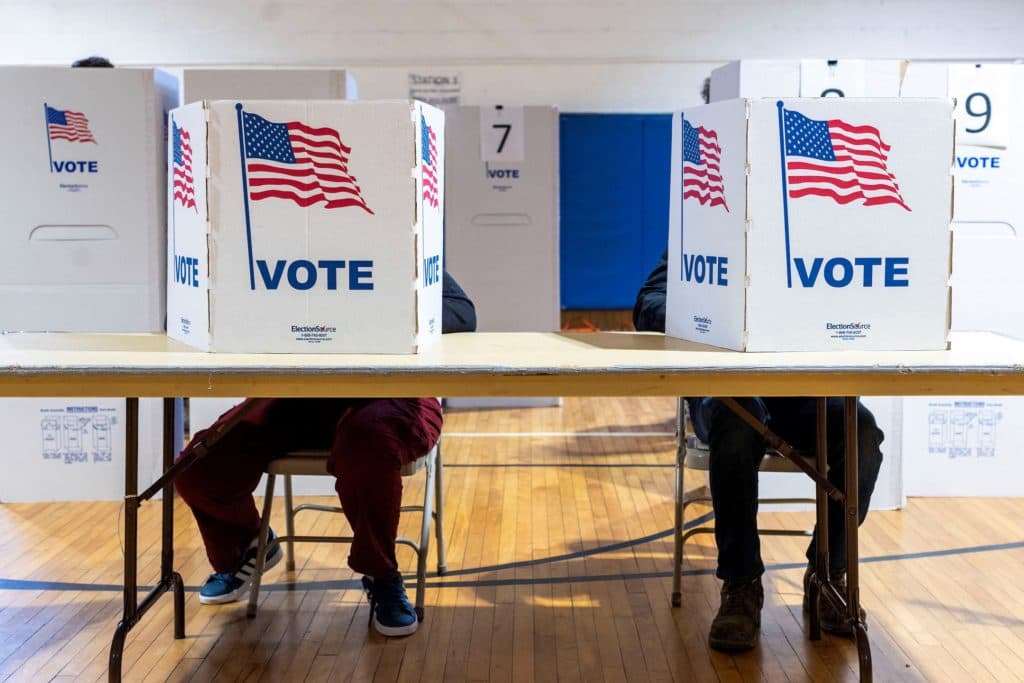
A woman holds the voting booth at an East Harlem school turned into a polling center on Election Day 2024, in New York City. File photo by Kent J. Edwards/ Reuters
Already there is a significant drop in confidence among communities of color. While 72% of white Americans think their state and local governments will run elections fairly, just 63% of Black Americans and 57% of Latinos say the same.
"That's the trust in the system. That's a sense of history of being excluded," Miringoff said. "Latinos have been in the spotlight right now politically. And so I'm not surprised that folks who feel they've been outside the system or been under a spotlight are not as comfortable and don't have as much confidence in the system."
Tammy Patrick, the chief executive officer for programs at The Election Center at the National Association of Election Administrators, said sustained political attacks on local election administrators have had a concrete cost. They've driven professionals from the field and could risk further undermining faith in elections, she said.
"It absolutely makes it more difficult to be an election professional when your day-to-day work life is justifying every action that you take, even when you're proceeding in a lawful and legal manner," said Patrick, a former election official in Maricopa County, Arizona.
How the SAVE America Act could 'create chaos' so close to an election
The timing of the president's push to question the safety of elections and the public's dropping confidence could hardly be more consequential. Several states have already held primary elections, and election administrators are well into planning for what will be one of the most closely watched midterm elections in modern American history.
Trump has insisted that the Senate take up and pass the SAVE America Act, getting rid of the 60-vote threshold if necessary. While Senate Majority Leader John Thune said Tuesday the chamber would take up the bill next week, he threw cold water on its chances of passing and of eliminating the filibuster to do it.
Workers sort mail-in ballots at the Orange County Registrar of Voters during a Nov. 1, 2022, media tour showing ballot security at the facility in Santa Ana, California. Photo by Mike Blake/ Reuters
"The votes aren't there for a talking filibuster," Thune said. "It's just a reality."
Becker, a former attorney in the Voting Section of the Department of Justice's Civil Rights Division, said he was unsurprised by the math.
"I've talked to Republican and Democratic election officials all over the country at the state and local level, and I've yet to find one of them that thinks this is a good bill," he said. "It would create chaos this close to an election."
Indeed, if the SAVE America Act were to be signed into law, it would likely be challenged in court. But in the meantime, election administrators across the country would be tasked with implementing sweeping new voter registration requirements in the months before November's general election.
Patrick, who helped enact Arizona's proof-of-citizenship requirement after voters approved it by ballot measure, said the experience should give Congress pause.