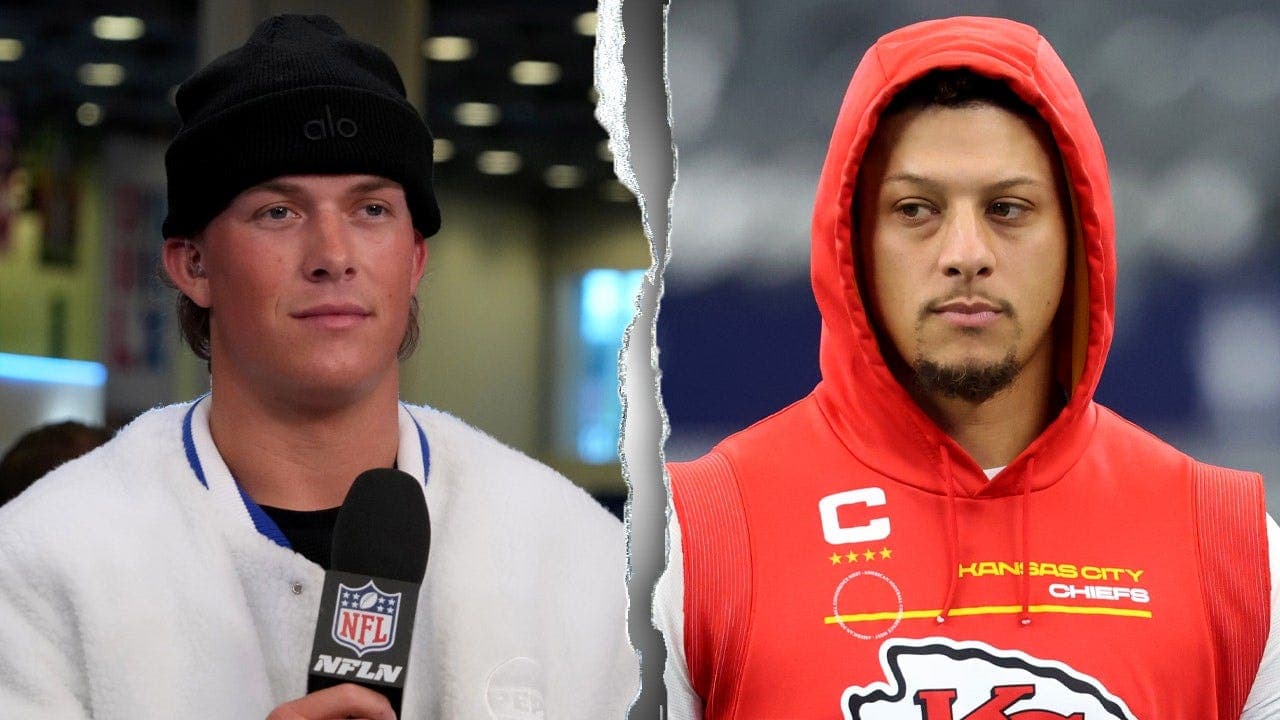
Jaxson Dart is stepping into the spotlight as the New York Giants’ unquestioned franchise quarterback in 2026, flanked by a revamped coaching staff led by offensive coordinator Matt Nagy—a man whose résumé includes sculpting Patrick Mahomes into a three-time Super Bowl champion. After a rookie season that hinted at elite potential but lacked consistency—15 passing touchdowns, nine rushing scores, and a fourth-place finish in Offensive Rookie of the Year voting—Dart now faces the daunting task of translating raw talent into sustained success under a system designed to amplify his strengths while mitigating his weaknesses. Nagy, who spent three seasons as the Chiefs’ offensive coordinator before joining the Giants this offseason, is armed with a playbook forged in the crucible of NFL innovation, where Mahomes’ improvisational genius was balanced by structured routines and elite decision-making. His challenge? Convince Dart—and the football world—that his journey won’t mirror Mahomes’ but will instead carve its own legacy.
From Mahomes to Dart: What Nagy’s Chiefs Blueprint Means for the Giants’ QB1
Matt Nagy’s tenure in Kansas City (2021–2024) coincided with a golden era for the Chiefs’ offense, where his ability to blend Andy Reid’s schematic flexibility with Mahomes’ generational playmaking redefined what was possible for an NFL quarterback. Under Nagy’s guidance, Mahomes won his second Super Bowl in 2023 (LVIII) and narrowly missed a historic three-peat in 2024, a season that saw him lead the league in passing yards (4,183) and touchdowns (27) despite missing four games. Those achievements were built on a foundation of meticulous preparation, where routines—from pre-game rituals to in-game adjustments—became as critical as physical talent. ‘I was able to be fortunate enough to be around Patrick for many years,’ Nagy told reporters this week. ‘I saw him as a rookie, and then I got to see four more years of him as a vet.’ But Nagy is quick to clarify that the goal isn’t to remake Dart in Mahomes’ image. ‘The thing I would say with that conversation is just what you said: He’s Jaxson Dart. He’s not Patrick Mahomes.’
The Core Philosophy: Structure Without Stifling Creativity
Nagy’s approach with Dart hinges on a dual philosophy: provide the scaffolding of a championship-caliber offense while allowing the young quarterback’s instincts to flourish. This mirrors the framework he used with Mahomes, where structured concepts (like the ‘Kansas City Shuffle’ play-action series) were paired with pre-snap adjustments to exploit defensive weaknesses. For Dart, a dual-threat quarterback with a cannon for an arm but a tendency to force throws under pressure, Nagy’s system could emphasize play-action to set up deep shots, bootlegs to keep defenses honest, and quick, high-percentage reads to mitigate turnovers. ‘We’re going to be really intentional on how we do that,’ Nagy said. ‘You look at Brian Callahan. He’s been around a lot of great quarterbacks too… That’s valuable. That’s really valuable.’
The Giants’ 2025 season offered glimpses of Dart’s potential but also exposed vulnerabilities. In wins over Dallas (34–17) and Seattle, he flashed Mahomes-like escapability, scrambling for 487 rushing yards and nine touchdowns. Yet, in losses to the Eagles and Rams, he struggled with pocket pressure, completing just 58.3% of passes and throwing two interceptions in each game. Nagy’s task is to bridge that gap by refining Dart’s decision-making under duress—a skill Mahomes honed through thousands of reps in Kansas City’s ‘no huddle’ practices. ‘We’ve made it clear, you have to be Jaxson Dart,’ Nagy emphasized. ‘He has to tell us how he likes it, why he likes it, and so forth.’
Dart’s 2025 Rookie Year: A Tale of Two Halves
Jaxson Dart’s transition from Ole Miss to the NFL was smoother than most rookie quarterbacks’, thanks in part to his Alabama roots and pro-style offense under Lane Kiffin. He entered the 2025 season as a third-round pick (No. 68 overall) with high expectations, but injuries to the Giants’ offensive line and inconsistent play from the receiving corps limited his development. Still, his 2,272 passing yards and 15 touchdowns in 14 games (including playoffs) earned him the fourth-highest rookie QB rating in the league (89.2), trailing only C.J. Stroud, Drake Maye, and Jayden Daniels. His 487 rushing yards and nine touchdowns further underscored his dual-threat potential—a trait Nagy’s Chiefs offense thrived on. ‘He’s got a strong arm, good mobility, and the intangibles to be a franchise guy,’ said one NFC scout who requested anonymity. ‘But he’s got to cut down on the hero-ball throws. That’s where Nagy comes in.’
The Offensive Line: A Critical X-Factor
One of the biggest hurdles for Dart in 2026 will be the Giants’ offensive line, which ranked 28th in pass-blocking grade (per Pro Football Focus) in 2025. Left tackle Evan Neal, a former top-10 pick, showed flashes but was sidelined by injuries last season, while center John Michael Schmitz struggled in pass protection. Nagy’s Chiefs offense relied heavily on quick, clean pockets—something Dart rarely enjoyed in 2025. ‘Protection is everything,’ said Giants offensive line coach Chris Foerster, who worked with Mahomes in Kansas City. ‘If we don’t give Jaxson time, none of this matters.’ The Giants added depth this offseason by drafting tackle Jordan Love (third round) and guard Jonah Jackson (free agency), but depth remains a concern. If the line can’t improve, Dart’s development could plateau.
The Receiving Corps: Can the Giants’ Playmakers Rise to the Occasion?
Dart’s rookie season was hamstrung by inconsistent play from the Giants’ receivers, particularly downfield threats. Wan’Dale Robinson (72 catches, 822 yards) was a bright spot, but aging veterans like Darius Slayton (42 catches, 636 yards) and rookie Jalin Hyatt (17 catches, 292 yards) struggled to separate from coverage. Nagy’s offense in Kansas City thrived on a mix of speed (Tyreek Hill), physicality (Travis Kelce), and gadget plays (Skyy Moore). ‘You need a deep threat to stretch the field,’ said a former Chiefs receiver who worked with Nagy. ‘Dart’s arm talent is elite, but he needs targets who can win 1-on-1.’ The Giants addressed this in the draft by selecting speedster Brian Thomas Jr. (Florida) in the second round, but he’ll need time to acclimate. Until then, Dart’s reliance on improvisation could grow—something Nagy aims to curb.
Nagy’s Coaching Style: Discipline Meets Adaptability
Matt Nagy’s coaching philosophy is a blend of discipline and adaptability, a philosophy that helped Mahomes evolve from a high-risk, high-reward talent into a controlled maestro. In Chicago, Nagy’s tenure as Bears head coach (2018–2021) was marked by mixed results—three playoff appearances but zero postseason wins—but his offensive schemes were widely praised for their creativity. After returning to Kansas City as offensive coordinator in 2022, he refined his approach, emphasizing pre-snap motion, tempo, and quarterback-friendly reads. ‘Nagy doesn’t micro-manage,’ said a former Chiefs assistant. ‘He sets the framework, then lets the quarterback operate within it. That’s what Dart needs.’
The Influence of Reid and Callahan
Nagy’s time in Kansas City was deeply influenced by Andy Reid, the Chiefs’ longtime head coach known for his quarterback-friendly systems. Reid’s fingerprints are all over Nagy’s approach, particularly in how he structures plays to maximize a quarterback’s strengths. ‘Andy’s the best at it,’ Nagy said. ‘He taught me how to build an offense around a guy’s skill set.’ Another key mentor for Nagy is Brian Callahan, now the Giants’ head coach, who has worked with elite quarterbacks like Peyton Manning, Matthew Stafford, and Joe Burrow. Callahan’s experience in developing franchise QBs could complement Nagy’s hands-on approach with Dart. ‘Brian’s seen it all,’ Nagy noted. ‘His insights have been invaluable.’
The 2026 Outlook: Realistic Expectations for Dart and the Giants
For the Giants to contend in 2026, Dart must take a significant leap from his rookie year. The NFC East is stacked—Dallas, Philadelphia, and Washington all made aggressive moves this offseason—meaning the Giants can’t afford another year of inconsistency. Nagy’s system should help, but the margin for error is thin. ‘Jaxson’s got the tools, but he’s got to cut down on the mistakes,’ said a league executive familiar with the Giants. ‘A 15-TD, 10-INT season isn’t going to cut it.’ The good news? The Giants’ schedule isn’t a death march—only two games against last year’s Super Bowl participants (Chiefs, Eagles)—and their defense, bolstered by additions like edge rusher Brian Burns, should keep them in most games. If Dart can improve his completion percentage (58.3% in 2025) and reduce turnovers (13 in 14 games), Nagy’s offense could become one of the league’s most dynamic units.
Key Takeaways: What to Watch for in Dart’s Breakout Season
- Jaxson Dart enters 2026 as the Giants’ undisputed franchise quarterback, tasked with building on a promising rookie campaign that showed elite potential but concerning inconsistencies.
- Matt Nagy’s offensive system, forged in the Super Bowl era with Patrick Mahomes, prioritizes structure and quarterback autonomy—a balance Dart must master to avoid regression.
- The Giants’ offensive line and receiving corps remain critical weaknesses; without improvement, Dart’s development could stall despite Nagy’s guidance.
- Dart’s ability to cut down on forced throws and improve his completion percentage (58.3% in 2025) will determine whether the Giants can challenge for a playoff spot in 2026.
- Nagy’s mentorship, combined with Brian Callahan’s experience developing elite QBs, provides a unique support system for Dart’s breakout season.
Frequently Asked Questions About Jaxson Dart’s 2026 Season Under Matt Nagy
Frequently Asked Questions
- How much did Matt Nagy’s time with Patrick Mahomes influence his approach to coaching Jaxson Dart?
- Nagy’s tenure in Kansas City (2021–2024) shaped his philosophy around structured routines, play-action, and quarterback autonomy—tools he’ll adapt for Dart’s dual-threat skill set. However, he’s emphasized that Dart’s development must follow his own path, not Mahomes’.
- What are the biggest challenges Jaxson Dart faces in his second NFL season?
- Dart must improve his pocket presence, reduce turnovers, and elevate the play of his offensive line and receivers. The NFC East’s competitiveness means even small steps backward could derail the Giants’ playoff hopes.
- Will Matt Nagy’s Chiefs-style offense work for a dual-threat quarterback like Dart?
- Nagy’s systems in Kansas City thrived on quarterback-friendly concepts, but Dart’s mobility requires adjustments to maximize his running ability without over-relying on improvisation. The Giants’ offensive line will play a pivotal role in determining its success.