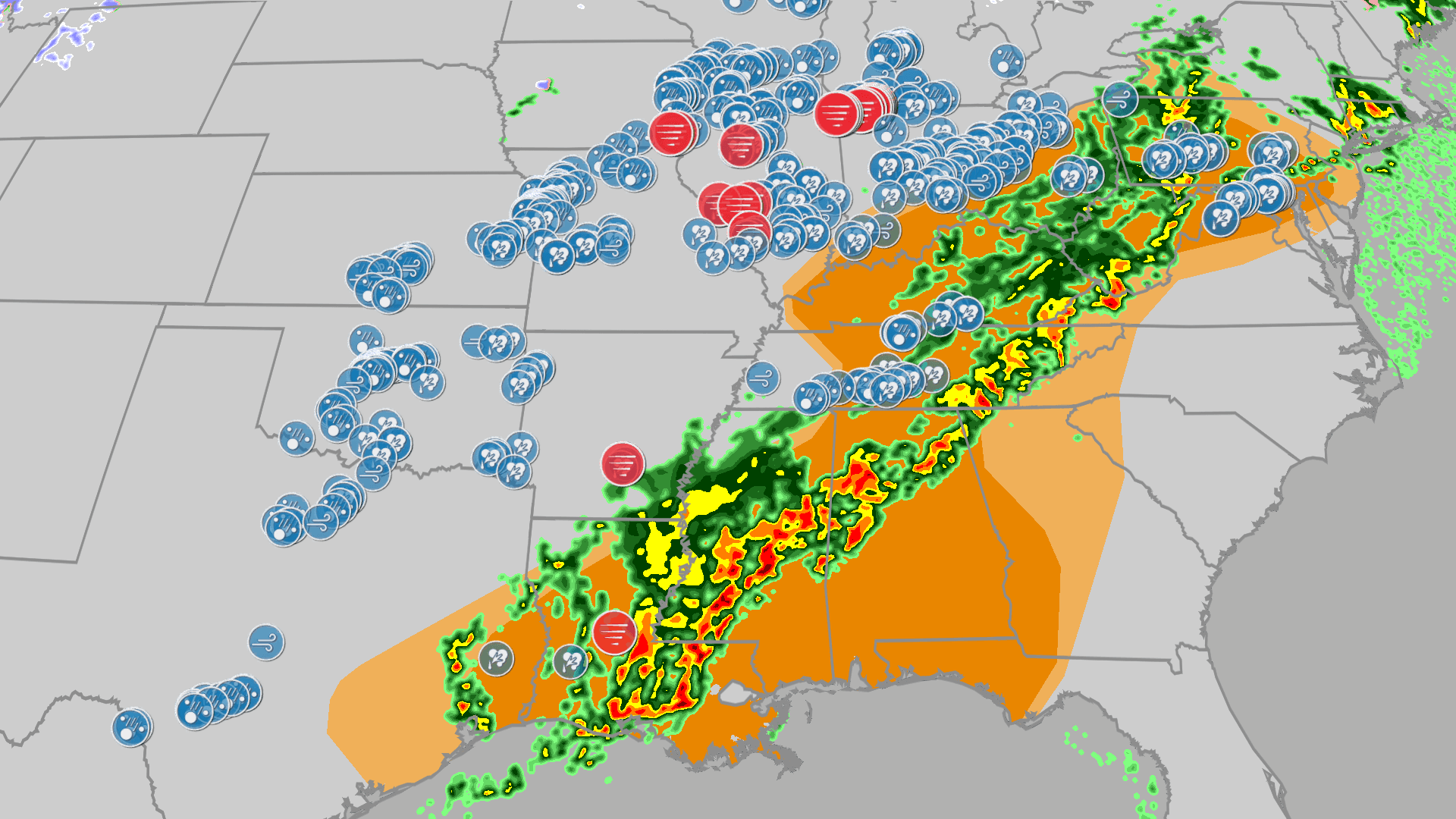
Southeast: Watch For High Winds, Isolated Tornadoes
A powerful, multiday severe weather outbreak hit the Central and Eastern US on March 10 and 11, bringing deadly tornadoes, very large hail and gusty winds. This happened less than a week after an outbreak of 24 tornadoes swarmed over many of the same areas.
A moderate risk, or a level 4 of 5, was issued primarily for northern Illinois and northern Indiana. This was the first moderate risk since July 2025.
About 240 reports of severe weather were received by the National Weather Service Tuesday through early Wednesday morning, the most of any 24-hour period in the U.S. since July 28, 2025.
(News: As It Happened March 10)
Conditions were favorable for long-duration tornadoes across northern Illinois and northern Indiana due to a stationary front that formed just south of Chicago. This caused plenty of lift for hundreds of miles, which set the stage for major impacts.
The most heavily damaged areas were from one supercell thunderstorm which tracked over 120 miles in almost 4.5 hours from northeast Illinois into northern Indiana. That supercell spawned destructive tornadoes in Kankakee, Illinois; Lake Village and Wheatfield, Indiana, according to the National Weather Service.
EF3 level damage consistent with winds of 150 mph was surveyed by NWS Chicago in the area of Aroma Park, Illinois, where two people were killed. This tornado was on the ground for 36.6 miles.
Further east, an EF1 tornado has been confirmed near Wheatfield, Indiana, with winds of around 110 mph. There were three people injured.
There was also an EF2 tornado reported in Knox, Indiana, with estimated peak winds of 115 mph. There was a tornado emergency issued for Knox as well.
(EXPERT ANALYSIS: The Setup For The Long Track Supercell)
This supercell also dumped giant hail from 5 to 6 inches in diameter in or near Buckingham, Campus and Kankakee, Illinois. This may have set a state hail record, something an ad hoc committee of meteorologists will examine at a later date.
North of the boundary, in the cooler air, no tornadoes were able to develop and only large hail was reported, which you can see on the graphic below.
A second supercell thunderstorm tracked into Chicagoland, dumping 3 to 5-inch diameter hail in the far southwest suburbs of Bolingbrook and Darien, then half-dollar size hail downtown at the Loop.
Across the rest of the region, there was more of a traditional setup for severe weather. A cold front was moving through the region, stretching as far south as Texas.
An EF1 tornado also moved through Moro and Midway, Illinois, early on March 11 with winds of 95 mph. There was one injury reported.
Elsewhere, hail up to baseball size pelted the western Oklahoma City metro area from a tornado-warned supercell thunderstorm. Several severe thunderstorms pelted the Kansas City metro with hail up to 2 inches in diameter.
At least two tornadoes touched down in western Texas, one just southeast of Abilene and the other just east of Laughlin Air Force Base near Del Rio.
There were also two EF1 tornadoes in southeastern Iowa near Donnellson in Lee County. One tornado had winds of 100 mph while the other had winds of 90 mph.
There were over 100 wind damage reports, with the greatest wind speed being an 85 mph gust in Anderson County, Kansas.
Flash flooding stranded vehicles in Grand Rapids and near Holland, Michigan.
These are initial severe weather reports received by the National Weather Service from March 10 through March 12, 2026. These are only preliminary reports of tornadoes, and don't represent the actual number of tornadoes that occurred, which will be determined by NWS damage surveys.
(News: As It Happened March 11)
The low-pressure system and its associated cold front shifted east on Wednesday, and as they did so, it became a mainly wind event.
Tornado watches continued through the overnight hours between March 10 and March 11 and were issued along the storms as they moved east. But as was expected, the threat for tornadoes was less for March 11.
There was an EF1 tornado confirmed in Kingsland, Arkansas, with estimated peak winds of 105 mph.
In Cheneyville, Louisiana, the police department reported a tornado sighting along the Cheneyville-Echo road.
In Central Georgia, there were reports of damage caused by a likely tornado.
March 11 brought with it over 200 gusty winds as the storms moved from the Upper Midwest and the South to the Northeast and the Southeast.
Notable wind gusts to 70 mph were reported in Madison County, Indiana, and Laurel County, Kentucky.
There were even 7 hail reports: three in Tennessee and four in Pennsylvania.
For Thursday, there was a brief round of severe weather across the Carolinas, with a handful of wind reports, before the cold front moved offshore. For the Northeast, there wasn’t a severe threat but due to the cooler air in the region, there was a light wintry mix for the major metropolitan areas.