NVIDIA has officially unveiled the Vera CPU, a groundbreaking processor engineered specifically for the demands of agentic artificial intelligence and reinforcement learning. The chip, announced at the company’s annual GTC conference, delivers up to 50% faster processing speeds and twice the energy efficiency compared to conventional rack-scale CPUs, positioning it as the first CPU purpose-built for the next era of AI systems capable of reasoning, planning, and executing tasks autonomously. Major hyperscalers, national laboratories, and enterprise infrastructure providers—including Alibaba Cloud, Meta, Oracle Cloud Infrastructure, and Dell Technologies—have already committed to deploying Vera, signaling a seismic shift in how AI workloads are processed in data centers worldwide.
What is NVIDIA Vera CPU and Why It Matters for the AI Revolution
The Vera CPU represents NVIDIA’s boldest bet yet on the future of AI, where systems are no longer mere tools but active agents capable of complex decision-making. Unlike traditional CPUs designed for general-purpose computing, Vera is optimized for the unique demands of agentic AI—systems that must plan tasks, interact with data, run code, and validate results in real time. Jensen Huang, NVIDIA’s founder and CEO, emphasized this transformation in a keynote address: “The CPU is no longer simply supporting the model; it’s driving it.” This shift is critical as AI adoption accelerates across industries, from autonomous coding assistants to enterprise decision engines, all of which require unprecedented levels of computational efficiency and responsiveness.
Agentic AI: The Next Frontier in Artificial Intelligence
Agentic AI refers to systems that can autonomously perform multi-step tasks, often by leveraging tools, APIs, and external data sources to achieve specific goals. This goes beyond traditional generative AI, which primarily focuses on producing text or images based on prompts. Agentic systems, such as coding assistants like Cursor or enterprise workflow automators, require real-time reasoning, tool integration, and seamless interaction with databases and APIs—all of which demand a new class of computational infrastructure. The Vera CPU is designed to meet these requirements with its 88 custom NVIDIA-designed Olympus cores, each capable of running two tasks simultaneously via Spatial Multithreading, ensuring consistent performance even under extreme utilization.
How Vera Outperforms Traditional CPUs: Speed, Efficiency, and Scalability
Vera’s performance gains are rooted in several architectural innovations. First, its cores are tailored for AI workloads, delivering higher single-thread performance and bandwidth per core compared to off-the-shelf alternatives. The CPU’s memory subsystem is equally groundbreaking: Vera integrates LPDDR5X memory, providing up to 1.2 TB/s of bandwidth while consuming half the power of general-purpose CPUs. This combination enables Vera to sustain more than 22,500 concurrent CPU environments in a single rack—each running independently at full performance—thanks to NVIDIA’s modular reference architecture.
- Vera delivers up to 50% faster performance and twice the energy efficiency over traditional rack-scale CPUs.
- The CPU features 88 custom Olympus cores with Spatial Multithreading for multi-tasking at scale.
- LPDDR5X memory delivers 1.2 TB/s bandwidth at half the power of conventional memory subsystems.
- A single Vera rack can support over 22,500 concurrent CPU environments.
Key Partners and Early Adopters: Who’s Deploying Vera
NVIDIA’s Vera CPU has already garnered widespread support from industry giants across cloud computing, AI infrastructure, and scientific research. Hyperscalers leading the adoption include Alibaba Cloud, ByteDance, Meta, and Oracle Cloud Infrastructure, all of which are integrating Vera into their AI factories—large-scale data centers optimized for training and deploying agentic AI models. Infrastructure providers such as Dell Technologies, HPE, Lenovo, and Supermicro are manufacturing Vera-based servers, while global system makers like ASUS, Foxconn, and Quanta Cloud Technology (QCT) are developing custom configurations for everything from reinforcement learning to high-performance computing.
Cloud Providers Betting on Vera for AI Workloads
Cloud service providers are among the first to deploy Vera due to its ability to handle the most demanding AI workloads. CoreWeave, a leading AI cloud provider, is incorporating Vera into its GPU-accelerated infrastructure to power its agentic AI services. Oracle Cloud Infrastructure is also embracing Vera to enhance the performance of its enterprise AI applications. Meanwhile, Cloudflare and Vultr are leveraging Vera to optimize real-time data processing and AI inference, respectively. Together.AI and Crusoe are also planning Vera deployments to support their AI-native platforms.
Scientific and Research Institutions Leading the Charge
National laboratories and research institutions are another critical segment adopting Vera. The Leibniz Supercomputing Centre in Germany, Los Alamos National Laboratory, Lawrence Berkeley National Laboratory’s National Energy Research Scientific Computing Center, and the Texas Advanced Computing Center (TACC) are all testing or planning to deploy Vera. TACC’s director, John Cazes, highlighted the CPU’s transformative potential: “Vera’s per-core performance and memory bandwidth represent a giant step forward for scientific computing.” The Horizon system at TACC, set to launch later this year, will feature Vera-based nodes to support advanced research applications.
The Vera CPU Rack: A New Standard for AI Data Centers
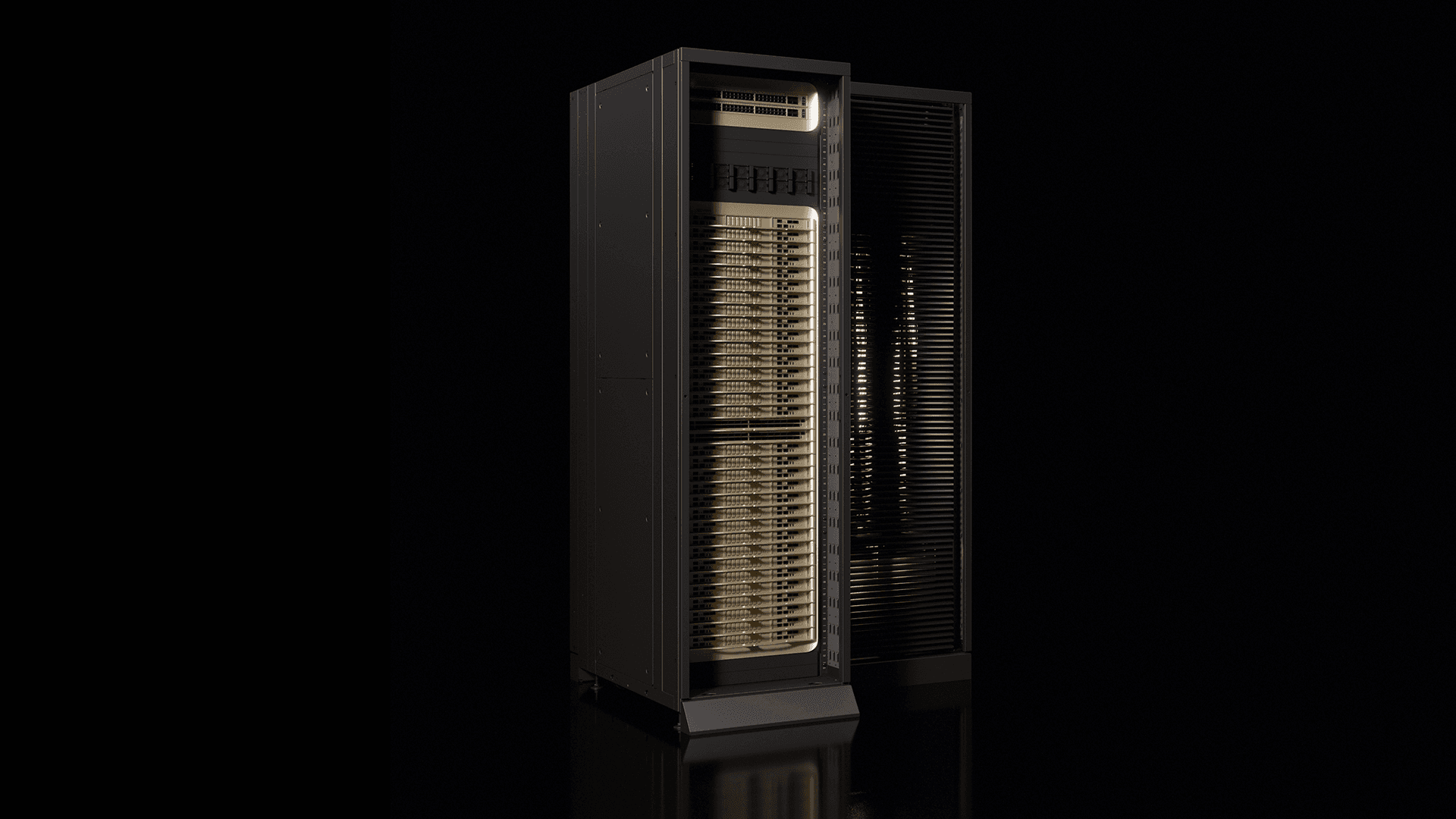
To demonstrate Vera’s scalability, NVIDIA introduced a new Vera CPU rack integrating 256 liquid-cooled Vera CPUs. This rack is designed to sustain more than 22,500 concurrent CPU environments, each running independently at full performance. The reference architecture supporting this system involves 80 ecosystem partners worldwide, ensuring compatibility with existing data center infrastructure. The Vera rack is part of the broader NVIDIA Vera Rubin NVL72 platform, which pairs Vera CPUs with NVIDIA GPUs via NVLink-C2C interconnect technology, offering 1.8 TB/s of coherent bandwidth—seven times the bandwidth of PCIe Gen 6.
Software Synergy: How Vera Enhances NVIDIA’s AI Ecosystem
Vera doesn’t operate in isolation; it’s designed to seamlessly integrate with NVIDIA’s broader AI ecosystem. The CPU is paired with NVIDIA GPUs in systems like the HGX Rubin NVL8, where Vera acts as the host CPU to coordinate data movement and system control for GPU-accelerated workloads. Additionally, Vera systems incorporate NVIDIA ConnectX SuperNIC cards and BlueField-4 DPUs for accelerated networking, storage, and security—critical components for agentic AI workloads that require real-time data processing and robust threat mitigation. This integration ensures customers can maintain a single software stack across the NVIDIA platform while optimizing for their specific needs.
“Vera is arriving at a turning point for AI. As intelligence becomes agentic—capable of reasoning and acting—the importance of the systems orchestrating that work is elevated. With breakthrough performance and energy efficiency, Vera unlocks AI systems that think faster and scale further.” — Jensen Huang, founder and CEO of NVIDIA
Real-World Performance: Early Benchmarks and Use Cases
Early adopters of Vera are already reporting dramatic performance improvements. Redpanda, a streaming data platform, tested Vera running Apache Kafka-compatible workloads and observed up to 5.5x lower latency compared to other systems. Michael Truell, cofounder and CEO of Cursor, an AI-native coding platform, noted that Vera boosts overall throughput and efficiency, enabling faster, more responsive coding agent experiences. These results underscore Vera’s potential to redefine real-time AI applications, from autonomous agents to high-frequency data processing.
Availability and Future Roadmap: When and Where to Access Vera
NVIDIA Vera is already in full production and will be available through ecosystem partners in the second half of 2025. Customers can expect a phased rollout, with initial deployments focused on data centers and cloud providers, followed by broader availability for enterprises and research institutions. NVIDIA’s GTC conference sessions provide further insights into Vera’s capabilities, including deep dives into its architecture, benchmarking results, and deployment strategies. The company is also offering reference designs for single and dual-socket server configurations, optimized for workloads like reinforcement learning, agentic inference, and high-performance computing.
The Broader Implications: Democratizing AI and Redefining Infrastructure
The launch of Vera CPU marks a pivotal moment in the AI industry, where infrastructure is no longer a bottleneck but a catalyst for innovation. By delivering unparalleled efficiency, speed, and scalability, Vera enables organizations of all sizes—from startups to national laboratories—to build AI factories that can handle the most complex agentic workloads. This democratization of AI infrastructure could accelerate breakthroughs in fields like healthcare, finance, and scientific research, where real-time decision-making and autonomous systems are becoming essential. As Huang noted, “The CPU is driving the model,” and Vera is poised to lead that charge.
Key Takeaways
- NVIDIA Vera CPU is the first processor purpose-built for agentic AI, delivering 50% faster performance and twice the energy efficiency of traditional CPUs.
- Major cloud providers (Alibaba Cloud, Meta, Oracle), infrastructure firms (Dell, HPE, Lenovo), and national labs (TACC, Los Alamos) are adopting Vera for AI workloads.
- The Vera CPU rack supports over 22,500 concurrent environments, redefining scalability for AI data centers.
- Early benchmarks show Vera reduces latency by up to 5.5x for streaming workloads, while boosting throughput for coding agents.
- Vera integrates with NVIDIA’s GPU ecosystem via NVLink-C2C, offering 1.8 TB/s bandwidth for high-speed data sharing.
Frequently Asked Questions
Frequently Asked Questions
- What makes NVIDIA Vera CPU different from traditional CPUs?
- Vera is purpose-built for agentic AI, featuring custom Olympus cores, Spatial Multithreading, and LPDDR5X memory for higher efficiency and performance. Traditional CPUs are general-purpose, whereas Vera is optimized for real-time reasoning, tool use, and multi-tasking in AI workloads.
- Which companies are already using or planning to use NVIDIA Vera?
- Major adopters include Alibaba Cloud, ByteDance, Meta, Oracle Cloud Infrastructure, Dell Technologies, HPE, Lenovo, CoreWeave, and national labs like TACC and Los Alamos. A full list of partners spans cloud providers, infrastructure makers, and AI software firms.
- When will NVIDIA Vera CPUs be available for purchase?
- NVIDIA Vera is in full production and will be available through ecosystem partners in the second half of 2025. Customers can expect phased rollouts starting with data center and cloud deployments.
- How does Vera improve performance for AI workloads?
- Vera delivers up to 50% faster processing and twice the energy efficiency by combining high-performance cores, low-power LPDDR5X memory, and NVLink-C2C interconnects for high-speed data sharing with GPUs. Early tests show up to 5.5x lower latency for streaming workloads.
- What is agentic AI, and why does it require specialized CPUs?
- Agentic AI systems can autonomously perform multi-step tasks, such as running code, interacting with APIs, and validating results. These workloads demand real-time reasoning and tool integration, which traditional CPUs struggle to support efficiently. Vera’s architecture is tailored to meet these requirements.