
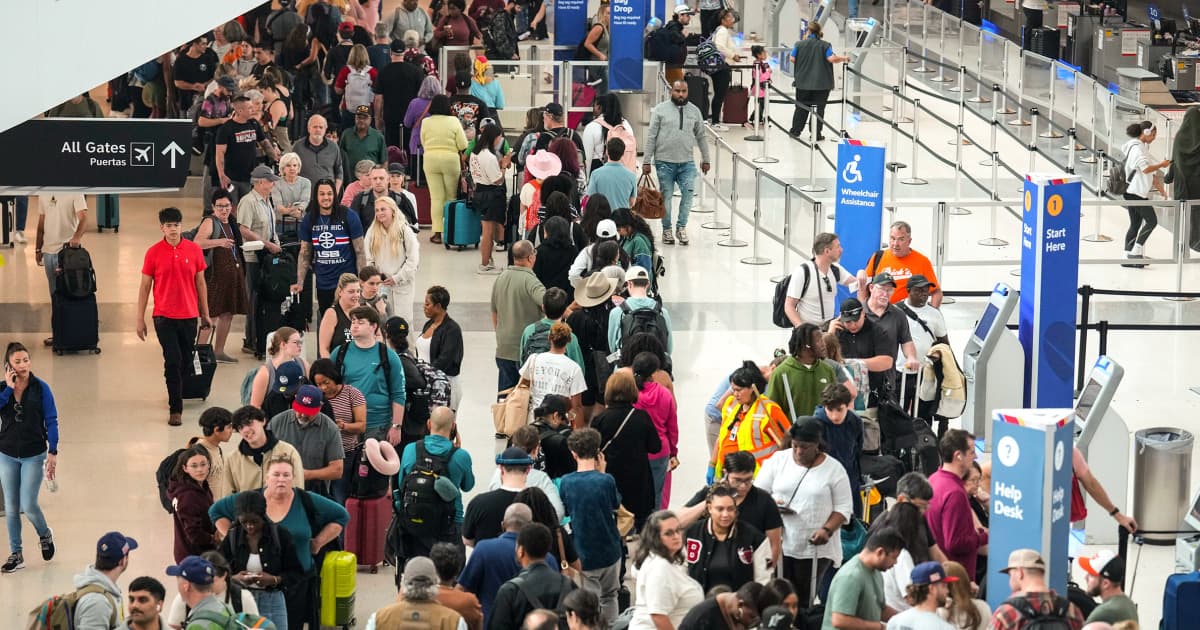
As the busiest spring break week of the year kicked off on Sunday, major airlines and millions of US travelers are facing a rare convergence of challenges that are making it both costlier and less convenient to fly. The Department of Homeland Security's partial shutdown has created staffing shortages at domestic airport security checkpoints, while the Iran war has driven up jet fuel costs and forced many global carriers to reroute or suspend flights over the Middle East. This perfect storm of challenges has resulted in hours-long security lines at airports nationwide, with social media flooded with videos of TSA screening lines that fill up entire terminals.
How the Iran War is Affecting Jet Fuel Prices and Air Travel
The Iran war and the blockade of the Strait of Hormuz off Iran are driving up the price of oil worldwide, causing a surge in the cost of jet fuel. On Friday, the spot price of a gallon of jet fuel was $3.99, roughly double the price at this time last year, according to the Argus U.S. Jet Fuel Index. This fuel price spike is testing the ability of airlines around the world to absorb financial shock and respond quickly to rapidly evolving situations.
The Impact of Rising Jet Fuel Prices on Airlines and Consumers
Airlines can accept lower profits or raise their fares, and experts expect that they would do a bit of both. 'Airlines can accept lower profits or raise their fares, and I expect that they would do a bit of both. So consumers will feel the Iran war's oil price hike not only at the gas pump, but also in the airfares they pay,' said Jan Brueckner, economics professor emeritus at the University of California, Irvine.
- The Department of Homeland Security's partial shutdown has created staffing shortages at domestic airport security checkpoints
- The Iran war has driven up jet fuel costs and forced many global carriers to reroute or suspend flights over the Middle East
- Airlines are increasing ticket prices and adding fuel surcharges to keep up with rising costs
- The cost of jet fuel is the single largest expense for most major airlines, accounting for around 30% of total expenses
- Experts warn that surging jet fuel prices could push airline ticket prices higher and force airlines to ground thousands of aircraft
How US Airlines are Responding to the Challenges
Unlike European and Asian air carriers, most major US airlines don't hedge their fuel costs or lock in prices using futures. 'For airlines, it's about their appetite for risk, their comfort level on hedging. And if they don't hedge, then obviously they have to find another way to recover their costs,' said Louise Burke, Argus Media's renewables and aviation senior vice president. Airlines like Air New Zealand and Cathay Pacific are already increasing ticket prices and adding fuel surcharges to keep up with rising costs.
Airline Reactions to the Fuel Price Spike
Cathay Pacific Airways has announced that it plans to double its fuel surcharge on all tickets starting Wednesday. For many of the airline's routes, the carrier's current fuel surcharge of $72.90 will rise to $149.20 beginning later this week. Other airlines making changes include Hong Kong Airlines, IAG, Qantas Airways, SAS, Thai Airways, and Vietnam Airlines, according to Reuters.
What This Means for US Air Travelers
The average ticket price for last-minute domestic flights on March 6 was higher for most US airlines week-over-week, except at Spirit Airlines and American Airlines, according to Deutsche Bank. The increases ranged from 0.4% to 13.6%. For tickets purchased in advance, the price to fly on March 27 increased week-over-week. Spirit's fare spiked the most, at 124.3%, while other airlines' fares rose anywhere from 14.8% to 56.7%, the Deutsche Bank analysts reported.
Key Takeaways
- US air travel is becoming more costly and less convenient due to staffing shortages and rising fuel costs
- Airlines are increasing ticket prices and adding fuel surcharges to keep up with rising costs
- The cost of jet fuel is the single largest expense for most major airlines, accounting for around 30% of total expenses
- Experts warn that surging jet fuel prices could push airline ticket prices higher and force airlines to ground thousands of aircraft
- US airlines are responding to the challenges by increasing ticket prices and adding fuel surcharges
Frequently Asked Questions
Frequently Asked Questions
- What is causing the increase in jet fuel prices?
- The Iran war and the blockade of the Strait of Hormuz off Iran are driving up the price of oil worldwide, causing a surge in the cost of jet fuel. The spot price of a gallon of jet fuel was $3.99 on Friday, roughly double the price at this time last year.
- How are US airlines responding to the challenges?
- US airlines are responding to the challenges by increasing ticket prices and adding fuel surcharges to keep up with rising costs. Airlines like Air New Zealand and Cathay Pacific are already making changes to their pricing strategies.
- What does this mean for US air travelers?
- The average ticket price for last-minute domestic flights on March 6 was higher for most US airlines week-over-week, except at Spirit Airlines and American Airlines. For tickets purchased in advance, the price to fly on March 27 increased week-over-week, with Spirit's fare spiking the most at 124.3%.

