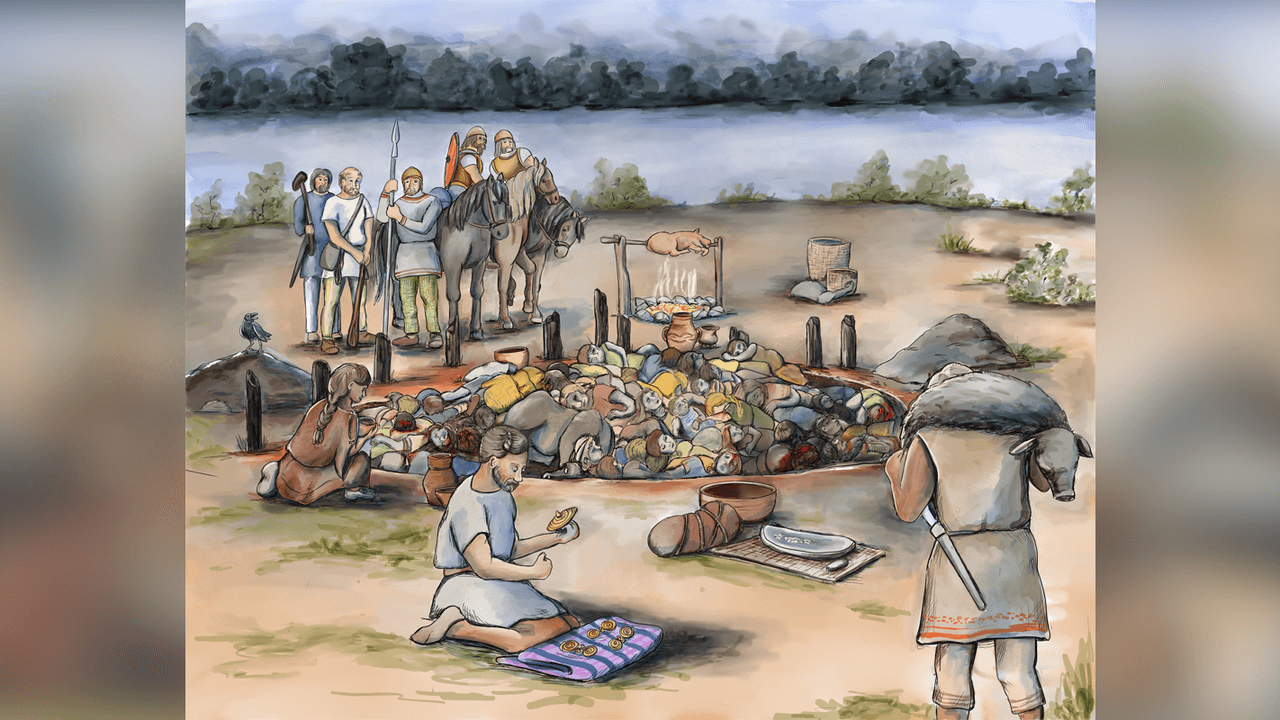
An analysis of a mass grave found in northern Serbia is revealing new information about violence in Early Iron Age Europe.
When you purchase through links on our site, we may earn an affiliate commission. Here’s how it works.
Unlock instant access to exclusive member features.
By submitting your information you agree to the Terms & Conditions and Privacy Policy and are aged 16 or over. You are now subscribed
Once a week Life's Little Mysteries Feed your curiosity with an exclusive mystery every week, solved with science and delivered direct to your inbox before it's seen anywhere else.
Get full access to premium articles, exclusive features and a growing list of member rewards.
Archaeologists have analyzed a mass grave in southeastern Europe that held the remains of women and children who were violently murdered 2,800 years ago. The grave may be key to understanding the evolution of strategic mass violence in the Early Iron Age, researchers reported in a new study.
The grave was unearthed at the archaeological site of Gomolava, located near the modern town of Hrtkovci in northern Serbia. Originally founded as a settlement on the Sava River in the sixth millennium B.C., both settled and mobile cultural groups used Gomolava repeatedly over the centuries. By the ninth century B.C., semisedentary groups in the Carpathian Basin were consolidating around sites like Gomolava, creating tension over land use and ownership.
Gomolava "was situated at a physical, political and conceptual flashpoint" — and the consequences of these new interactions were deadly, researchers wrote in the study, which was published Monday (Feb. 23) in the journal Nature Human Behaviour.
- Viking Age mass grave holds mysterious mix of dismembered human remains and complete skeletons, including a 'giant' who'd had brain surgery
- Male human heads found in a 'skull pit' in an ancient Chinese city hint at sex-specific sacrifice rituals
- 3,300-year-old cremations found in Scotland suggest the people died in a mysterious catastrophic event
The researchers focused their analysis on a small mass grave at Gomolava that was just 9.5 feet (2.9 meters) in diameter and 1.6 feet (0.5 m) deep. Archaeologists discovered postholes around the burial pit that suggested there had been some sort of memorialization of the grave. The pit also contained ceramic vessels and small, bronze accessories, along with the bones of nearly 100 animals, including the complete skeleton of a young cow at the very bottom of the grave.
But when the researchers began to study the 77 human skeletons in the pit, they found that more than 70% of the skeletons were female and 69% were children.
"The predominance of women and younger individuals in the mass grave at Gomolava is exceptional in European prehistory," the researchers wrote.
Additionally, the archaeologists found extensive evidence of intentional, violent, lethal trauma to the victims' heads involving "close contact and especially blunt force, which could have resulted from a number of implements or weapons," they wrote. The attackers may have been significantly taller than the victims or on horseback, given the location of the injuries, the team said.
Get the world’s most fascinating discoveries delivered straight to your inbox.
"Overall, the patterning reveals severe violence that was brutal, deliberate and efficient," the researchers wrote.
To learn more about the victims, the researchers studied the individuals' DNA. This analysis revealed that only a handful of the 77 people had close biological ties, which suggests that the killing was not a raid on a settlement of extended families. A study of the skeletons' strontium isotope ratios — a chemical variant found in dental enamel that is influenced by geographic origin — also showed that more than one-third of the people grew up outside the Gomolava region.
"It is clear that this is a heterogenous assembly of individuals," study lead author Linda Fibiger, a bioarchaeologist at the University of Edinburgh, told Live Science in an email. Gomolava was "a focus for burying predominantly women and children that had been brutally killed at the time," she said.
- Male human heads found in a 'skull pit' in an ancient Chinese city hint at sex-specific sacrifice rituals
- 3,300-year-old cremations found in Scotland suggest the people died in a mysterious catastrophic event
- 1,100-year-old burials of elite warriors and their ornate weapons discovered in Hungary
But the reason for the mass violence remains elusive.
In the ninth century B.C., myriad cultural groups were moving and settling across the Carpathian Basin. This population influx, coupled with tension between mobile and sedentary lifestyles, may have created a "potentially explosive set of conflicting ideologies of land use and ownership," the researchers wrote. This tension may have led to the forced migration or displacement of certain people, the capture and killing of specific groups, and the exchange of women and children through marriage or fostering.
"There is nothing osteologically or archaeologically that indicates that these individuals were captured and held for a while," Fibiger said. "We are looking at shifting settlement structure, land use and most likely accompanying power structures."
—Viking Age mass grave holds mysterious mix of dismembered human remains and complete skeletons, including a 'giant' who'd had brain surgery
—5,000-year-old mass grave of fallen warriors in Spain shows evidence of 'sophisticated' warfare
—Skeleton-filled well in Croatia likely holds remains of Roman soldiers, study finds