edited by Gaby Clark, reviewed by Robert Egan
This article has been reviewed according to Science X's editorial process and policies. Editors have highlighted the following attributes while ensuring the content's credibility:
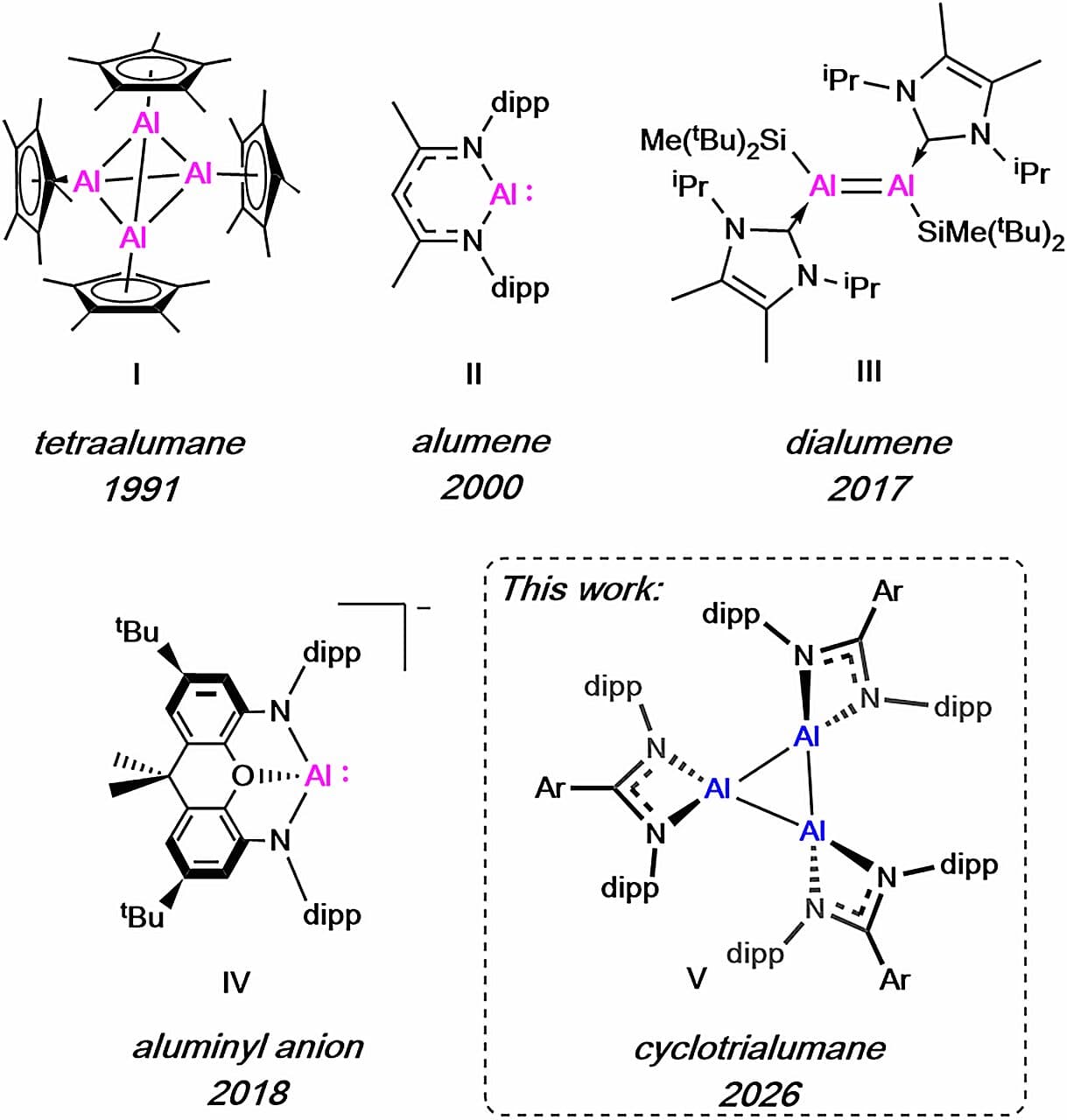
Add as preferred source Examples of landmark AlI complexes. Credit: Nature Communications (2026). DOI: 10.1038/s41467-026-68432-1 A research team at King's College London has isolated a new form of aluminum—a highly abundant metal, that could provide a far cheaper and more sustainable alternative to commonly used rare earth metals. Dr. Clare Bakewell, Senior Lecturer in the Department of Chemistry, and her lab developed highly reactive aluminum molecules able to break apart tough chemical bonds. Published in Nature Communications, their work has also unlocked molecular structures that have never been observed before, which creates the potential for new kinds of reactive behavior.
The team reported the first example of a cyclotrialumane, a compound comprising three aluminum atoms arranged in a trimeric—triangular—structure. The trimeric molecule carries unprecedented reactivity as the structure is retained when dissolved into different solutions, making it robust enough for use in a range of chemical reactions. These include splitting dihydrogen and the stepwise insertion and chain growth of the 2-carbon hydrocarbon, ethene.
Metals are vital for making a whole range of commodity and fine chemicals produced in industry. However, many processes, especially catalytic ones, use expensive precious materials like platinum, which are environmentally damaging to extract.
Scientists have long been searching for alternative metals to use in chemical transformations. Dr. Bakewell said, "Transition metals are the workhorses of chemical synthesis and catalysis—but many of the most useful are becoming increasingly difficult to access and extract—often being located in regions of political instability, increasing the demand and price.
"Chemists have been looking towards more common elements from the periodic table, and we chose aluminum, as it's super abundant, making it ~20,000 times less expensive than precious metals such as platinum and palladium."
Not only is Dr. Bakewell and her team making progress in designing aluminum compounds that can be used in chemical synthesis, they are also discovering new and interesting reactions along the way.
Dr. Bakewell said, "What's special about this work, is that we're pushing the boundaries of chemical knowledge. Most excitingly, we can use this aluminum trimer to build completely new compounds with levels of reactivity that have never been observed before—these include the 5- and 7-membered aluminum and carbon rings formed through reaction with ethene. These capabilities go beyond the transition metals we were originally trying to mimic, to the forefront of chemical research."
Through this chemistry, Bakewell believes chemists could develop new forms of reactions, or create even larger molecular architectures, with unique properties with which to build new materials and products.
She said, "We're very much in the exploratory phase and we're just at the start of beginning to unlock the capabilities of these earth-abundant materials.
"But from what we've seen already, this chemistry could support a transition to cleaner, greener and cheaper chemical production, while making new discoveries along the way."
Imogen Squire et al, A neutral cyclic aluminium (I) trimer, Nature Communications (2026). DOI: 10.1038/s41467-026-68432-1
Journal information: Nature Communications
Provided by King's College London