Scientists have uncovered a trove of 700 fossils in southwestern China’s Yunnan province that rewrites the timeline of life on Earth, revealing that complex, three-dimensional animals emerged 4 million years earlier than previously believed. The discovery, published in the journal Science, provides the first direct evidence of symmetrical, mobile creatures thriving 539 million years ago—during the twilight of the Ediacaran period—challenging long-held assumptions about the so-called Cambrian explosion, the rapid diversification of life that followed.
- Fossils from Yunnan province, China, date back 539 million years—4 million years earlier than the Cambrian explosion.
- The discovery includes symmetrical, mobile animals with left-right body plans, a hallmark of modern life.
- Findings resolve a decades-long debate in paleontology, known as the 'rocks versus clocks' controversy.
- Researchers now seek to understand the ecological and environmental triggers behind this evolutionary leap.
China’s Fossil Treasure Trove: A Window into Earth’s Distant Past
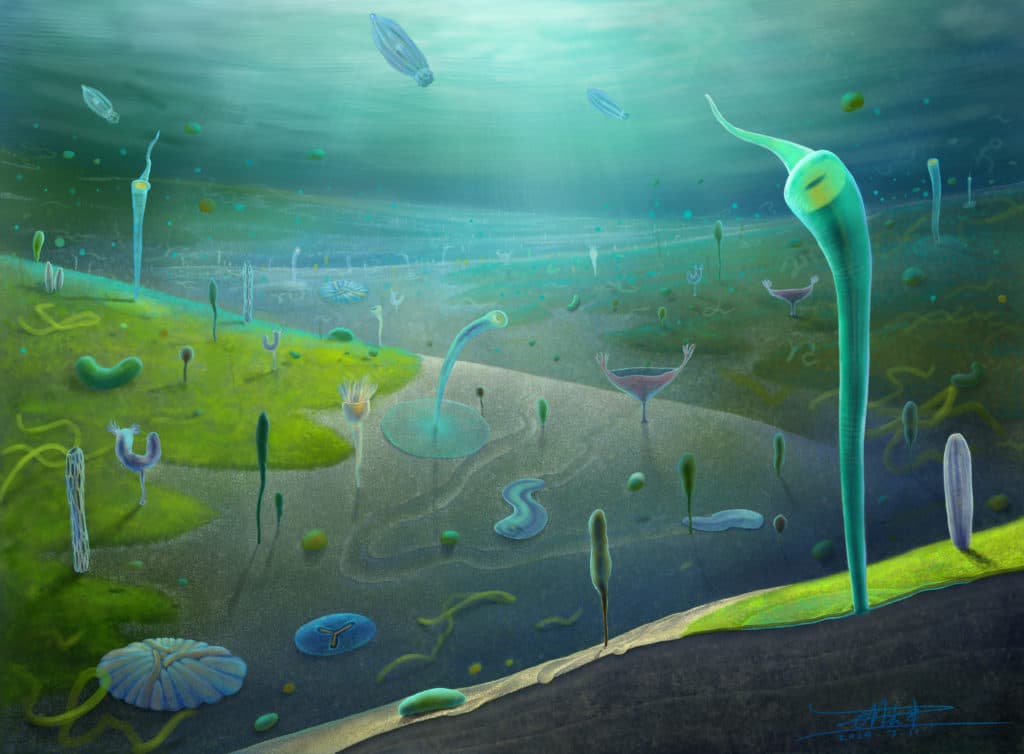
Buried in a nondescript roadside exposure near the UNESCO-listed Chengjiang fossil site, the newly documented fossils offer an unprecedented snapshot of life just before the Cambrian period—a time when Earth’s oceans teemed with bizarre, often immobile organisms. Unlike the flat, frond-like creatures typical of the Ediacaran—such as Dickinsonia, a soft-bodied organism with no clear head or limbs—the fossils from Yunnan province reveal animals with bilateral symmetry, a body plan that allows for directional movement and predation. "This is the first window we have into how the modern animal-dominated biosphere was formed," said Frankie Dunn, a paleontologist at Oxford University’s Museum of Natural History and co-author of the study.
The Ediacaran Period: Earth’s First Complex Ecosystems
The Ediacaran period (635–541 million years ago) marked a pivotal chapter in Earth’s history, sandwiched between the global glaciations of the Cryogenian and the explosive diversification of the Cambrian. Named after the Ediacara Hills in Australia, where the first definitive fossils of this era were discovered in the 1940s, this period is now recognized as the cradle of complex animal life. However, the Ediacaran fauna—such as the quilted, disc-shaped Charnia or the armored Tribrachidium—lacked the mobility and anatomical complexity of later animals. "These were creatures that lived in a two-dimensional world," explained Dunn. "They didn’t burrow, swim vertically, or engage in predation. They were essentially passive, filter-feeding organisms stuck to the seafloor."
From Ediacaran Oddities to Cambrian Giants: The Evolutionary Leap
The Cambrian explosion, which began around 541 million years ago, is often hailed as the 'Big Bang' of animal evolution, when life diversified into nearly all modern phyla within a geologically brief span. But the new fossils suggest this transition was not sudden but rather a gradual buildup, with critical innovations appearing earlier than the Cambrian. The Yunnan fossils include creatures with bilateral symmetry—a body plan shared by 99% of modern animals, from insects to humans. Ross Anderson, another co-author of the study, noted, "Now we know what’s making those fossil tracks we’ve seen for decades. We finally have the animals themselves."
Resolving the 'Rocks vs. Clocks' Debate in Paleontology
For years, paleontologists have grappled with a discrepancy between two key methods of dating evolutionary events: molecular clocks (which estimate divergence times based on genetic mutation rates) and the fossil record (the physical evidence preserved in rocks). Genetic studies had suggested that humans and starfish shared a common ancestor as far back as the Ediacaran period, but until now, no fossils had been found to support this timeline. The Yunnan discovery bridges this gap. "What our new fossil site tells us is that the rocks and the clocks are in closer agreement than we thought," Dunn said. This reconciliation is reshaping how scientists view the pace of evolutionary change.
Skepticism and Scientific Consensus
While the study has been widely praised, some experts remain cautious. Jonathan Antcliffe, a paleontologist at the University of Lausanne, questioned whether the fossils definitively represent complex, mobile animals, suggesting that more evidence is needed to confirm their behavior and anatomy. However, most researchers, including Emily Mitchell of the University of Cambridge (who was not involved in the study), agree that the findings make "a huge amount of sense." "The Ediacaran period must have contained transitional forms," Mitchell said. "Without them, the Cambrian explosion would lack context."
The Oxygen Hypothesis: Why Complex Life Arose When It Did
The timing of the Yunnan fossils aligns with a critical shift in Earth’s chemistry: rising oxygen levels in the atmosphere and oceans. Life first emerged around 3.5 billion years ago, but it took nearly 2.4 billion years for complex animals to evolve. The delay, according to Charles Marshall of the University of California, Berkeley (who was not part of the research), may be tied to oxygen thresholds. "The Cambrian explosion was sudden because the developmental systems were already in place," Marshall said. "But the environment had to catch up—specifically, oxygen levels needed to rise high enough to support larger, more active animals."
Feedback Loops: How Life Shaped—and Was Shaped by—Earth
The emergence of complex animals didn’t just transform ecosystems; it fundamentally altered Earth’s geochemical cycles. Duncan Murdock, curator of Oxford’s Museum of Natural History, explained: "Once animals started eating each other and churning up sediment, they changed the planet forever. The oxygen-rich atmosphere we rely on today is partly a legacy of this early animal activity." This interplay between biology and geology—where life both adapts to and reshapes its environment—remains one of the most compelling questions in evolutionary science.
The Roadside Discovery: How a 'Snapshot' of Time Was Found
The fossils were unearthed in a roadside outcrop near the Chengjiang Fossil Site, a UNESCO World Heritage Site renowned for its exceptionally preserved Cambrian fossils. Unlike the famous Burgess Shale in Canada or China’s own Maotianshan Shale, this area had been overlooked until now. "It’s not glamorous," Dunn admitted, but the exposure’s layered strata allowed researchers to "literally walk through geological time." The site’s mix of Ediacaran and early Cambrian fossils provides a rare opportunity to study the transition between two major eras of life.
Unanswered Questions and the Future of Paleontology
While the Yunnan fossils answer critical questions, they also open new avenues of inquiry. Dunn and her colleagues are now focused on understanding the mechanisms behind this evolutionary surge. "Was it a feedback loop between Earth and life? Did the rise of Ediacaran animals make the Cambrian explosion inevitable?" These questions could redefine how we view the origins of biodiversity. For now, the fossils stand as a testament to life’s resilience—and its relentless drive to innovate.
Broader Implications: From Earth to Exoplanets
The findings also carry implications beyond Earth. If complex animal life can emerge under Ediacaran-like conditions, astronomers searching for extraterrestrial life may need to adjust their expectations. The presence of oxygen and sediment-churning animals could be a universal hallmark of advanced biospheres, not just a terrestrial oddity. As Murdock noted, "The planet we live on is built on the foundations from the Ediacaran and Cambrian. Understanding this period helps us decipher what to look for in the search for life elsewhere."
Frequently Asked Questions
- Why is the Cambrian explosion so important in evolution?
- The Cambrian explosion marks the rapid diversification of life into nearly all modern animal groups. Occurring around 541 million years ago, it introduced complex body plans, mobility, and predation, setting the stage for the biodiversity we see today.
- What are Ediacaran fossils, and why were they overlooked for so long?
- Ediacaran fossils, dating from 635–541 million years ago, represent some of Earth’s earliest complex organisms. Many lacked hard parts, making them difficult to preserve and identify until advanced imaging techniques and new discoveries like those in China.
- How do these new fossils change our understanding of animal evolution?
- The Yunnan fossils push back the emergence of symmetrical, mobile animals by 4 million years, suggesting that the Cambrian explosion was preceded by a longer period of innovation. This bridges gaps between genetic predictions and the fossil record.