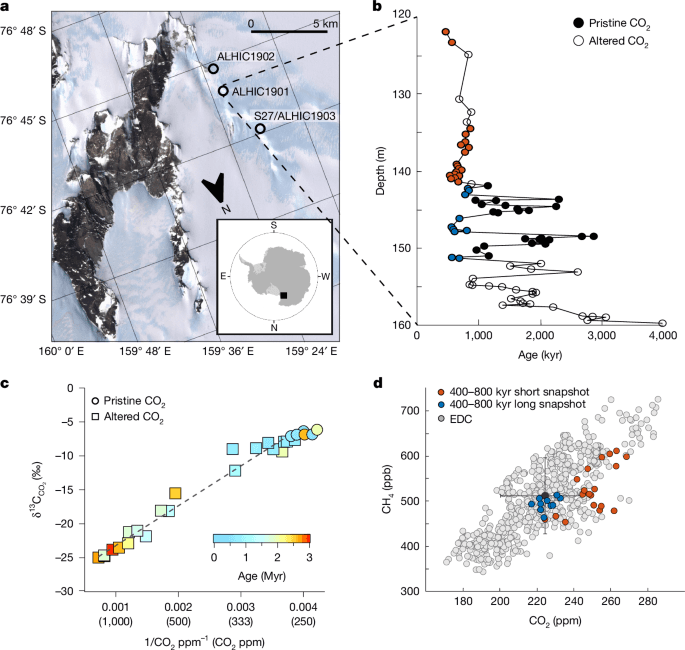
For the past three million years, Earth’s atmosphere has maintained surprisingly stable concentrations of carbon dioxide (CO2) and methane (CH4), according to a groundbreaking analysis of ancient Antarctic ice. Researchers examining blue ice records from the continent’s Allan Hills region and the European Project for Ice Coring in Antarctica (EPICA) Dome C have reconstructed atmospheric gas levels dating back to the Pliocene epoch, revealing that CO2 fluctuated within a narrow range of 200 to 280 parts per million (ppm) while methane varied between 300 and 700 parts per billion (ppb). These findings, published across multiple studies in Nature and other leading journals, challenge long-held assumptions about the role of greenhouse gases in driving long-term climate shifts and underscore the complexity of Earth’s climate system.
What Antarctic Ice Cores Reveal About Earth’s Ancient Atmosphere
Antarctic ice cores serve as time capsules, preserving tiny bubbles of ancient air that provide direct evidence of past atmospheric composition. The blue ice areas of the Allan Hills, for instance, contain ice dating back as far as 2 million years, offering a rare glimpse into the Pleistocene epoch’s atmospheric conditions. Unlike traditional ice cores drilled vertically, blue ice forms horizontally as ancient snow layers are exposed and compressed, making it easier to extract well-preserved gas samples without the contamination risks associated with deeper drilling.
The Allan Hills Blue Ice Advantage
In a 2019 study published in Nature, researchers led by Yuzhen Yan of Princeton University extracted ice samples from the Allan Hills that contained atmospheric gases dating back 2 million years. The team found that CO2 levels during this period averaged around 230 ppm, with methane concentrations hovering near 500 ppb—levels consistent with glacial periods in more recent ice ages. This stability contrasts sharply with the dramatic CO2 spikes observed during the industrial era, which have surpassed 420 ppm. The Allan Hills data also revealed orbital-scale variations in methane tied to Earth’s Milankovitch cycles, which influence solar radiation distribution and glacial-interglacial transitions.
EPICA Dome C: A Window Into the Last 800,000 Years
The EPICA Dome C ice core, drilled in East Antarctica, provides an even more detailed record of atmospheric CO2 spanning the last 800,000 years. A 2015 revision of this dataset, led by Bernhard Bereiter of the University of Bern, confirmed that CO2 levels oscillated between 180 ppm during ice ages and 280 ppm during interglacial periods. Methane, analyzed in a 2008 Nature study by Laetitia Loulergue and colleagues, mirrored these cycles, peaking at 700 ppb during warm intervals and dropping to 300 ppb during glacial maxima. These cycles align with temperature shifts of up to 10°C in Antarctica, illustrating the sensitivity of Earth’s climate to greenhouse gas concentrations.
The EPICA data also highlighted millennial-scale events, such as Dansgaard-Oeschger oscillations, where methane levels spiked abruptly by 100–200 ppb over decades to centuries. Such events, linked to rapid ice sheet changes and ocean circulation shifts, demonstrate how greenhouse gases can respond to—and amplify—climate feedbacks. The stability observed in the longer-term records, however, suggests that these fluctuations were superimposed on a relatively constrained baseline, a finding with implications for modern climate projections.
Why Stable Greenhouse Gas Levels Matter for Climate Science
The revelation that CO2 and methane levels remained broadly stable over the past 3 million years contradicts the assumption that higher greenhouse gas concentrations were a prerequisite for past warm periods, such as the mid-Pliocene warm period (3.3 to 3 million years ago), when global temperatures were 2–3°C warmer than pre-industrial levels. Instead, the data suggests that Earth’s climate system may have operated within a narrower range of CO2 concentrations than previously thought, with other factors—such as ocean circulation, ice sheet dynamics, and albedo changes—playing more dominant roles in driving long-term climate shifts.
Rethinking the Mid-Pleistocene Transition
Around 1.2 million years ago, Earth’s climate underwent a dramatic transition: glacial cycles lengthened from 41,000 years to 100,000 years, marking the Mid-Pleistocene Transition (MPT). Scientists have long debated whether declining CO2 levels triggered this shift. However, a 2021 study in Reviews of Geophysics by Christiaan Berends and colleagues argued that while CO2 played a role, changes in Earth’s orbital configuration and the removal of regolith (weathered rock) from continental surfaces were equally critical. The new ice core data supports this nuance, showing that CO2 levels during the MPT were similar to those in earlier glacial periods but that other feedbacks, such as ice sheet growth and ocean heat transport, became more influential.
Implications for Future Climate Projections
The stability of CO2 and methane over the past 3 million years raises questions about the sensitivity of Earth’s climate to anthropogenic greenhouse gas emissions. Modern CO2 levels, now exceeding 420 ppm, are already far higher than the 280 ppm peak observed during the warmest interglacial periods in the EPICA record. Yet, the paleoclimate data suggests that Earth’s climate system may not have experienced such high concentrations in millions of years, implying that the current rate of change is unprecedented in geological history. This underscores the urgency of reducing emissions to avoid triggering irreversible tipping points, such as the collapse of major ice sheets or the disruption of ocean currents.
The Science Behind Ice Core Analysis: How Do Researchers Extract Ancient Air?
Extracting and analyzing air from ice cores is a meticulous process that involves drilling into glaciers or blue ice zones, where ancient snow layers have been preserved. In blue ice areas like the Allan Hills, ice flows horizontally, exposing layers that can be sampled without the need for deep drilling. Researchers carefully melt the ice in a vacuum chamber, allowing trapped air bubbles to be released and analyzed for CO2, methane, and other gases. However, the process is not without challenges. Contamination from modern air, diffusion of gases within the ice, and the formation of clathrate hydrates (where gases are trapped in ice crystals) can distort the record. To address these issues, scientists use multiple methods, including gas chromatography and mass spectrometry, to cross-validate their findings.
Overcoming Contamination and Preservation Challenges
One of the biggest hurdles in ice core research is ensuring that the air trapped in ice accurately reflects past atmospheric conditions. In 2009, Bernhard Bereiter and colleagues demonstrated that molecular diffusion could alter CO2 concentrations in ice cores, particularly in older samples. To mitigate this, researchers now use high-resolution sampling techniques and compare results across multiple ice cores. The Antarctic Ice Core Chronology 2023 (AICC2023), for instance, provides a unified timescale for EPICA Dome C and other ice cores, improving the accuracy of gas age estimates. Additionally, studies like those by Thomas Bauska and colleagues have used stable carbon isotopes in CO2 to distinguish between natural and anthropogenic influences on the carbon cycle.
Key Takeaways: What the Data Tells Us About Earth’s Climate Past
- Atmospheric CO2 and methane levels remained broadly stable over the past 3 million years, fluctuating within a narrow range despite significant climate shifts.
- Ice core records from Antarctica’s Allan Hills and EPICA Dome C provide the most detailed glimpses into Earth’s ancient atmosphere, with data extending back 2 million and 800,000 years, respectively.
- The Mid-Pleistocene Transition, marked by longer glacial cycles, was likely influenced by a combination of declining CO2, orbital changes, and ice sheet dynamics—not solely by greenhouse gas concentrations.
- Modern CO2 levels, now exceeding 420 ppm, are far higher than any observed in the past 3 million years, raising concerns about the unprecedented pace of current climate change.
- Technological advancements in ice core analysis, such as high-precision gas extraction and cross-validation methods, have significantly improved the reliability of paleoclimate reconstructions.
Broader Implications: What This Means for Future Climate Research
The new findings from Antarctic ice cores force scientists to reconsider the drivers of Earth’s climate over geological time scales. While greenhouse gases like CO2 and methane are critical to understanding past and present climate dynamics, the data suggests that their concentrations alone cannot fully explain every major climate event. For example, the Pliocene epoch’s warm climate, despite CO2 levels similar to pre-industrial times, may have been sustained by factors such as altered ocean gateways, reduced ice sheet coverage, or changes in Earth’s energy budget. This complexity highlights the need for integrated climate models that incorporate not just greenhouse gas concentrations but also ice sheet behavior, ocean circulation, and biogeochemical cycles.
Moreover, the stability of methane levels over the past 3 million years contrasts with the rapid increases observed in recent decades, driven by human activities such as agriculture and fossil fuel extraction. Methane, though shorter-lived than CO2, is 28 times more potent as a greenhouse gas over a 100-year period. The paleoclimate record underscores the importance of curbing methane emissions to avoid amplifying near-term warming trends.
Frequently Asked Questions About Ancient Atmospheric Gases and Climate Change
Frequently Asked Questions
- How do scientists extract air from ice cores?
- Researchers drill into glaciers or blue ice zones, then melt the ice in a vacuum to release trapped air bubbles. The gases are analyzed using techniques like gas chromatography and mass spectrometry to determine past CO2 and methane concentrations.
- Why are ancient CO2 levels important for understanding modern climate change?
- Ice core records show that current CO2 levels (over 420 ppm) are higher than at any point in the past 3 million years. This provides context for the unprecedented rate of modern climate change and highlights the urgency of reducing emissions.
- What caused the Mid-Pleistocene Transition, and how does it relate to CO2 levels?
- The Mid-Pleistocene Transition, which extended glacial cycles from 41,000 to 100,000 years, was likely driven by a combination of declining CO2, orbital changes, and ice sheet dynamics. While CO2 played a role, other feedbacks became more dominant during this period.