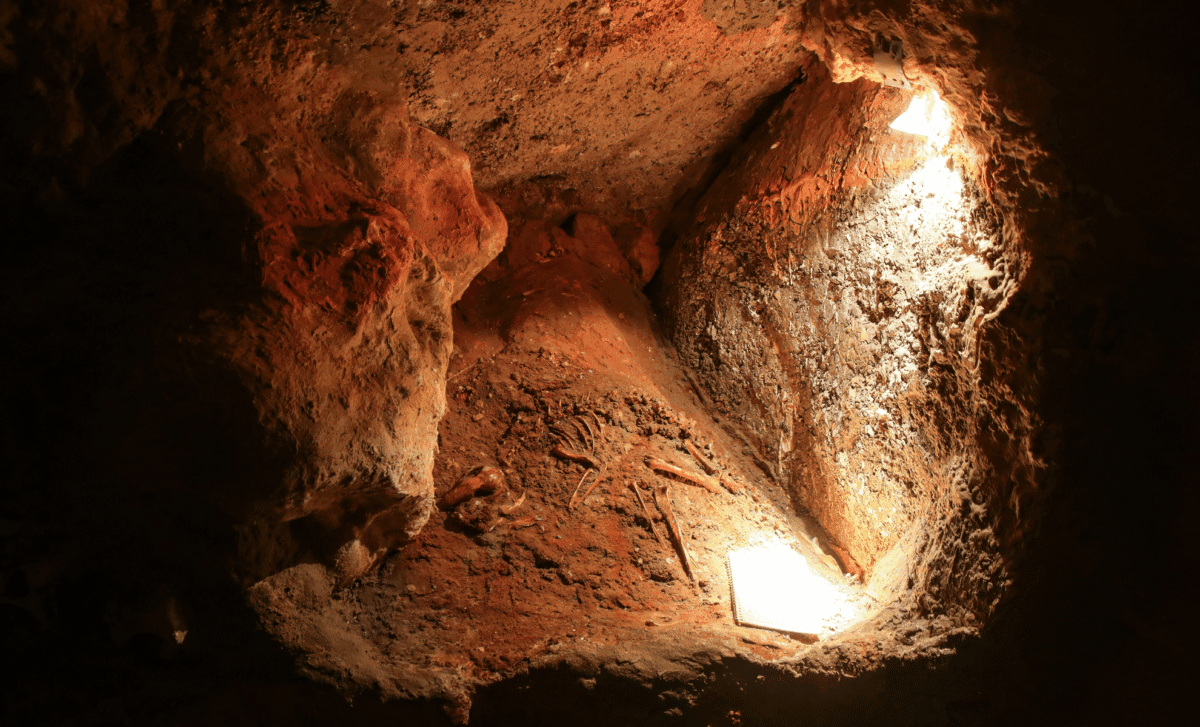
Archaeologists have uncovered mysterious collections of animal skulls in a Neanderthal cave, raising new questions about their rituals and symbolic practices.
Archaeologists recently unearthed a series of animal skulls in a Neanderthal cave in Spain, sparking new questions about the rituals and symbolic practices of early humans. The skulls, some of which belong to horned animals, weren’t placed there all at once, but accumulated over a long period. This repeated behavior hints at a deeper, structured practice, offering a rare glimpse into the cultural complexity of Neanderthals that challenges previous assumptions about their way of life.
The Collection of Animal Skulls: An Unusual Ritual?
Neanderthal behavior has long intrigued archaeologists, and the discovery of animal skulls in the Des-Cubierta Cave adds yet another layer of complexity to our understanding of these early humans. In a study published in Archaeological and Anthropological Sciences, researchers uncovered the skulls of at least 35 animals, yet the rest of the skeletal remains, such as limbs, jaws, and cheekbones, were notably absent. The skulls were arranged in a way that suggests they were not placed in the cave all at once. This repeated collection, spanning several episodes, indicates a long-term process embedded within Neanderthal culture. The studys findings highlight that this was not a random act but a structured, ritualistic practice, giving us new insight into the symbolic lives of Neanderthals.
Excavation teams, led by archaeologist Lucía Villaescusa from the University of Alcalá, carefully examined the spatial arrangement of these skulls, the surrounding geological evidence, and the condition of the remains. According to their study,
The integration of geological, spatial, and taphonomic data demonstrates that the accumulation of large herbivore crania was not a single depositional event, but rather the result of repeated episodes embedded within a long-term process of gallery use.
This finding reveals that the skulls were not just randomly discarded but were instead part of an ongoing and structured activity.
The concept of repeated actions is vital in understanding the role these skulls may have played. Far from being a casual or haphazard practice, the intentional accumulation and placement of these skulls highlight a deliberate cultural or symbolic act. This opens up a fascinating area for speculation: Did the Neanderthals view these skulls as having ritualistic significance? Were they using them as markers for social or cultural events? The studys findings suggest that there was more to these actions than meets the eye.
The Significance of Symbolism in Neanderthal Culture
One of the most compelling aspects of this study is the suggestion that Neanderthals engaged in symbolic behavior. The deliberate act of collecting and storing these skulls over a long period points to a level of cognitive sophistication previously not attributed to Neanderthals. This sustained practice, as the researchers explain, highlights the structured and transmitted nature of this practice, adding a significant piece to the broader discussion on the complexity and symbolic potential of Neanderthal cultural expressions.
Symbolism is a cornerstone of what sets humans apart from other species, and the evidence from Des-Cubierta Cave forces us to reconsider the cognitive abilities of Neanderthals. This behavior could suggest that Neanderthals were capable of conceptualizing meaning beyond the practical aspects of survival. They may have been creating a connection between these skulls and something greater—whether it was spiritual, social, or cultural. The repeated nature of the skull placements implies that this was not a one-off, isolated incident but part of an ongoing tradition, possibly passed down through generations.
Furthermore, the cave itself, its narrow gallery and the strategic placement of the skulls, adds to the mystery. Could this have been a place of significance, perhaps a site where Neanderthals performed rituals or gathered for communal purposes? The deliberate choice of which animal skulls to bring into the cave may also be indicative of the Neanderthals connection to the animals they hunted, representing a deeper cultural or spiritual connection with the creatures they relied on for food and resources.
How Neanderthal Behaviors Challenge Our Understanding
The discovery of these animal skulls serves as a reminder of how much we still don’t know about Neanderthal life. For a long time, it was believed that Neanderthals were primarily concerned with survival and lacked the symbolic thinking found in modern humans. However, this new evidence challenges that assumption and suggests that Neanderthals had more complex behaviors and cultural practices than we ever realized.
Archaeologists often struggle with interpreting the behavior of ancient humans due to the limited evidence available, and the ambiguity surrounding the skull collection in Des-Cubierta Cave is no exception. However, this study, published in Archaeological and Anthropological Sciences, underscores the need to rethink Neanderthal cognitive abilities. Far from being the brutish, primitive beings once depicted in popular media, Neanderthals may have engaged in practices that were rich with meaning, which is a surprising revelation that could change how we view our ancient relatives.
As we continue to uncover new evidence and reinterpret old findings, it’s likely that more of these intriguing aspects of Neanderthal culture will come to light. The study of the Des-Cubierta Cave is just one piece of a larger puzzle, but it offers a fascinating glimpse into the symbolic world of Neanderthals. It suggests that these early humans were not just survivors—they were also thinkers, perhaps in ways we’ve yet to fully comprehend.
Rania is a biology engineer and versatile computer scientist with strong proficiency in digital tools. She holds a Master’s degree in Biology from Mouloud Mammeri University and a BTS in Computer Science, both obtained in 2022. Positioned at the intersection of life sciences and technology, she explores the connections between nature, the environment, and innovation. Since 2023, she has been dedicated to writing web content and has been collaborating with The Indian Defense Review since October 2024.
Indian Defence Review is an independent media. Support us by adding us to your Google News favorites:
- 5,000-Year-Old Seals Found in Iran Reveal Complex Trade Networks in Prehistoric Western AsiaFebruary 23, 2026
- This WWII Submarine Sank With 67 Tons of Mercury, And It’s Still LeakingFebruary 23, 2026
- Students Digging for Ancient Pottery Discovered a Viking Burial Ground Containing a GiantFebruary 22, 2026
- A “Smiling” Stone Found at a Sacred Shrine Turns Out to Be 350 Million-Year-Old FossilFebruary 20, 2026
- Photographer Stumbles Upon One of the Largest Dinosaur Trackways Ever RecordedFebruary 20, 2026
- Storms Expose Rare 2,000-Year-Old Footprints on Scottish CoastFebruary 20, 2026