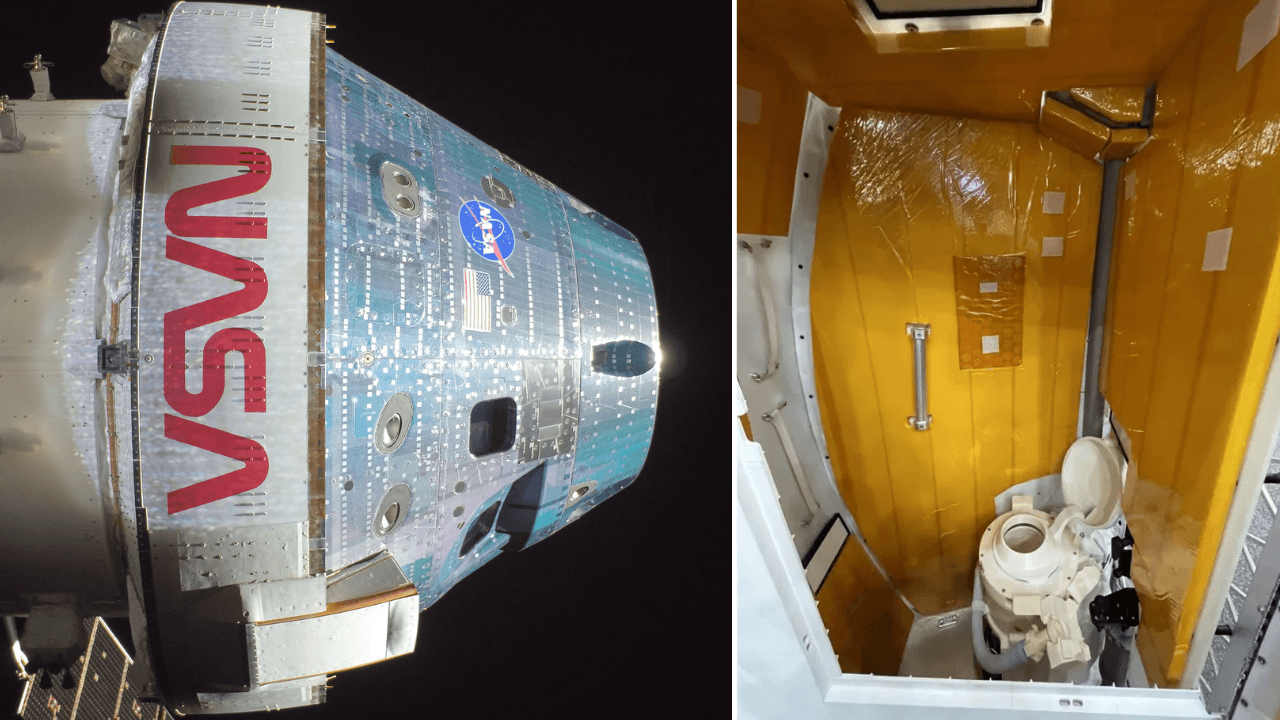
The Artemis 2 mission made history this month not just for carrying humans farther from Earth than any crewed spacecraft since 1972, but also for testing one of the most critical – and least glamorous – systems aboard NASA’s Orion capsule: the space toilet. While the loo has remained fully operational throughout the mission, engineers are troubleshooting a persistent issue with venting stored urine into space, a problem that could have implications for future lunar and Mars missions. On April 7, just days after Orion’s historic lunar flyby, NASA officials provided an update on the toilet’s performance during a press conference, revealing new details about the mechanical and chemical challenges plaguing the system.
Artemis 2’s Space Toilet: Functional but Facing Venting Challenges
Contrary to early reports suggesting a malfunction, NASA has confirmed that the space toilet aboard the Orion spacecraft is fully operational. The issue lies not with the toilet itself, but with the system designed to expel urine from the capsule. Artemis 2 Flight Director Rick Henfling explained that the team is grappling with a reduced venting capacity in the tank that stores wastewater.
The challenge that we're working through is evacuating the tank. The vent is a lot less than we were expecting, and so we're having to fall back to some other alternate means, other than the toilet.
The Artemis 2 toilet is a scaled-down version of the more advanced system currently in use on the International Space Station (ISS), which recycles urine into drinking water. However, unlike the ISS toilet, the Orion system is not designed for water reclamation, meaning all waste is simply vented into space. This design choice reflects Orion’s shorter mission duration compared to the ISS, which operates as a long-term orbital laboratory.
The venting problem first became apparent shortly after launch on April 1, when the crew reported difficulties expelling urine. Initial suspicions pointed to ice formation in the vent nozzle on Orion’s exterior, a concern given the spacecraft’s exposure to the cold vacuum of space. Engineers attempted to address this by activating heaters and tilting Orion toward the sun to warm the nozzle – a process NASA refers to as "baking away" potential ice. However, the problem persisted, prompting mission control to explore alternative explanations.
Chemical Reactions May Be Clogging the System
The latest theory centers on the chemistry used to prevent biofilm formation in the wastewater system. NASA adds special chemicals to the urine to inhibit the growth of microbial colonies that could clog filters or foul equipment. Henfling suggested that a reaction between these chemicals and other compounds in the waste stream might be generating debris that is accumulating in a filter, restricting flow.
The latest theory is related to some of the chemistry that goes into ensuring that the wastewater doesn't develop any biofilms. And there may be something going on with a chemical reaction where there's some debris that's generated as part of that reaction, and it's getting clogged in a filter.
This explanation highlights a broader challenge in human spaceflight: managing life support systems in microgravity environments where fluids behave unpredictably. Unlike on Earth, where gravity naturally separates solids and liquids, waste management in space requires carefully engineered systems to handle separation, containment, and disposal. The Artemis 2 team’s ongoing investigation underscores how even minor chemical interactions can disrupt critical spacecraft systems, a lesson that will be vital as NASA prepares for longer-duration missions to the Moon and eventually Mars.
A Historic Mission with Unforeseen Technical Hurdles
Artemis 2 is not only NASA’s first crewed mission beyond low Earth orbit in over five decades but also a critical test flight for the Orion spacecraft and its life support systems. The four astronauts aboard – NASA’s Reid Wiseman, Victor Glover, Christina Koch, and the Canadian Space Agency’s Jeremy Hansen – are slated to splash down off the coast of San Diego on April 10, marking the conclusion of their 10-day journey. The mission’s success is essential for NASA’s Artemis program, which aims to return humans to the Moon, including the first woman and person of color, by 2026.
The toilet issue, while not a mission-critical failure, serves as a reminder of the complexities involved in sustaining human life in space. Every system aboard Orion must function flawlessly to ensure the crew’s safety, from oxygen generation to thermal regulation. Lori Glaze, acting associate administrator for NASA’s Exploration Systems Development Mission Directorate, emphasized the importance of post-mission analysis during the April 7 briefing.
As soon as we get this [spacecraft] down on the ground, we'll be able to get inside, and we will get to the root of that.
Glaze’s remarks reflect a common theme in space exploration: ground-based analysis is often where the most valuable insights are gained. The Artemis 2 capsule will be recovered and transported to a NASA facility for detailed inspection, providing engineers with the opportunity to examine the toilet’s vent system firsthand. This hands-on approach is standard for NASA missions, allowing teams to refine designs for future spacecraft.
Why Space Toilet Design Matters for Future Lunar and Mars Missions
The Artemis 2 toilet may seem like a minor component in the grand scope of space exploration, but its performance has outsized importance for the future of human spaceflight. As NASA and its international partners plan for sustained lunar presence through the Artemis program and eventual crewed missions to Mars, reliable life support systems are non-negotiable. The Orion toilet’s venting issue illustrates the kind of unexpected technical hurdles that can arise when operating in environments vastly different from Earth.
For longer missions, such as those to Mars, which could last up to three years, recycling urine into potable water becomes essential. The ISS currently recycles about 90% of its water, including urine, through a sophisticated filtration system. While Orion does not include this capability, future lunar landers and deep space habitats will need to adopt similar technologies to reduce reliance on Earth-based supply missions. The challenges faced by Artemis 2’s toilet underscore the need for robust, redundant systems that can adapt to the unforeseen.
Additionally, the psychological and cultural aspects of space toilets cannot be overstated. Astronauts have historically faced stigma around discussing waste management, but NASA has made efforts to destigmatize the topic to ensure open communication about system performance. The Artemis 2 crew’s willingness to address the toilet’s issues publicly reflects a broader shift toward transparency in space exploration.
What’s Next for Artemis 2 and NASA’s Human Spaceflight Ambitions
With Artemis 2 nearing its conclusion, NASA is already looking ahead to the next phase of its lunar program. The Artemis 3 mission, currently targeted for 2026, will attempt the first crewed lunar landing since Apollo 17, using SpaceX’s Starship as the human landing system. Subsequent missions will focus on establishing a sustainable presence on the Moon, including the construction of the Lunar Gateway, a small space station orbiting the Moon.
The lessons learned from Artemis 2’s toilet issue will be incorporated into these future missions. Engineers will analyze the Orion capsule’s waste management system in detail, identifying any design flaws or operational improvements needed. NASA’s Exploration Systems Development Mission Directorate, led by Glaze, will play a central role in implementing these changes, ensuring that life support systems are optimized for the demands of deep space exploration.
In the meantime, the Artemis 2 crew will return to Earth with a mix of relief and accomplishment. Their mission has already proven that Orion can safely transport humans to the Moon and back, a critical milestone for NASA’s ambitions. The toilet’s venting issue, while inconvenient, does not detract from this achievement. Instead, it serves as a reminder of the meticulous planning and problem-solving that define human spaceflight.
Key Takeaways
- The Artemis 2 toilet remains fully operational, but engineers are troubleshooting a venting issue affecting urine expulsion from the Orion spacecraft.
- A potential chemical reaction in the wastewater system may be generating debris that is clogging a filter, restricting flow.
- The Artemis 2 mission is the first crewed flight beyond low Earth orbit since 1972, testing critical systems for future lunar and Mars missions.
- NASA will conduct a detailed post-mission analysis of the Orion capsule to identify the root cause of the toilet’s venting problem.
- The incident highlights the challenges of managing life support systems in microgravity and the importance of redundancy in space exploration.
Frequently Asked Questions
Frequently Asked Questions
- Is the Artemis 2 toilet broken?
- No, the toilet is fully operational. The issue is with the system’s ability to vent stored urine into space, not with the toilet itself.
- What caused the Artemis 2 toilet’s venting problem?
- NASA suspects a chemical reaction in the wastewater system may be generating debris that is clogging a filter. Engineers continue to investigate the issue.
- How will the Artemis 2 crew return to Earth if the toilet is having issues?
- The toilet’s venting problem does not affect the crew’s safety or the spacecraft’s ability to return. The Orion capsule is designed to operate safely even with minor system anomalies.